Let's get one thing straight: teamwork isn't some fluffy, feel-good concept from a corporate retreat poster. It's the engine of any successful business. Think of it as a force multiplier—it takes the individual skills of your people and fuses them into a collective powerhouse, one that can tackle bigger challenges and innovate faster than any lone wolf ever could.
It's the secret sauce that turns a group of employees who just happen to work together into a high-octane team that actually wins together.
Why Teamwork Is Your Ultimate Competitive Advantage
Ever look at a team that just clicks and wonder how they do it? It’s not magic, and it’s rarely just about hiring a bunch of A-players. The real magic happens when those players learn to move in sync, anticipating each other’s needs and building on each other's strengths. It’s like watching a championship basketball team—the victory comes from the seamless passes and coordinated plays, not just one person’s slam dunks.
When that synergy happens in a business, the whole truly becomes greater than the sum of its parts. This isn't just a nice feeling; it's a strategic weapon. It’s what allows you to pivot on a dime, solve a problem that seemed impossible, and consistently leave siloed competitors in the dust.
The Core Pillars of Effective Teamwork
Building a rock-solid team isn't about luck; it's about getting the fundamentals right. Think of these pillars as the foundation of a skyscraper. If they're strong, you can build something incredible. If they're weak, the whole structure is at risk, no matter how talented your people are.
Here’s a look at the non-negotiables that make teamwork tick.
| Pillar | Why It Matters for Your Team | Red Flag (When It's Missing) |
|---|---|---|
| Shared Goals | When everyone is aiming for the same target, their individual actions become meaningful and aligned. It’s the difference between rowing in circles and surging toward the finish line. | People work on conflicting tasks, duplicate effort, or focus on pet projects that don’t move the needle for the company. |
| Psychological Safety | This is the big one. It’s the trust that allows people to speak up, pitch a "crazy" idea, or admit a mistake without fearing they'll be shot down or shamed. | Meetings are silent, nobody challenges the status quo, and the same few people do all the talking. Innovation grinds to a halt. |
| Clear Communication | Information has to flow like water—freely and transparently. When people have the context they need, they make smarter decisions and stay in sync without constant hand-holding. | Misunderstandings run rampant, deadlines get missed because someone "didn't get the memo," and a blame culture starts to fester. |
These components are absolutely essential. When they're missing, things fall apart fast. In fact, a jaw-dropping 86% of employees and executives blame workplace failures on a lack of collaboration or poor communication. That stat alone shows that teamwork isn't a soft skill; it's a hard requirement for survival. You can explore the full breakdown of teamwork statistics to see just how deep the rabbit hole goes.
"Great teams do not hold back with one another. They are unafraid to air their dirty laundry. They admit their mistakes, their weaknesses, and their concerns without fear of reprisal." - Patrick Lencioni, Author of The Five Dysfunctions of a Team
Getting a handle on why teamwork matters is the first real step. Once you nail these pillars, you’re ready to unlock the massive, evidence-backed benefits that truly high-performing teams bring to the table.
How Strong Teamwork Drives Business Growth
Let's cut right to the chase. Great teamwork isn't just a fluffy, feel-good concept; it's a cold, hard driver of your bottom line. When people truly collaborate, they create a tangible return on investment that shows up right on the balance sheet.
Think of it like a jazz band. The solo pianist might be a genius, but the full ensemble creates something far richer and more complex. They play off each other, improvise, and build a sound no single musician could ever create alone. That’s exactly what happens in a high-performing team—individual talent is amplified into collective brilliance, directly fueling business growth.
Sparking Innovation Through Diverse Perspectives
A team where everyone thinks, acts, and looks the same is a recipe for stagnation. Real magic happens when you bring together people with different skills, backgrounds, and ways of seeing the world. An engineer, a marketer, and a support specialist will attack the same problem from completely different angles.
That blend of perspectives is your secret weapon. It helps you spot the blind spots and challenge the lazy assumptions that a lone individual would almost certainly miss.
Studies have shown time and again that diverse teams simply make better decisions. They naturally resist the dreaded "groupthink," where everyone just nods along to the first half-decent idea. Instead, they poke, prod, and debate their way to far more innovative and bulletproof outcomes.
By building a culture where different viewpoints aren't just tolerated but actively sought out, you create an incubator for breakthroughs. This is where your next game-changing product or strategy will come from.
This kind of collaborative friction is a good thing. It forces a more rigorous vetting of ideas, ensuring the final plan is battle-tested before it ever meets the real world. The result is a stronger, more resilient strategy.
Increasing Efficiency and Reducing Costly Errors
Silos are the silent killers of productivity. When people hoard information and work in isolation, you get duplicated effort, constant miscommunication, and a ton of expensive, preventable mistakes. Strong teamwork tears down those walls.
Just imagine a software team where designers, developers, and QA testers are in sync from the very beginning.
- Designers get instant reality checks on whether their beautiful concepts are actually buildable.
- Developers code with a crystal-clear picture of the user's needs.
- Testers flag potential bugs early on, not when you’re hours from launch.
This kind of integrated workflow slashes rework and dramatically shrinks project timelines. When everyone is rowing in the same direction, the whole process just flows better.
Adapting to Market Changes with Agility
Let's be real: the market doesn't care about your five-year plan. New competitors and sudden shifts in customer demand are a constant threat. A deeply collaborative team is your best defense against this chaos. Because they already have strong lines of communication and trust, they can pivot on a dime without the whole operation grinding to a halt.
This agility is born from a shared understanding of the mission and each other's strengths. When a curveball comes their way, a cohesive team can regroup, reassign tasks, and execute a new plan with incredible speed. That collective resilience is a massive competitive edge, turning potential disasters into opportunities to get ahead.
At the end of the day, investing in teamwork is a direct investment in the financial health and future of your business. Companies that get this right don't just survive—they thrive. They build a culture that consistently generates better ideas, produces higher quality work, and is ready to tackle whatever the market throws at them next.
The Human Element of Winning Teams
Forget the spreadsheets and Gantt charts for a minute. The real magic behind a winning team runs on a fuel source you can't quantify: genuine human connection. Great teamwork isn't some corporate buzzword; it's the secret sauce that drives motivation, resilience, and even our own well-being.
When people feel seen, supported, and safe, something shifts. They stop showing up just for a paycheck and start showing up for each other. This is the glue that turns a group of talented individuals into a force of nature—the kind that can weather any storm. It’s what makes a workplace feel less like a drain and more like a source of energy.
Building a Foundation of Psychological Safety
The absolute bedrock of any high-performing team is psychological safety. It's that unspoken feeling of trust in the room. It’s knowing you can toss out a half-baked, crazy idea, admit you screwed up, or ask a "dumb" question without getting laughed at or punished. It’s the freedom to bring your actual, authentic self to work.
Without it, creativity flatlines. People clam up, play it safe, and hide small problems until they explode into five-alarm fires. You can have a room full of geniuses, but if they’re too scared to speak their minds, that genius is worthless.
A culture of psychological safety gives people permission to take smart risks, question the way things have always been done, and voice new ideas without fear. This is where the real breakthroughs are born.
This is even more vital for remote and async teams. When you can't rely on hallway conversations, strong collaborative ties are the only real defense against the isolation that leads straight to burnout.
Boosting Engagement and Job Satisfaction
When people feel like they belong to something bigger than themselves, their whole relationship with work changes. They lean in. They become more invested, more proactive, and way more engaged. And highly engaged employees aren't just a little happier—they're wildly more productive and fiercely dedicated.
This sense of belonging and mutual respect is a direct pipeline to higher job satisfaction. It's simple, really: people who like and trust their teammates are just happier at work. That good vibe creates a ripple effect that touches company culture and, yep, the bottom line.
- Increased Loyalty: People don't leave teams they love. A supportive environment dramatically cuts down on the headache and cost of employee turnover.
- Greater Resilience: When the pressure mounts, a tight-knit team doesn't crack; it locks arms. They share the load, back each other up, and figure it out together.
- Enhanced Well-being: A positive team culture reduces stress and supports better mental health, creating a workplace that’s not just productive, but sustainable.
Nurturing these dynamics is a masterclass in leadership. If you want to get better at creating this kind of environment, our guide on essential team management skills is packed with practical stuff you can use today.
Turning Individuals into a Support System
Picture a strong team as a built-in support network. When one person is wrestling with a tricky problem or dealing with a rough patch in their personal life, others jump in. They offer a hand, a bit of advice, or sometimes just a listening ear. This kind of mutual support builds incredible resilience.
Instead of facing down challenges all alone, each person knows they have a crew that has their back. This collective strength allows the team to tackle high-stakes projects and navigate chaos with a sense of confidence and grace.
It transforms the workplace from a competitive arena into a collaborative community. This human-first approach is the true secret behind why teamwork is so important—it creates an environment where people don't just produce their best work, they feel valued while doing it.
Building a Cohesive Team in a Remote World
Getting a team to truly click is hard enough when everyone's in the same building. But what happens when your crew is scattered across cities, countries, and time zones? The digital office throws up a whole new set of walls. Screens become barriers, and trying to coordinate across different schedules can feel like you're all speaking different languages.
The old playbook just doesn't work anymore. You can't rely on hallway chats, grabbing lunch together, or that shared energy from a successful brainstorming session. In a remote world, connection has to be built on purpose. It means ditching the knee-jerk reaction to schedule yet another meeting and instead creating a culture of what I call "ambient visibility."
The Asynchronous Communication Gap
One of the sneakiest challenges remote teams face is the asynchronous communication gap. Think about it: in a physical office, you absorb a massive amount of information just by being there. You overhear a conversation about a tricky bug, see who's huddled around a whiteboard sketching out a new feature, and just get a gut feel for the team's momentum.
That all vanishes when you go remote. Instead, you get a firehose of Slack messages and a calendar that looks like a game of Tetris gone wrong. This chaos breeds two huge problems:
- The "Always On" Trap: People feel this immense pressure to respond to every ping instantly, just to prove they're actually working. This constant context-switching absolutely murders deep, focused work and is a one-way ticket to burnout.
- The Context Black Hole: When updates are fragmented across DMs, project management tickets, emails, and random video calls, nobody has the complete picture. Crucial decisions and progress updates get lost in the noise, leading to confusion, duplicated work, and that sinking feeling of "Wait, I thought we were working on that?"
Trying to fix this by cramming more meetings onto the calendar is like trying to put out a fire with gasoline. The solution isn't more synchronous time; it's getting way, way smarter about how you work asynchronously.
The goal isn't to be in constant communication but to create a shared consciousness. It's about giving everyone effortless access to the team's story as it unfolds, without demanding their attention every five minutes.
Creating Intentional Visibility
So, how do you actually bridge this gap? You create intentional visibility. This is all about having a central, low-effort way for everyone to see what’s happening, what’s been accomplished, and where the ship is sailing next. It's about building a living, breathing narrative of the team's work that anyone can tune into.
This is where the right tools are an absolute game-changer, especially ones designed with an async-first mindset. For example, a lightweight tool like WeekBlast lets team members share their progress on their own time. It's not some clunky, overbearing project management system; it’s a simple, human-first changelog for your team.
Suddenly, all those scattered updates transform into a clear, searchable, and permanent record of what you've achieved together.
Practical Strategies for Remote Cohesion
Building a tight-knit remote team means creating a new set of rituals and picking the right tools for the job. It's about being deliberate in how you connect, communicate, and celebrate your wins. For a much deeper look, check out our guide on essential remote team management tips.
But to get you started, here are a few strategies that pack a serious punch:
- Embrace Asynchronous Updates: Ditch the soul-crushing daily stand-up meeting. Replace it with a simple, written daily or weekly update. This gives everyone back huge chunks of time for focused work while keeping the entire team perfectly aligned on what matters.
- Establish Clear Communication Channels: Write down exactly where different conversations are supposed to happen. Maybe urgent issues go in a specific Slack channel, task-related chatter lives on the project board, and progress updates belong in your async work log. This cuts through the noise and makes information ridiculously easy to find later.
- Carve Out Time for Fun: Real connection almost never happens when it's an agenda item in a formal meeting. You have to create dedicated, totally optional spaces for people to just be people. Think virtual coffee breaks, online game sessions, or a Slack channel dedicated to sharing pictures of pets. It might feel a little forced at first, but these rituals are what build the personal trust that great professional collaboration runs on.
- Make Wins Visible and Permanent: In an office, you might celebrate a big launch with cake in the breakroom. Remotely, you need a digital trophy case. Using a tool that creates a permanent archive of accomplishments ensures that big wins and small victories don't just get swept away by the endless scroll of a chat feed. This makes it a breeze to look back during performance reviews or company all-hands meetings and give credit where credit is due.
By putting these practices into play, you can stop just managing a remote team and start truly leading one. You'll build a culture of trust, transparency, and shared purpose that doesn't care how many miles are between you. This is why teamwork is important, no matter the setting—it creates a resilient, connected unit that can thrive no matter the distance.
Measuring What Actually Matters in Teamwork
There's an old saying in business: "If you can't measure it, you can't improve it." This couldn't be more true for teamwork. But how do you slap a number on something as fluid as collaboration without getting lost in meaningless "vanity metrics" like hours clocked or Slack messages sent?
The secret is to stop tracking individual inputs and start measuring collective outcomes. The old-school way of measuring productivity was designed for an assembly line, not a dynamic, creative team. It’s time for a serious upgrade. We need to peek under the hood and look at metrics that truly reveal the health and efficiency of the team as a single unit.
This infographic nails down three core pillars for evaluating teamwork, especially when your team is scattered across different locations and time zones.
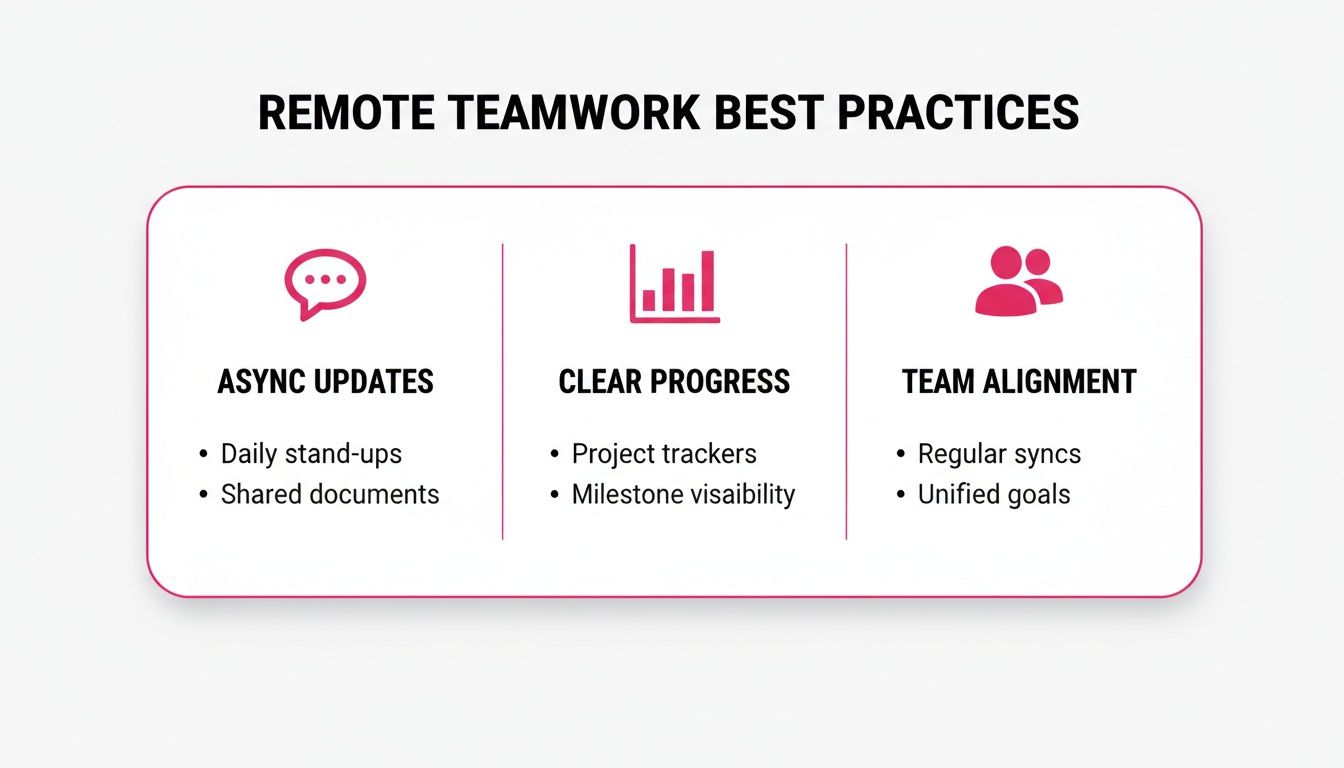
It all boils down to a simple formula: consistent async updates + clear progress visibility = a beautifully aligned team.
Look Beyond the To-Do List
First things first: stop obsessing over individual task completion rates. Sure, it's important, but it tells you absolutely nothing about how well people are actually working together. Instead, let's look at metrics that reflect the team's combined horsepower.
Here are a few modern metrics that paint a much richer picture of genuine collaboration:
- Cross-Functional Project Success Rate: How often do projects that span multiple departments actually hit their goals on time and within budget? A high success rate here is a massive flashing sign that your collaboration is top-notch.
- Time to Resolution on Tough Problems: When a big, hairy problem lands on your team's plate, how quickly do they swarm it and wrestle it into submission? Short resolution times mean communication is flowing and knowledge is being shared like it should be.
- Rate of Rework or Revisions: Are your engineers constantly rebuilding features because of a communication breakdown with the product team? A low rate of rework is a godsend—it means the team is in sync from the get-go, saving an incredible amount of time and sanity.
These metrics focus on the results of teamwork, not just the busywork. They help you see if your team's gears are meshing together smoothly or just grinding to a halt.
Using the Right Tech for Real Insights
This is where a good tool can feel like a superpower. Trying to track these kinds of metrics by hand is a one-way ticket to a migraine. Modern platforms, however, can surface these insights for you, automatically. It’s not about playing Big Brother; it's about getting a clear, unbiased look at your team's collaborative pulse.
Take a tool like WeekBlast, for example. It creates a living, searchable archive of every single thing your team gets done. It’s not just another chat log; it’s a structured story of your team’s journey.
By turning scattered updates into a reliable source of truth, you gain the ability to spot patterns over time. You can see who contributed to key initiatives and get the data you need to nurture a more effective and engaged team.
This gives you insights you can actually use, not just a pile of numbers. For instance, the AI-powered summaries in WeekBlast can instantly pull together a highlight reel of a project's entire lifecycle. This makes it ridiculously easy to see how collaboration played out when it’s time for performance reviews. It completely changes the conversation from "So, what did you do?" to "Look at what we accomplished together."
From Vanity Metrics to Actionable Indicators
Let's be honest, measuring teamwork is about asking better questions. Instead of "Is everyone busy?" we should be asking, "Are we moving forward together, efficiently?" Making this shift means throwing out the old measurement playbook and adopting a new one.
This table breaks down the old-versus-new way of thinking about teamwork metrics.
Traditional vs. Modern Teamwork Metrics
| Metric Category | Outdated Approach (What to Avoid) | Modern Approach (What to Track) |
|---|---|---|
| Productivity | Tracking individual hours logged or lines of code written. | Measuring the team’s project completion velocity and the frequency of successful launches. |
| Communication | Counting the number of Slack messages or emails sent. | Assessing the speed of cross-departmental responses and the clarity of asynchronous updates. |
| Engagement | Relying on annual employee satisfaction surveys alone. | Monitoring peer recognition frequency and participation in collaborative problem-solving sessions. |
When you start tracking what truly matters, you essentially get a health dashboard for your team. You can spot potential roadblocks before they derail a project and pour fuel on the behaviors that are driving real success. This is precisely why it’s so important to measure teamwork the right way—it transforms a fuzzy concept into a tangible asset you can build on.
Avoiding The Sneaky Traps That Wreck Teamwork
Even the most well-oiled teams can run into trouble. It’s almost never a single, dramatic explosion. Instead, teamwork dies a death of a thousand cuts—small, seemingly harmless habits that slowly poison the atmosphere. These are the teamwork killers. They creep in, erode trust, stall momentum, and turn a high-performing crew into a collection of siloed, frustrated individuals.
Catching these issues early is like doing preventative maintenance on your car. You don't wait for the engine to seize; you change the oil. By spotting and fixing these problems before they cause a total breakdown, you keep your team's engine humming along. The first step is knowing what to look for.
The "Who's on First?" Problem: Murky Roles and Responsibilities
Want to inject instant chaos into a project? Let roles get fuzzy. When no one’s quite sure who owns what, you get a predictable mess. Important tasks get dropped, two people accidentally do the same work, and accountability vanishes into thin air.
Before you know it, people are either stepping on each other's toes or assuming someone else is handling that critical thing that's… well, not being handled at all. This confusion doesn't just slow things down; it breeds resentment. The solution is unapologetic, in-your-face clarity.
- Bring in a RACI Chart: It sounds corporate, but it works. Define who is Responsible, Accountable, Consulted, and Informed for key projects. This simple grid completely eliminates the guesswork.
- Assign a Clear "Owner" for Everything: Every single initiative needs one person who is ultimately responsible for seeing it through. They don't have to do all the work, but the buck stops with them.
Bad Communication—The Undisputed Heavyweight Champion of Failure
If teamwork problems were a boxing match, poor communication would be the reigning, undefeated champion. It's the number one reason things fall apart. In fact, a survey of employers found that a staggering 86% of workplace failures boil down to a lack of communication or collaboration. We're not just talking about the occasional misunderstanding; we're talking about a culture of confusion.
When information gets hoarded, meetings are a waste of time, and feedback is a myth, you create a system designed for failure. Great teams are built on a bedrock of open, honest, and deliberate communication.
Fighting this requires a real strategy. For some practical ideas on building a stronger communication backbone, you can check out our guide on how to improve communication in the workplace. Things like adopting better async habits can slash the number of pointless meetings while keeping everyone on the same page.
The Twin Terrors: Micromanagement and the Blame Game
Nothing crushes the human spirit quite like a boss who hovers over every tiny detail or a culture where every mistake is a punishable offense. Micromanagement is a giant neon sign flashing, "I don't trust you," and it absolutely obliterates autonomy and drive.
A blame culture is just as toxic. It encourages people to hide their mistakes, which is how tiny slip-ups fester and grow into full-blown catastrophes. To build a team that can bounce back from anything, you have to create psychological safety—an environment where people feel safe enough to take smart risks, speak up, and, yes, even fail. Treat mistakes as data, celebrate the lessons learned, and give your people the trust and space they need to do amazing work.
Got Questions About Teamwork? We’ve Got Answers.
Even with the best intentions, the reality of getting people to work together can get messy. It’s totally normal to have questions pop up when you're trying to put all this theory into practice. Let's dig into a few common head-scratchers and get some straight-up, practical answers.
Think of this as your no-fluff guide to the tricky bits of teamwork.
How Do You Get Lone Wolves to Play Nice on a Team?
Ah, the classic challenge. You've got brilliant people on your team who just prefer to fly solo. Trying to force them into being rah-rah team players is a surefire way to make everyone miserable. So don't. The real secret is to make collaboration the most logical path to their own success.
Frame the work so that the finish line is something so big, so ambitious, that one person simply can't cross it alone. When that fiercely independent performer sees that their personal win is tangled up with a teammate's input, the lightbulb goes on. Suddenly, collaboration isn't a chore—it's a strategy.
You can't rewire someone's personality. What you can do is change the game. Structure the work so that teamwork becomes the smartest, most efficient way to win. It respects their nature while nudging them toward the group.
What's the One Thing Everyone Forgets About Good Teamwork?
It’s surprisingly simple: celebrating the small wins. We all get laser-focused on the giant project deadline or the massive product launch, and we completely steamroll over the tiny victories that get us there. That impossible bug someone finally squashed after three days? The tense client email that was navigated perfectly? These moments are the bedrock of team morale.
Celebrating these little milestones isn't just about feeling good. It does two powerful things:
- It creates momentum. Acknowledging progress, no matter how small, builds a positive feedback loop that keeps everyone’s energy up.
- It shows what 'good' looks like. You're actively reinforcing the collaborative behaviors you want to see more of.
A quick shout-out on Slack or a 30-second mention at the start of a meeting can change the entire vibe. It’s the stuff that holds a team together when the big goal still feels miles away.
Can You Actually Have Too Much Collaboration?
Oh, absolutely. And it’s a nightmare. The goal isn't to have every single person weigh in on every single decision. That’s how you get "death by committee," where nothing ever gets done and nobody feels accountable for anything. This is a huge reason why getting teamwork right is so important—it’s about being smart, not just being together all the time.
The best teams are masters of rhythm. They know when to huddle up and brainstorm and when to break apart for deep, focused work. The trick is being deliberate about it. Assign clear decision-makers and give them the trust and autonomy to make the call. If you're stuck in endless meetings, it's usually a sign that roles are fuzzy or trust is low.
Ready to build a culture of effortless visibility and ditch those soul-crushing status meetings for good? WeekBlast creates a simple, human-first changelog for your team, turning scattered updates into a clear narrative of your progress. See how WeekBlast can transform your team’s alignment today.


