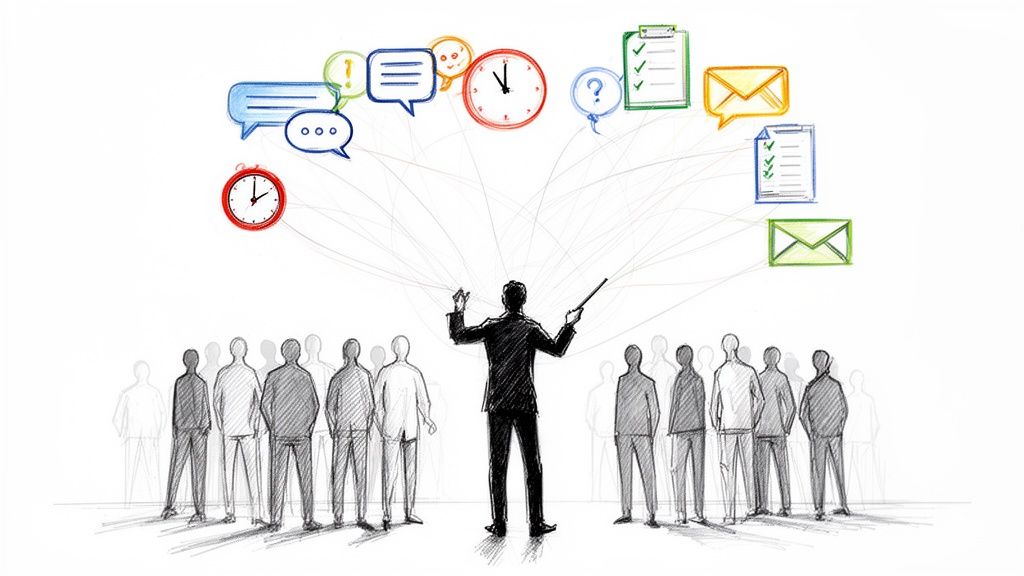
So, what exactly is communication project management? Let's ditch the textbook definition. Think of it as the strategic playbook for how your team talks. It’s the art and science of making sure the right people get the right information at the right time—without burying them in noise.
It's not about sending more emails or scheduling more meetings. It's about creating a deliberate, predictable flow of information that keeps the entire project from spiraling into chaos.
Why Projects Fail Without a Communication Plan
Ever seen a talented orchestra where every musician has the wrong sheet music? It’s not a symphony; it’s a disaster. That’s exactly what happens to a project when it lacks a solid communication plan. Most projects don’t crash and burn because of a lack of talent or resources. They crumble under the immense, crushing weight of bad communication.
This isn't just a hunch; the numbers back it up. A jaw-dropping 70% of professionals admit that communication screw-ups lead directly to wasted time. And in today’s world, where 72% of project teams are either fully remote or hybrid, the need for crystal-clear updates is more critical than ever. If you're curious, you can dive deeper into these project management statistics and see how they impact team productivity.
The Real Cost of Misinformation
When communication lines get crossed, the damage isn't just a few ruffled feathers. It creates a domino effect that can tank your entire project. Little gaps in information quickly snowball into blown budgets, missed deadlines, and a team that’s completely demoralized. It's the silent project killer, the one you don't see coming until it's way too late.
Take a look at how seemingly small communication gaps create major business problems.
| Symptom | Direct Impact | Business Consequence |
|---|---|---|
| Outdated Information | A developer codes a feature based on an old spec from an email thread. | Rework & Wasted Hours: The entire feature has to be rebuilt, doubling the effort and cost. |
| Missed Stakeholder Input | A key decision-maker isn't invited to a crucial meeting. | Scope Creep & Delays: The project has to be re-routed late in the game to accommodate their feedback. |
| Team Misalignment | Marketing launches a campaign for a product whose release date was just pushed back. | Reputational Damage: The company looks disorganized, confusing customers and hurting brand trust. |
Each of these nightmare scenarios stems from one core failure: nobody was managing the flow of information. This is precisely where communication project management shines. It elevates communication from a "soft skill" to a core strategic pillar of any successful project.
Think of it this way: Your project plan is the blueprint for a house. Your communication plan is the set of instructions that ensures the electricians, plumbers, and carpenters are all working on the same room at the same time.
Without that coordination, you end up with a house that has fancy plumbing but no walls. It’s a costly, dysfunctional mess. The goal is to build a system for sharing information that is both predictable and reliable.
From Chaos to Cohesion
At the end of the day, a strong communication plan is what transforms a project from a jumble of individual tasks into a single, cohesive effort. It makes sure that everyone—from the junior designer to the executive sponsor—knows the goals, understands their role, and can see the latest status at a glance.
This level of clarity zaps ambiguity, cuts down on friction, and empowers your team to do what they do best: deliver amazing results. In our distributed work world, getting this right isn’t just a nice-to-have. It’s the very foundation of success.
The Core Principles of Effective Project Communication
Let’s think of your project as a well-oiled machine. The principles of great communication are the oil itself—without them, even the most brilliantly designed engine will grind to a halt. Friction, chaos, and confusion take over. But get the communication right, and you turn that jumble of messages into a predictable, powerful asset.
This isn't about fluffy ideals. Solid project communication is built on a few non-negotiable rules. These ground rules ensure every message, from a quick Slack update to a formal report, actually helps push the project forward.
Establish a Single Source of Truth
Nothing kills a project faster than conflicting information. You know the drill: one person pulls a deadline from an old email, another remembers a different date from a meeting, and a third saw something else in a chat thread. It’s a recipe for absolute disaster. That's why having a single source of truth (SSoT) is your first line of defense.
An SSoT is just one central, universally agreed-upon place where all the important project info lives. It could be a Trello board, a dedicated Confluence page, or a shared Google Doc. The magic is in its simplicity: when anyone has a question, they know exactly where to find the real answer.
This one move eliminates confusion, stops people from working on outdated specs, and puts an end to those painful "who said what?" arguments. It's the bedrock of a calm, organized project.
Practice Radical Transparency
In project management, secrecy is a bug, not a feature. Hoarding information creates bottlenecks, tanks morale, and leaves your team feeling like they’re flying blind. The cure is radical transparency, which just means sharing information openly and proactively by default.
No, this doesn't mean you air out sensitive HR records. It means making project progress, roadblocks, and key decisions visible to the whole team. When everyone sees the bigger picture, they can make smarter decisions on their own without having to ask for permission at every turn.
Transparency builds a culture of ownership. When people understand the "why" behind their work and see its direct impact, they stop just completing tasks and start solving problems.
Master Audience-Aware Messaging
Your CEO doesn't need to know about a minor CSS bug fix. Your lead engineer probably doesn't need the 30,000-foot view of the quarterly budget. Blasting the same message to everyone is lazy communication, and it’s the fastest way to get your updates ignored.
Good communication is always tailored. Before you hit send, run through a quick mental checklist:
- Who is this really for? (Executives, developers, the client?)
- What do they actually need to know? (Just the facts, ma'am.)
- Why should they care? (How does it affect their work?)
- When do they need this info? (Immediately, or by EOW?)
- Where is the best place to reach them? (Email, chat, a formal report?)
This simple "Five Ws" check ensures your message is relevant, punchy, and lands where it will have the most impact. For more on this, check out our guide on how to improve communication in the workplace.
Champion Clarity and Consistency
Finally, the rhythm of your communication is just as important as the content. Vague updates and a random, unpredictable schedule just create anxiety. The goal is to make project communication so clear and consistent that your team doesn't even have to think about it—it just is.
Clarity is about using plain language, cutting the jargon, and putting the main point right at the top. Consistency is about delivering updates on a predictable schedule through channels everyone has agreed on. When your team knows they’ll get a straightforward status update every Friday morning, they stop wasting energy wondering what’s going on and just focus on their work. This is how you turn communication from a chaotic distraction into your project’s secret weapon.
How to Build a Bulletproof Communication Plan
Alright, enough with the theory. It's time to get your hands dirty.
Creating a communication plan isn't about filling out some dense, corporate template that no one will ever read. Think of it more like planning a heist: every single person on the crew needs to know their role, their target, and their timing perfectly for the job to go off without a hitch.
This is how you turn abstract goals into a concrete action plan, making your communication project management a deliberate strategy, not just a series of happy accidents.
Let's walk through the five steps to make it truly bulletproof. This simple flow chart breaks down the core components of your plan into the essentials: who, what, and when.
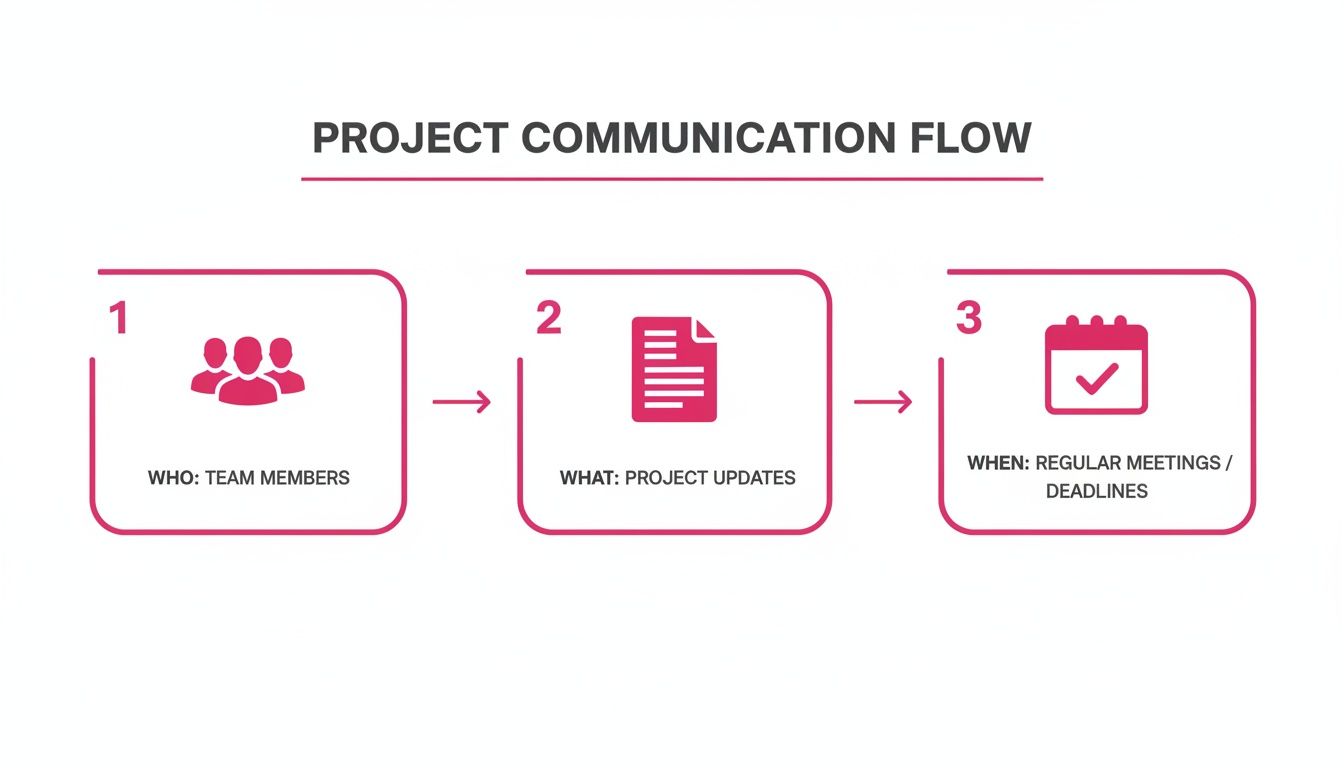
As you can see, a solid plan always starts with identifying your audience, defining your message, and locking in a schedule.
Step 1: Assemble Your Crew
Before you can plan anything, you have to know who you’re talking to. This is your stakeholder analysis. A stakeholder is anyone with a vested interest in your project's outcome, from the executive sponsor signing the checks to the junior developer slinging the code.
Don't just make a list of names. You need to dig deeper to figure out what they actually care about:
- Executives: They want the 30,000-foot view. Are we on time and on budget? What are the big-picture risks?
- Team Members: They need the nitty-gritty details. What are my priorities right now? Are there any blockers in my way?
- Clients: They need to see progress and feel confident you've got things handled. When's the next deliverable coming? How does this track with the original scope?
Mapping this out first stops you from sending the wrong message to the wrong person—which is the fastest way to get your updates completely ignored.
Step 2: Define the Target
You know your audience. Now, what are you actually going to say? This step is all about defining your key messages and goals. Your goal is never just to "keep people updated"; it's to drive specific actions and keep everyone marching in the same direction.
For each stakeholder group, ask yourself: What is the one thing they absolutely must know? And what feeling or action do I want this message to inspire? This simple exercise sharpens your focus and cuts through all the noise.
A great key message is concise, clear, and consistent. It’s the headline that ensures everyone, no matter their role, gets the project's direction and their part in it.
Step 3: Choose Your Gear
With your audience and messages dialed in, it's time to pick your tools. This is where you decide on your communication channels. Not all channels are created equal. Using a flamethrower to light a candle is ridiculous overkill, and so is calling a 60-minute meeting for a three-sentence update.
The secret is matching the tool to the task:
- Asynchronous (Async) Tools: Perfect for routine updates, progress logs, and non-urgent questions. A lightweight tool like WeekBlast is gold here, creating a persistent, searchable changelog that keeps everyone in the loop without the constant interruptions.
- Synchronous (Sync) Tools: Save these for the heavy lifting—urgent problem-solving, complex brainstorming sessions, and critical decision-making. Think video calls or getting everyone in the same room.
By defaulting to async for status updates, you protect your team's most precious resource: their uninterrupted focus time.
Step 4: Synchronize Your Watches
Consistency is everything. This step is about setting a clear cadence and schedule. When your team knows exactly when to expect an update, they stop wasting mental energy wondering what’s going on. That kind of predictability builds trust and lowers anxiety for everyone.
Keep your schedule simple and reliable. For instance:
- Daily: Async check-ins via WeekBlast.
- Weekly: A concise email summary for key stakeholders.
- Bi-weekly: A sync meeting for sprint planning or retrospectives.
- Monthly: A more formal progress report for executive leadership.
This rhythm keeps information flowing steadily without ever overwhelming people.
Step 5: Plan Your Escape Route
No plan survives contact with reality. Projects are full of surprises, so your final step is to plan for feedback and risk management. You need a clear, known process for how people can raise concerns, ask questions, or even suggest improvements to the communication plan itself.
Think of this as a safety valve. It lets you adapt and adjust before small frustrations become project-derailing disasters. This could be as simple as a dedicated Slack channel, a standing agenda item in your weekly meeting, or even an anonymous feedback form.
On that note, having the right project management tools is a proven game-changer. Data shows organizations using PM software have a 61% on-time project completion rate—a massive leap from the 41% rate for those flying blind. With a staggering 88% of organizations now using these tools, adopting the right ones is a clear path to better outcomes. You can explore more project management trends to see just how big the impact is.
Choosing Your Channels: Async vs. Sync Communication
Is your calendar a graveyard of meetings that should have been emails? We've all been there. Knowing which communication tool to grab for the job is a core skill in communication project management. You wouldn’t use a flamethrower to light a candle, so why are you still using a 60-minute meeting for a three-sentence update?
The secret is understanding the huge difference between two ways of talking: synchronous and asynchronous. Getting this right is how you reclaim your team's most precious resource—their focus.
The Great Divide: Synchronous vs. Asynchronous
Synchronous (sync) communication is live, happening right now. It demands that everyone be present and paying attention at the same time. Think of it like a live concert—you all have to be in the same venue (physical or virtual) to experience it together.
Asynchronous (async) communication happens on your own time. It’s like leaving a message on a shared whiteboard. People can read it and respond when it makes sense for them, without dropping everything they’re doing.
Here's a quick look at how they stack up:
- Synchronous Examples: Video calls, in-person meetings, and those instant messages that demand an immediate reply.
- Asynchronous Examples: Emails, project management updates, recorded video messages, and work logs.
The goal isn't to kill off all sync communication. It's to use it like a scalpel—precisely and only when necessary. Save it for the high-stakes, messy conversations that genuinely need that live back-and-forth, like brainstorming a new feature or working through a heated debate. For everything else? Default to async.
Fostering an Async-First Culture
An async-first culture is one that fiercely protects deep work time. It’s built on the truth that constant pings and context-switching are absolute productivity killers. This approach is more critical than ever, especially with the explosion of remote and hybrid work. A whopping 72% of project teams are working this way now, and the old "tap on the shoulder" habits are falling apart.
In fact, nagging communication gaps are a direct reason why a mere 35% of projects succeed globally. This isn't just an annoyance; it's a crisis, highlighting the urgent need for better async tools. You can find more details on these and other worldwide project management trends.
Building this culture means giving your team the right gear. You need a simple, central place for updates that doesn't feel like another chore to check off a list. This is where lightweight, human-first tools become the bedrock of your strategy.
This screenshot shows how a tool like WeekBlast makes async updates dead simple, with a clean interface for adding quick notes.
The big idea here is the focus on speed and simplicity. It encourages frequent, low-friction updates that keep everyone in the loop without calling a meeting.
An async-first mindset doesn't mean "never talk live." It means "talk live when it truly matters." It's about respecting each other's time and attention as the finite, valuable resources they are.
Choosing the Right Tool for the Job
So, how do you pick? It really just boils down to the purpose of your message. Your communication stack should give your team energy, not drain it.
Use this simple guide to make your choice:
| Communication Need | Best Channel (and Why) |
|---|---|
| Urgent Problem Solving | Synchronous Call: A fast-moving issue needs immediate, collaborative troubleshooting. No time to waste. |
| Routine Status Updates | Asynchronous Work Log (e.g., WeekBlast): Creates a searchable, permanent record without derailing anyone's day. |
| Complex Brainstorming | Synchronous Meeting: Live interaction sparks creativity and lets ideas snowball in real time. |
| Sharing FYIs & Wins | Asynchronous Update: Lets the team celebrate progress and stay informed on their own schedule. |
| 1-on-1 Feedback | Synchronous Call: Absolutely essential for nuance, empathy, and building a real human connection. |
By defaulting to asynchronous updates for daily and weekly progress, you build a powerful, searchable story of your project's journey. Tools like WeekBlast are built for exactly this, letting you log a win in seconds via the app or by just sending an email. This is how you learn to build a system of effective async updates that people actually use. It’s all about creating a culture where visibility is constant, but interruptions are rare.
Common Communication Mistakes to Avoid
Even the most buttoned-up communication plans can get torpedoed by a few bad habits. In the world of project management, these aren't just minor quirks; they're the project-killing villains hiding in plain sight. Learning to spot them is the first step toward getting your project back on track.
These breakdowns don't just feel frustrating—they're wildly expensive. Communication blunders are responsible for 9.9% of every project dollar being wasted across the globe. It's no wonder that only 35% of projects actually finish on time and on budget. Fixing these communication gaps is one of the fastest ways to boost your ROI.
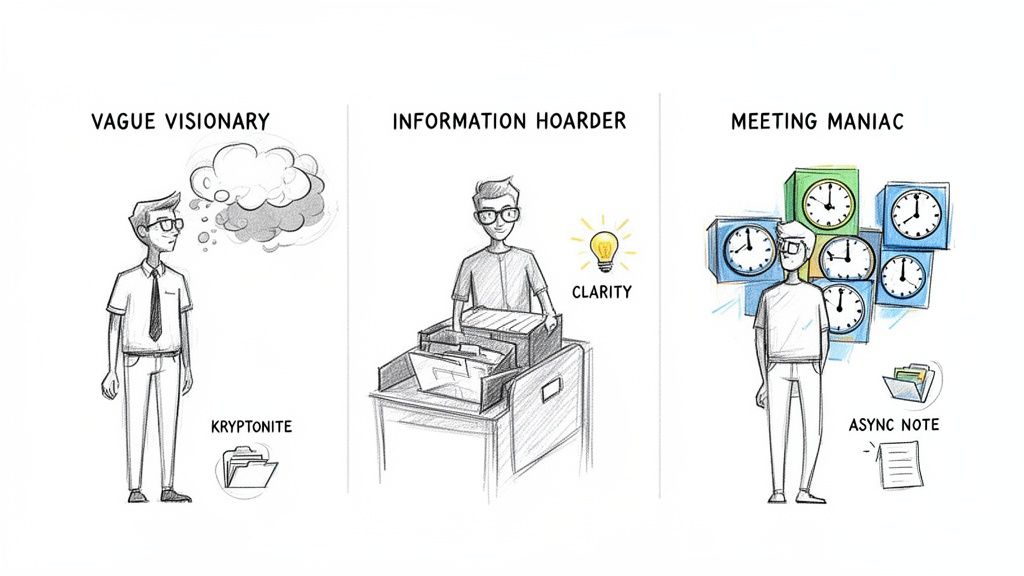
So, let's meet the three most wanted communication villains and figure out how to take them down.
The Vague Visionary
We've all met this one. The Vague Visionary speaks in grand, fluffy statements but offers zero actionable detail. They’ll drop gems like, "Let's make this pop," or "We need to aim for a world-class experience," leaving your team completely baffled about what to do next.
This kind of ambiguity is a recipe for disaster. It forces your team into a painful cycle of guesswork and rework. They build what they think the visionary wants, only to hear, "No, that's not it at all." It’s the fastest way to burn through your budget and your team's will to live.
Kryptonite: The power of clarification. Never, ever let a fuzzy statement slide. Push back with gentle, clarifying questions. "When you say 'pop,' can you show me an example of what that looks like?" or "What are two specific features our 'world-class' experience absolutely must have?"
By demanding concrete answers, you translate those lofty dreams into a tangible to-do list. This simple habit turns a guessing game into a shared, crystal-clear goal.
The Information Hoarder
This villain operates from a misplaced sense of power, believing that knowledge is a treasure to be guarded, not shared. The Information Hoarder creates frustrating knowledge silos where critical project details live only in their head or on a secret spreadsheet. Suddenly, they become a bottleneck, and nothing moves an inch without their direct sign-off.
When people can't get the information they need, they can't make smart decisions on their own. This grinds progress to a halt, stirs up resentment, and creates a massive single point of failure. If the Hoarder takes a vacation, the entire project goes on vacation, too.
Kryptonite: A single source of truth. The best way to disarm this villain is to make hoarding impossible. Insist that all essential project information—from technical specs to meeting notes—lives in a central, accessible place like a shared wiki or your project management tool.
Build a culture of transparency where open access isn't a privilege; it's the default. This not only foils the hoarder but also empowers the entire team to be more autonomous and effective.
The Meeting Maniac
For the Meeting Maniac, the solution to every question, problem, or minor update is to "just hop on a quick call." Their calendar is a terrifying wall of back-to-back meetings, and they're determined to drag everyone else into the vortex with them, completely shattering any hope for deep, focused work.
This habit is a colossal productivity killer. Most of these meetings are just one-way info-dumps that could have been an email or a quick message. They interrupt your team's flow, create mental chaos from constant context-switching, and leave people with zero time to actually do the work they just talked about.
Kryptonite: An async-first mindset. The ultimate weapon against the Meeting Maniac is to make asynchronous communication the default for all status updates. Instead of a daily stand-up, try a tool like WeekBlast for quick, written progress reports. You can learn more about replacing status meetings and reclaiming your team's time.
This frees up everyone's calendar for the truly important, collaborative conversations that actually require a meeting. By making async the norm, you give your team the incredible gift of uninterrupted time and teach the Meeting Maniac that a call is the exception, not the rule.
Frequently Asked Questions About Project Communication
You've got the principles down, you’ve sketched out a plan, and you've even picked your favorite tools. But let's be real—the moment a project kicks off, curveballs start flying. Great communication project management isn't about having a perfect, rigid plan; it's about how you bob and weave when things get messy.
This quick-fire Q&A tackles the most common headaches project managers face in the wild. Think of it as your field guide for navigating those tricky, real-world communication traps with a bit of grace and a lot of confidence. Here are some no-nonsense answers you can put to work today.
What Is the Single Most Important Part of a Project Communication Plan?
Hands down, it's the stakeholder analysis. If you don't know exactly who you're talking to and what they're losing sleep over, the rest of your beautifully crafted plan is just shouting into the void. It’s the concrete foundation you build everything else on.
Getting a handle on each person's role, their level of clout, and what info they actually need is everything. A plan that spams a non-technical exec with daily code commits is just as broken as one that "forgets" to tell developers about a massive strategy pivot.
Nail this part first, and the rest starts to fall into place. It’s the difference between sending targeted, laser-focused messages and just making a lot of noise.
How Can I Convince My Team to Reduce Meetings?
The secret is to sell it as a gift of uninterrupted focus time, not another corporate mandate from on high. People are fiercely protective of their deep work time, so you have to position async tools as their personal shield against a chaotic calendar. Don't demand they change; invite them to try an experiment.
Kick things off with a small, low-risk trial run. Try saying something like, "For the next two-week sprint, let's kill the daily stand-up and use async updates in a tool instead. We'll huddle up afterward and see how it felt."
Once the trial is over, get their honest feedback and make a big deal about the wins. Point to the extra hours of focus, the searchable log of what actually happened, and the sweet, sweet relief from constant context switching. When people truly feel the freedom of an open calendar, they’ll become the biggest advocates for the new way of working. Just be sure to lead by example with your own crystal-clear async updates.
Key Insight: The goal isn't to kill all meetings, but to make the ones you do have count. When meetings become rare and hyper-focused, their value skyrockets, and people actually want to be there.
What Metrics Can I Use to Measure Communication Effectiveness?
While "good communication" can feel a bit fuzzy and subjective, its impact is surprisingly concrete and measurable. You just have to know where to look. Stop focusing on abstract feelings and start tracking the tangible results of a well-informed team.
Here are a few powerful signs you're on the right track:
- A Drop in "Urgent" Meetings: A sudden nosedive in last-minute, fire-fighting meetings is a massive win. It means information is getting to people proactively, not reactively.
- Fewer Clarification Questions: When tasks get assigned and you're hearing fewer "Wait, what do you mean by...?" questions, you know your initial communication is landing right.
- Faster Decision-Making: Keep an eye on how long it takes for key decisions to get made. A smooth flow of information empowers stakeholders to give a thumbs-up or thumbs-down without endless delays.
- Improved Stakeholder Satisfaction: Use simple, post-project surveys to ask key players how informed and involved they felt along the way.
But honestly, the best metric of all is a higher rate of hitting your milestones on schedule and within budget. A successful communication plan creates a smooth, predictable rhythm where everyone feels confident and aligned, and that translates directly to better project outcomes.
How Often Should I Update My Project Communication Plan?
Your communication plan should never be a "set it and forget it" document left to collect digital dust in a forgotten folder. Think of it as a living, breathing guide, not a stone tablet. It needs to adapt right alongside the project itself.
A good rule of thumb is to give it a quick check-up at every major project milestone or at the start of each new phase. This keeps the plan from getting stale as the project grows and changes.
But the most important trigger for a review isn't on the calendar—it's when you feel friction. If you notice more confusion, messages getting lost, or a sudden spike in pointless meetings, that’s your alarm bell. It’s a dead giveaway that your current system is breaking down. When that happens, don't wait. Pull up the plan immediately and tweak your channels, cadence, or messaging to get things running smoothly again. A flexible plan is a resilient one.
Tired of chasing updates and sitting in pointless status meetings? WeekBlast is the lightweight work log that gives you and your team a simple, human-first way to stay in sync. Ditch the bloated trackers and get back to doing what you do best. Get started for free with WeekBlast and see how async updates can transform your workflow.


