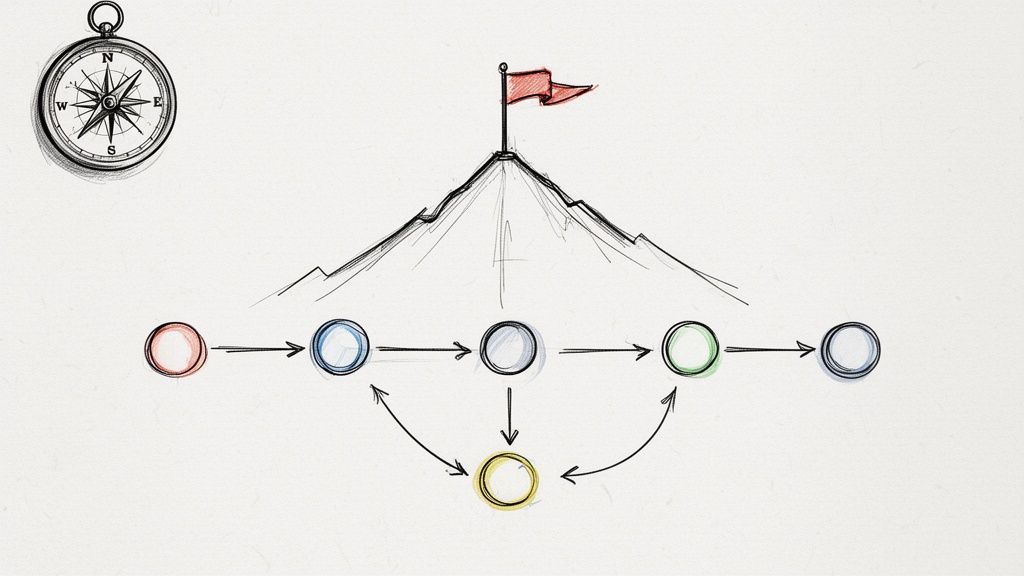
A project management strategy is the high-level thinking that connects your company’s projects to its biggest goals. It’s not just one project plan; it's the entire framework that dictates why and how you choose, plan, and run your projects. The whole point is to make sure every bit of effort pushes the company in the right direction.
Why Your Business Needs a Project Management Strategy
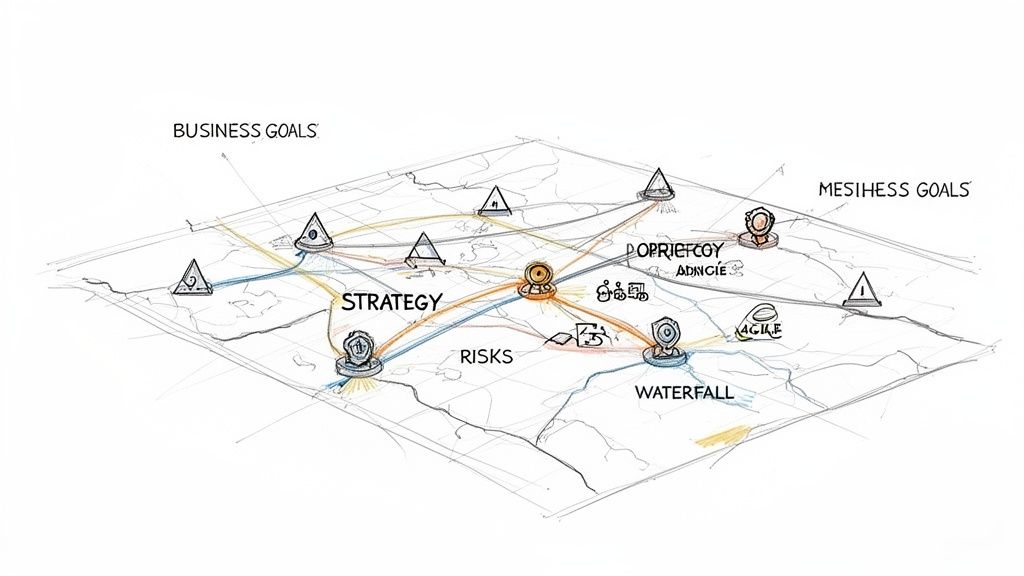
Without a real strategy, teams often end up working in silos. They're busy, sure, but they’re hammering away at tasks that might not actually line up with what the company is trying to achieve. This leads to wasted money, missed deadlines, and that frustrating feeling of spinning your wheels but going nowhere.
A good strategy acts like a GPS for your organization. It gives everyone a shared destination and a clear path to get there.
Think of it like this: a project plan is a single, turn-by-turn route for one road trip. Your project management strategy is the entire navigation system. It knows all the possible destinations (your business goals), can see the traffic jams ahead (risks), and suggests the best routes to take (your methodologies).
This strategic thinking is what separates teams that are just busy from teams that are truly effective. It elevates project management from a simple checklist of tasks into a powerful driver of business growth.
The Core Benefits of a Strategic Approach
Putting a solid strategy in place delivers benefits almost immediately. It cuts through the noise, empowers your teams, and makes sure you're putting your time and money where it counts. When people understand the "why" behind their work, they start making smarter decisions on their own.
This is a game-changer for remote or asynchronous teams. A shared strategic framework gives everyone the context they need to work independently while still pulling in the same direction. The biggest wins include:
- Improved Alignment: Every project, big or small, directly supports the company's main objectives.
- Enhanced Decision-Making: Provides a clear filter for prioritizing projects and allocating resources, so you can confidently say "yes" to the right things and "no" to the wrong ones.
- Greater Team Autonomy: Frees up individuals to make smart calls because they see how their piece fits into the larger puzzle. No more constant hand-holding.
- Increased Project Success Rates: When you focus on the right projects and have a system for managing them well, you naturally see better outcomes and more projects crossing the finish line.
A project management strategy isn't about rigid control. It's about providing a clear sense of direction so teams can navigate complexity with confidence and purpose. It answers the most important question of all: "Are we working on the right things?"
From Planning to Performance
A strong strategy isn't just some document that collects dust. It's a living, breathing framework that guides everything you do. You can see this shift happening across the industry, as the project management software market is on a rocket ship, expected to hit $12.02 billion by 2030.
The data backs it up, too. Companies that use project management tools get 61% of their projects done on time, a massive leap from the 41% success rate for those who don't. As you can find in these project management statistics from monday.com, a strategy backed by the right tools delivers real results.
Ultimately, a strategy is the bridge between your company's big vision and the daily grind required to make it a reality. It provides the structure you need to manage chaos, spark collaboration, and consistently deliver work that actually matters.
The Essential Components of Your Strategy
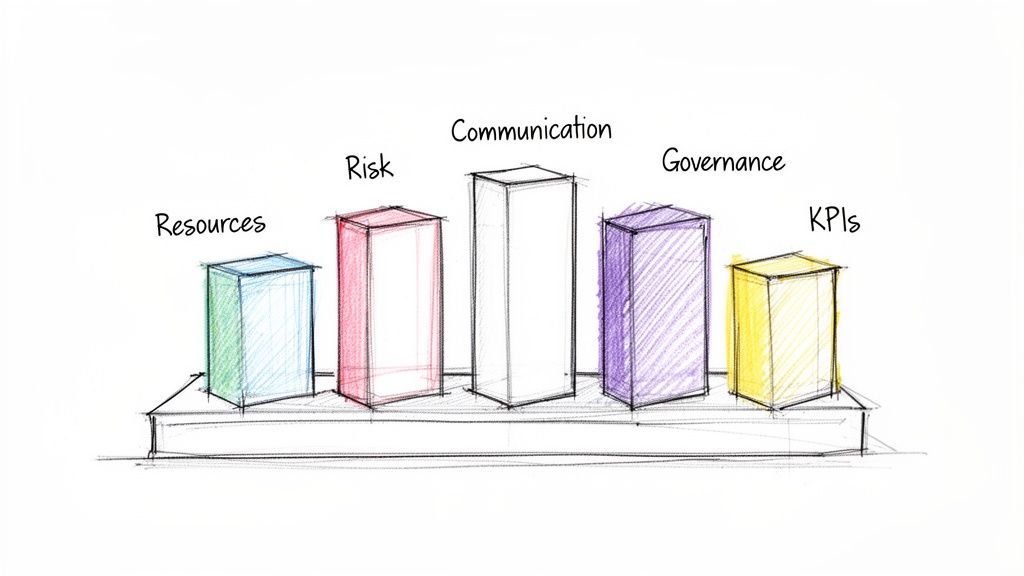
A great project management strategy isn't just a vague promise to "get things done." It’s a real, tangible framework built on a few core pillars that all lean on each other. When these pieces work together, they create a reliable system that guides a project from a simple idea to a successful launch.
Think of it like building a house. You wouldn't just start throwing up walls without a foundation, plumbing, and electrical plans. Each component is essential. Leave one out, and the whole structure becomes wobbly and unsafe.
Resource Management: The Foundation of Execution
At its heart, resource management is about making the most of what you have: your people, your time, and your money. It's no surprise that poor resource planning is one of the biggest reasons projects fail, leading straight to team burnout, blown deadlines, and shoddy work.
A strategic approach means you stop just assigning tasks and start thinking bigger. It involves truly understanding your team's capacity, anticipating what skills you'll need next month, and making sure the right people are on the right tasks. You might build a simple skills matrix to see where your team shines or use planning tools to avoid piling all the critical work on one person.
The goal of strategic resource management is not just to allocate people to projects. It's to create a sustainable workflow where teams are challenged but not overwhelmed, enabling them to produce their best work consistently.
When you get this right, you stop pulling people off their main priorities to put out fires. Instead, you create a predictable, steady flow of work that respects everyone's time and talent.
Proactive Risk Assessment
Let's be honest: every project has risks. You might hit a technical snag nobody saw coming, or the market could suddenly shift. A good strategy doesn't ignore these risks; it anticipates them. Proactive risk assessment is all about spotting potential roadblocks before they become actual problems.
Instead of just reacting, you get ahead of the game. This can be as simple as a brainstorming session where the team lists out everything that could possibly go wrong. From there, you can rank those risks by how likely they are to happen and how much damage they could do.
Once you know the biggest threats, you can make a plan. For example, if you rely heavily on a single supplier, your plan might be to find and vet a backup before you ever need one. This shifts your team's mindset from constantly fighting fires to strategically solving problems.
Communication and Governance
Clear rules of engagement are the glue that holds a project together. Governance is simply the "who-decides-what" framework. It clarifies who has the final say, how changes get approved, and who steers the ship. Without it, projects drift, scope creep takes over, and nobody knows who to listen to.
Stakeholder communication is the project's lifeblood, especially when you're working with remote teams. Your strategy needs to clearly outline how, when, and to whom information gets shared. This means setting a regular schedule for updates, deciding which channels to use for what (like Slack for quick chats and formal reports for leadership), and keeping things transparent.
A solid communication plan ensures everyone has the info they need, cutting down on misunderstandings and endless status meetings. Our guide on how to prioritize tasks dives deeper into communicating them effectively.
Defining Success with KPIs
So, how do you know if any of this is actually working? You measure it. Key Performance Indicators (KPIs) are the specific, measurable numbers you track to see if you're hitting your goals. They give you cold, hard data on what's working and what isn't.
But good KPIs aren't just about finishing "on time" or "on budget." They should connect what your project accomplishes to the bigger business goals. Your strategy needs to pinpoint which metrics truly matter.
Here are a few you might consider:
- Cost Performance Index (CPI): This measures how financially efficient your project is. Are you getting the value you expected for the money you're spending?
- On-Time Completion Percentage: A simple but powerful metric that tracks how well your team hits deadlines, giving you a clear picture of your scheduling reliability.
- Stakeholder Satisfaction: You can track this with quick surveys or feedback scores to see if the project is actually meeting the needs of clients, users, and even your own team.
By setting these metrics from the start, everyone agrees on what success looks like, and you can make smart, data-driven decisions to keep your projects on the right path.
Choosing the Right Project Management Framework
Think of picking a project management framework less like finding the "best" one and more like choosing the right tool for the job. You wouldn't use a hammer to drive a screw, right? The same logic applies here. The best approach depends entirely on your team, your industry, and the kind of work you do.
Are you building something from a fixed blueprint, or are you creating something more like an adaptable recipe? Answering that question is the first step. The framework you land on will shape how your team plans its work, talks about progress, and handles the inevitable curveballs, setting the stage for either smooth sailing or constant friction.
The Blueprint Approach: Waterfall
The Waterfall methodology is the classic, linear way of managing projects. Picture building a house from a detailed architectural plan. You have to lay the foundation before you can frame the walls, and the walls have to be up before you can install the plumbing. Each phase is completed in a strict sequence, one after another.
With Waterfall, you figure out everything upfront. You gather all the requirements, draft a comprehensive plan, and then execute that plan step-by-step until you deliver the final product. It’s a rock-solid method when the project requirements are crystal clear and aren't going to change.
Waterfall is a great fit when:
- Scope is locked in: Think construction or manufacturing projects where the end goal is well-defined from day one.
- Predictability is everything: When stakeholders need to know exact timelines and budgets before any work starts.
- The path is clear: It's perfect for projects with few unknown variables, where you can see the finish line from the start.
But its greatest strength, its rigidity, is also its biggest weakness. If the market suddenly shifts or a key stakeholder has a change of heart halfway through, changing course can be incredibly difficult and expensive. There's almost no room for feedback until the very end, which is a gamble.
The Recipe Approach: Agile
On the other end of the spectrum, you have Agile methodologies. If Waterfall is a blueprint, Agile is more like cooking a complex new dish. You start with a general recipe (the project goal), but you taste and adjust as you go. A little more spice here, a bit less time in the oven there; you adapt based on how it's turning out. This cycle of doing and adjusting is what allows for real flexibility and continuous improvement.
Agile works by breaking down huge projects into small, digestible chunks called sprints or iterations. At the end of each short cycle, the team delivers a small but functional piece of the final product. They get feedback on that piece and use it to adapt their plan for the next cycle. This makes it a perfect match for fast-moving environments where you expect things to change.
An Agile project management strategy is built on feedback. It treats change not as a problem, but as a competitive advantage that allows teams to pivot quickly without derailing the entire project.
The two most common Agile frameworks you'll hear about are Scrum and Kanban.
- Scrum: This framework is all about rhythm. Teams work in fixed-length sprints (usually two weeks) to deliver a chunk of work. It comes with defined roles, like a Scrum Master to keep things on track, and regular meetings (or "ceremonies") to keep everyone aligned.
- Kanban: This is a much more visual and fluid approach. The whole idea is to visualize your workflow on a board with columns like "To Do," "In Progress," and "Done." It’s fantastic for spotting bottlenecks and managing the flow of work in real-time.
Finding a Middle Ground: The Hybrid Model
But what if your project doesn't fit neatly into one of these boxes? Maybe some parts are fixed, but other parts need room to breathe. This is where a Hybrid approach shines. It’s exactly what it sounds like: a blend of Waterfall's structured planning and Agile's iterative way of working.
For instance, you could use a Waterfall approach to map out the overall project scope and major milestones, which is your blueprint. But when it comes to the actual development and execution, you could switch to a Scrum framework, building and testing in iterative cycles. That's your recipe.
This gives you the best of both worlds. Stakeholders get the upfront predictability they crave, while the teams doing the work get the flexibility they need to adapt and respond to feedback. This balanced project management strategy is getting more and more popular for complex projects that demand both structure and agility.
How to Build and Implement Your Strategy
Alright, let's get down to brass tacks. A great strategy is useless if it just sits in a document. The real magic happens when you turn those ideas into a living, breathing system that your team actually uses.
This isn’t about some abstract corporate exercise; it’s a practical, step-by-step process for making sure your team's hard work lines up with what the business actually needs. Think of it as moving from constantly putting out fires to proactively and strategically getting things done.
Here’s a clear roadmap for building a strategy that delivers.
Step 1: Define Your Business Objectives
Before you draw a map, you need to know where you're going. The absolute first step is to connect your project management strategy to your company's core goals. What is the organization trying to accomplish this quarter or this year?
Maybe the big push is to grow market share, slash customer churn, or get a new product out the door. Whatever it is, every single project you greenlight should be a clear step toward one of those big-picture goals. This simple filter helps you kill low-impact projects and focus everyone’s energy where it counts.
Step 2: Assess Your Current Processes
Next, it’s time for an honest look in the mirror. How does work really get done around here? You need to pinpoint what's working smoothly and, more importantly, what’s causing all the friction. This audit is about finding the bottlenecks, the communication black holes, and the spots where your team is just spinning its wheels.
Go talk to your team. Seriously. The people in the trenches have the best insights into the day-to-day headaches. The goal isn’t to point fingers; it’s to get a crystal-clear picture of your starting line.
Step 3: Select a Framework and Tools
Once you know your destination (objectives) and your starting point (current processes), you can pick the right vehicle to get you there. This means choosing a project management framework and the software to support it. The right choice between Waterfall, Agile, or a Hybrid model really depends on the kind of projects you’re tackling.
This infographic breaks down the basic idea behind each approach.
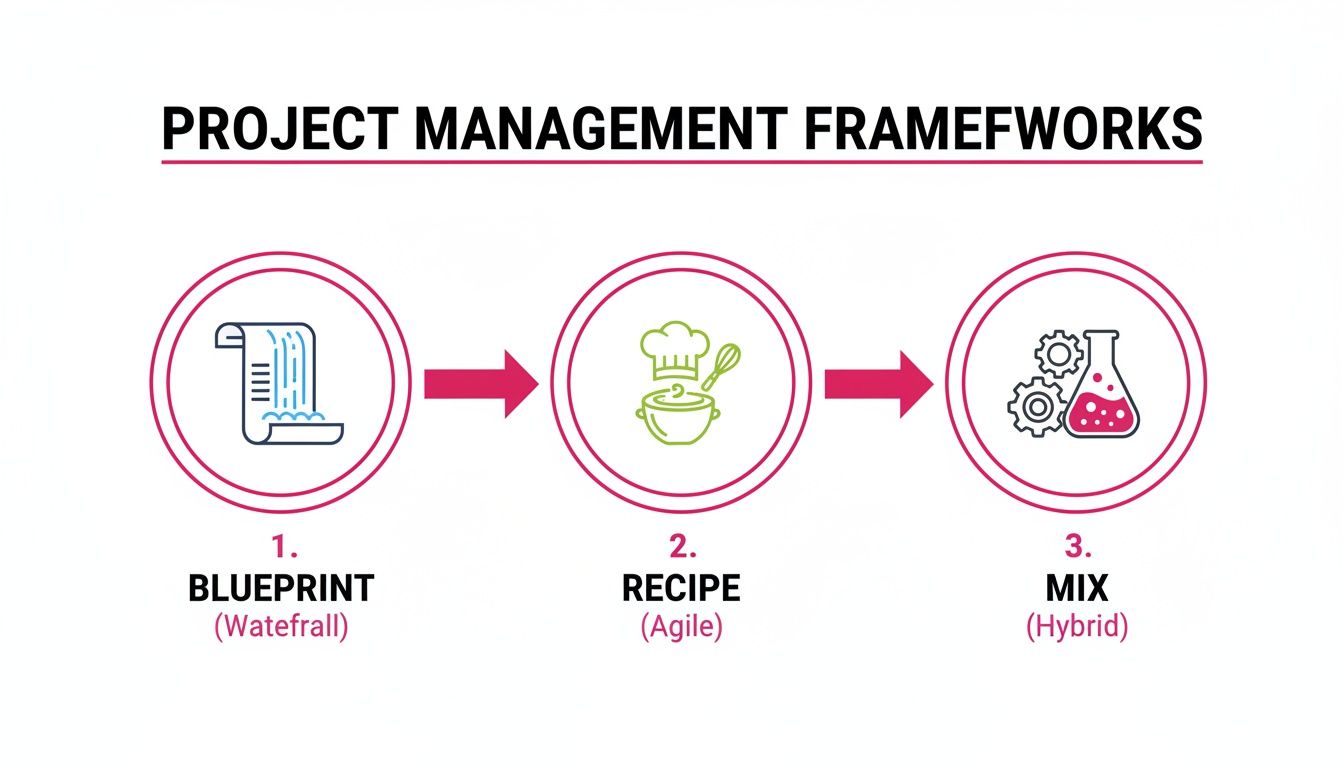
As you can see, whether you need a rigid blueprint or a flexible recipe, the framework you choose will fundamentally shape how your team works.
Step 4: Establish Governance and Roles
A solid strategy needs clear lines of ownership. Governance is just a fancy word for the rules of the road: who gets to make the final call, how do we handle scope changes, and who is ultimately on the hook for what? When roles and responsibilities are spelled out, people aren't afraid to make decisions, and the whole project moves forward with confidence.
This step is all about making sure everyone knows their part to play, which is critical for keeping up momentum and preventing chaos.
Gaining Team Buy-In
A strategy that’s just handed down from on high is dead on arrival. Real adoption only happens when the team feels like they own it. Pull them into the process, listen to their feedback, and explain why you’re making these changes. When people see how the new strategy will make their jobs easier and their work more meaningful, they’ll become its biggest champions.
Step 5: Create a Communication Plan
Information flow is the lifeblood of any project. A communication plan maps out how, when, and to whom information gets shared. It sets clear expectations for status updates, establishes the right channels for different conversations (e.g., Slack for quick questions, email for formal updates), and ensures key stakeholders are never left in the dark.
This is non-negotiable for remote teams, where you have to be deliberate about communication to avoid silos and confusion. You can dive deeper into effective communication in project management in our detailed guide. A good plan cuts down on pointless meetings and keeps everyone focused on what matters.
Step 6: Set KPIs and a Feedback Loop
Finally, how will you know if any of this is actually working? You need to measure your success and be ready to adapt. Key Performance Indicators (KPIs) are the specific numbers you’ll watch to see if your strategy is hitting the mark.
Think metrics like:
- On-Time Completion Percentage
- Cost Performance Index (CPI)
- Stakeholder Satisfaction
These numbers give you objective data, so you can stop guessing and start making informed decisions. A truly effective strategy also has a built-in feedback loop, a regular time to review what’s working and what isn’t. This commitment to constant improvement ensures your strategy evolves with your team and your business, staying sharp for years to come.
Tailoring Your Strategy for Different Teams
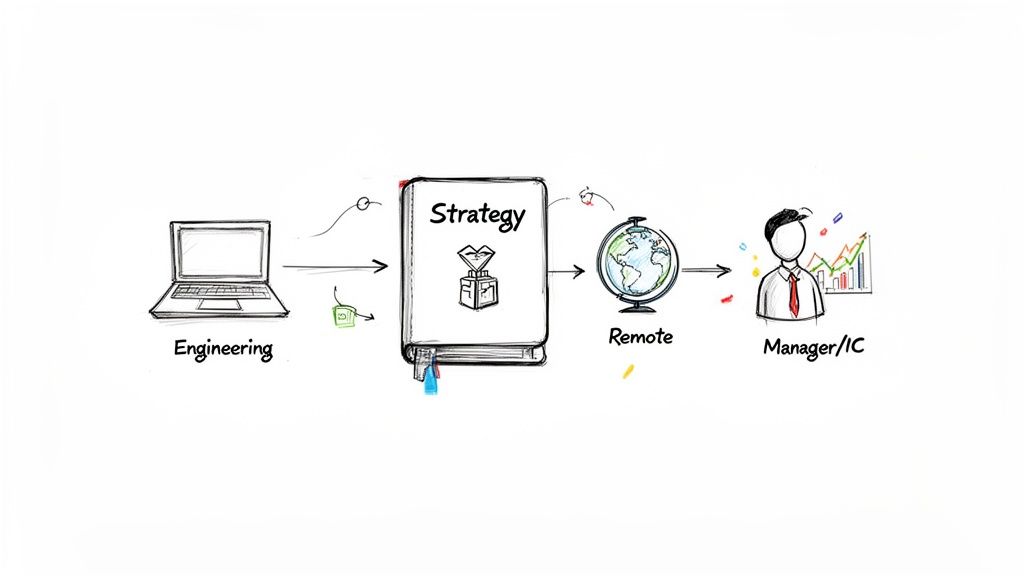
Trying to force a single project management approach on every team is a common mistake that almost always backfires. An engineering team's rhythm is completely different from a remote customer support team's, so why would they use the exact same system?
A smart strategy isn't rigid; it’s a flexible framework that each group can adapt to fit their unique workflows and communication habits. This way, you empower teams to work how they work best, all while keeping everyone pointed toward the same company-wide goals.
Let's break down how to fine-tune your strategy for different kinds of teams.
For Engineering and Product Teams
Engineers and product managers thrive on rapid iteration and tight feedback loops. Their project management strategy needs to be built for speed and clarity, helping them communicate seamlessly without getting buried in meetings.
The main goal here is to keep work flowing. This is why Agile frameworks like Scrum or Kanban are so popular, as they're designed for exactly this kind of adaptive, fast-paced environment. A solid strategy for these teams will have crystal-clear bug tracking, well-defined user stories, and a transparent product roadmap that everyone can see.
Here's what that looks like in practice:
- Iteration-Focused Frameworks: Using sprints to break down massive features into small, manageable pieces. This allows for constant check-ins and quick course corrections along the way.
- Integrated Tooling: Linking code repositories like GitHub directly to project management software. This automates progress updates, so developers don't have to stop coding to report what they’ve done.
- Clear Cross-Functional Communication: Setting up specific channels where product, engineering, and design can hash things out without derailing each other's focus. You can dive deeper into this in our guide on the new product development process.
For Remote and Distributed Teams
When your team is scattered across different cities and time zones, clear communication is everything. For remote teams, the project management strategy has to be built on a bedrock of trust, transparency, and asynchronous communication.
You can't rely on hallway conversations or quick desk-side chats anymore. The entire strategy has to shift toward a "write it down" culture, making sure information is centrally located and accessible to anyone, anytime.
For distributed teams, the project management strategy is the single source of truth. It’s what allows team members to work autonomously with confidence, knowing they have the context they need to make smart decisions without waiting for a reply.
An effective remote strategy will always emphasize:
- Async-First Communication: Making detailed, written updates in a shared tool the default, rather than scheduling yet another video call.
- A High-Trust Environment: Cultivating a culture where managers trust their people to deliver results without micromanaging their every move.
- Universal Visibility: Using tools that give everyone a real-time view of who is doing what. This single change eliminates a ton of confusion and unnecessary check-ins.
For Managers and Individual Contributors
Even within the same team, a project management strategy means different things to different roles. For a manager, it's about oversight and planning. For an individual contributor, it’s about clarity and impact.
For Managers and Leaders: A good strategy changes the job. Instead of constantly chasing people for status updates, managers can pull accurate progress reports, forecast resource needs for the next quarter, and even inform performance reviews with objective data. The strategy essentially becomes their dashboard for measuring team health and project velocity.
For Individual Contributors: When an IC understands the strategy, they feel empowered. It connects their day-to-day work to the bigger mission, answering that all-important question: "Why am I doing this?" Seeing the project roadmap and knowing the key objectives helps them make smarter decisions on their own, prioritize their tasks effectively, and solve problems proactively.
Your project management strategy shouldn't just be a set of rules; it should be a powerful tool that helps different teams solve their unique challenges. While the core goals might be universal, the tactics will, and should, vary.
The table below summarizes where each team type should place its primary focus when tailoring a project management strategy.
Strategic Focus by Team Type
| Team Type | Primary Strategic Focus | Key Tactic |
|---|---|---|
| Engineering & Product | Speed and Iteration | Implement Agile frameworks (Scrum/Kanban) and integrate development tools for automated progress tracking. |
| Remote & Distributed | Communication & Transparency | Establish an async-first communication protocol and use a central tool as a single source of truth. |
| Managers & Leaders | Oversight & Reporting | Leverage strategy tools for real-time dashboards, resource forecasting, and data-driven decision-making. |
| Individual Contributors | Clarity & Impact | Ensure easy access to roadmaps and project goals to connect daily tasks with broader company objectives. |
Ultimately, the best strategy is the one that gets used. By adapting your approach to fit the reality of how your teams actually work, you create a system that doesn't just look good on paper; it genuinely helps people get meaningful work done.
Your Path to Strategic Project Success
Think of your project management strategy not as some rigid document you write once and file away, but as a living, breathing guide. It's the connective tissue between the day-to-day work your team is doing and the big-picture business goals everyone is trying to hit.
This strategic layer is what gives all the individual tasks meaning and purpose. It’s how you ensure that every effort, whether it’s a small bug fix or a massive product launch, is actually moving the company forward. Getting this right is a journey, not a one-and-done task.
Start Your Strategic Journey
Look, you don't have to overhaul your entire process overnight. That's a recipe for burnout. The best way to build a real, working strategy is one step at a time. Just pick one or two ideas from this guide and start there.
For example, you could try:
- Defining clear KPIs for just one project. This simple act gets everyone on the same page about what "done" and "successful" actually mean.
- Holding one risk assessment meeting. Getting ahead of potential problems before they blow up can save you countless headaches down the road.
These small, deliberate actions start to build momentum. Before you know it, you're creating a culture where efficiency, alignment, and purpose aren't just buzzwords; they're how you operate.
The most powerful project management strategy is the one that grows with your team. Start small, refine as you go, and you’ll build a resilient system that delivers real, measurable results and turns ambitious goals into reality.
Start building your strategy today. You'll be amazed at how quickly your team's focus and impact begin to sharpen.
Frequently Asked Questions About Project Management Strategy
Even with the best-laid plans, questions are bound to come up when you start putting a new project management strategy into action. Let's tackle some of the most common ones head-on so you can move forward with confidence.
What's The Difference Between a Strategy And a Plan?
This is a great question, and it's easy to get them mixed up.
Think of your project management strategy as your North Star. It’s the high-level thinking that answers the "why" and "how" behind your projects, making sure everything you do pushes the company toward its biggest goals. It’s the framework that helps you decide which projects get the green light and what general approach you'll take to get them done.
A project plan, on the other hand, is the roadmap for a single journey. It gets into the nitty-gritty: the "what," "who," and "when" for one specific project. It’s the detailed list of tasks, deadlines, and resources needed to get from point A to point B. The plan is a direct result of the strategy.
How Often Should We Review Our Project Management Strategy?
A project management strategy isn't something you can set and forget. Your business is always changing, and your strategy needs to keep up.
As a general rule, you should give it a deep-dive review at least once a year. It’s also smart to revisit it anytime your company goes through a big shift, like setting new business goals, reacting to a major market change, or growing your team quickly.
The most effective strategy is a living one. Regular check-ins, perhaps on a quarterly basis, ensure your approach remains aligned with reality and allows you to make minor adjustments before small issues become major problems.
These frequent touchpoints stop your strategy from becoming a relic and make sure it’s actually helping your team, not holding them back.
How Do We Get Team Buy-In For a New Strategy?
This is absolutely critical. A strategy that’s handed down from on high is almost guaranteed to fail. You need your team to believe in it, and the only way to do that is to involve them from the very beginning.
Here are a few practical ways to build that support:
- Explain the ‘Why,’ Not Just the ‘What’: Don't just announce the change. Show your team the problems the new strategy solves. Frame it around how it will make their jobs less frustrating and their work more meaningful.
- Involve Them in the Build: Nobody knows the day-to-day friction points better than the people doing the work. Ask for their input on what’s broken and how to fix it. When people have a hand in creating the solution, they’re naturally invested in seeing it succeed.
- Run a Pilot Project: Instead of a company-wide shock to the system, test the new strategy with a single, willing team. A successful pilot creates a powerful case study and gets other teams excited to adopt it.
- Equip Them for Success: Never just throw a new process at your team and hope for the best. Provide solid training, clear documentation, and ongoing support to help everyone get comfortable with the new way of working.
Ready to stop juggling scattered updates and get a clear, silent view of your team's progress? WeekBlast replaces endless status meetings with a simple, high-speed work log that keeps everyone in sync. See how it works and start your free trial.


