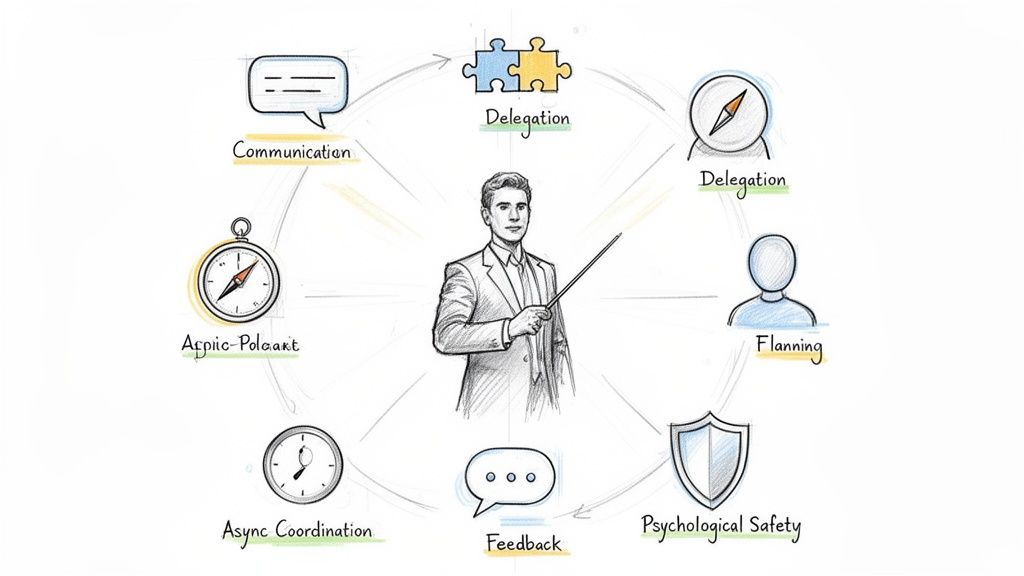
Great team management skills aren't some fuzzy, abstract concept. They are the specific behaviors and methods you, as a leader, use to guide, support, and get the absolute best out of your team. Think less "innate personality trait" and more "learnable, practical ability"—like nailing clear communication, delegating like a pro, and coaching people to be their best.
Why Modern Team Management Skills Matter More Than Ever
Let’s be honest: the old command-and-control leadership playbook is dead. Gone. Obsolete. In today's hybrid, fast-moving world, the manager-as-foreman who just barks orders and checks boxes is a recipe for disaster. That top-down style creates bottlenecks, kills creativity, and completely disengages anyone with a pulse.
The best leaders today are more like a "team conductor." They're not trying to play every instrument in the orchestra. Instead, their job is to set the tempo, give clear direction, and create an environment where every musician can shine. That’s the real art of team management skills.

The Growing Leadership Gap
Here's the scary part: there's a huge gap between the leadership teams need and what they’re actually getting. The numbers are pretty grim, showing that leadership quality is tanking right when we need it most.
Recent research shows a shocking 17% drop in leaders reporting high-quality leadership at their own company—the steepest decline in a decade. Add to that falling manager engagement and the fact that only 23% of organizations feel their leaders are equipped for today's chaotic world. You can explore the full research about leadership challenges and see just how deep the problem runs.
This isn't just a number on a chart. This leadership deficit directly causes disengagement, sends good people running for the exit, and tanks company goals. It’s a five-alarm fire signaling that managers need to build a modern skill set, and fast.
Core Skills for the Modern Conductor
To step up and be the leader your team deserves, you need to master a new set of essential instruments. These aren’t optional soft skills; they are the bedrock of effective leadership that gets results and keeps your best people from jumping ship.
Here are the most critical team management skills for the modern workplace:
- Crystal-Clear Communication: Not just talking, but building an environment of psychological safety where people feel they can speak up without fear.
- Strategic Delegation: Handing off work to do more than just clear your plate—it's about developing your people's strengths and giving them true ownership.
- Actionable Feedback & Coaching: Ditching the dreaded annual review for continuous, supportive guidance that actually helps people improve and grow.
- Async Coordination: Becoming a master of keeping remote and hybrid teams in sync without chaining everyone to back-to-back Zoom calls.
This guide will break down exactly how to master these skills with practical, no-fluff steps. Let's get to it.
1. Mastering the Art of Clear Communication & Radical Transparency
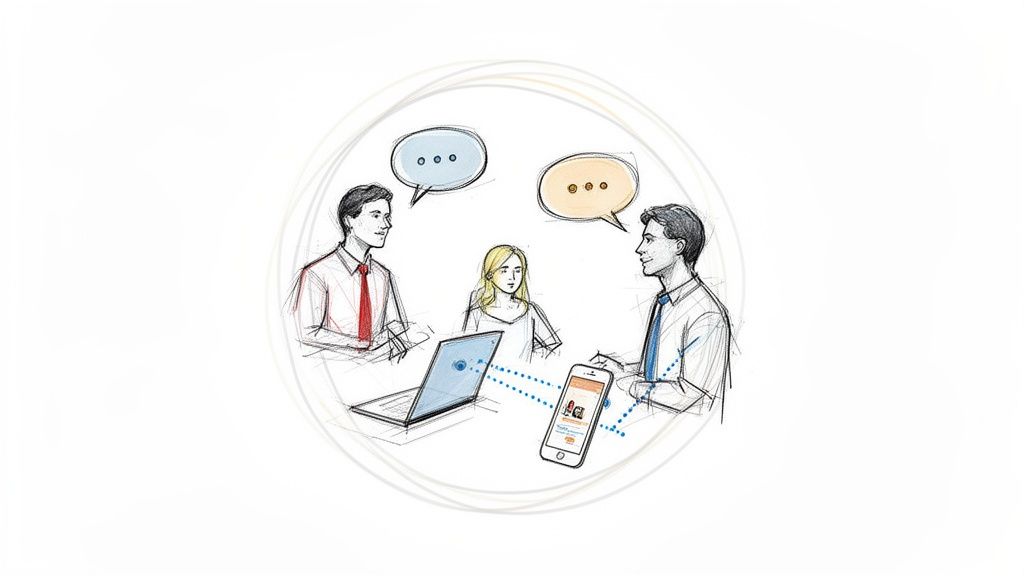
Let's get one thing straight: great communication has nothing to do with delivering a perfect monologue or drowning your team in Slack notifications. It’s about building a shared reality. If there's one skill that underpins every other aspect of management, it’s creating an environment where information flows freely and honestly, wiping out guesswork and building a bedrock of trust.
Think of it like you're all building with LEGOs. If you give one person the instruction booklet and everyone else just a pile of bricks, you’ll never end up with the castle on the box. You'll get a dozen different, wobbly shacks. Clear communication is that shared instruction manual, ensuring everyone is building the same thing, together. It’s the difference between creative synergy and chaotic frustration.
It All Starts with Psychological Safety
This idea of radical transparency hinges on one crucial thing: psychological safety. It's the shared belief that no one will get shut down, humiliated, or punished for speaking up with ideas, asking questions, flagging concerns, or—gasp—admitting they made a mistake.
A wild 86% of employees and execs point to a lack of collaboration or poor communication as the root cause of workplace failures. And what's behind that? Fear. Pure and simple.
When your team is afraid to say "I'm stuck," innovation grinds to a halt. Small problems get swept under the rug until they become full-blown catastrophes. Your number one job as a manager is to make it safer for someone to ask for help than to suffer in silence.
Here are a few micro-habits you can start practicing today to build this foundation:
- Model Vulnerability First: Be the first one to own a mistake. A simple, "Welp, I completely misjudged the timeline on this. Here's my plan to fix it," does more for trust than a thousand pep talks.
- Thank People for Bad News: Seriously. When someone flags a risk or points out a flaw, your immediate response should be, "Thank you for bringing this to my attention." This reinforces that you want the truth, not just good news.
- Ask Better Questions: Ditch "Is everything on track?" Instead, try "What are the biggest risks you see with our current plan?" One is a yes/no trap; the other invites a real conversation.
When you consistently reward honesty and own your own imperfections, you send a powerful signal: it’s safe to be human here. This single shift can transform a team’s entire dynamic from one of fear to one of collaborative problem-solving.
The Right Channel for the Right Message
Being a great communicator also means being a master of your tools. Not every update warrants a meeting, and not every question deserves an urgent ping. For a much deeper look, you can learn more about how to improve communication in the workplace, but here's a simple framework to get you started.
- Urgent & Important: This is for true "fire alarm" moments. Use synchronous tools like a direct Slack message or a quick call.
- Important, Not Urgent: This is the sweet spot for asynchronous updates. A simple work log in a tool like WeekBlast keeps everyone in the loop without the constant "ping-pong" of interruptions, protecting everyone's deep work time.
- Complex Problem-Solving: Time for a meeting. But make sure it has a crystal-clear agenda and is focused on collaborative brainstorming, not just reading a list of updates.
By sorting your communication into these channels, you slash unnecessary meetings and kill those productivity-destroying "just checking in" pings. You give your team the autonomy they crave, because they know exactly where to find information and where to share their progress. That clarity is the ultimate sign of respect for their time and focus.
2. Mastering Delegation: The Ultimate Team-Building Play
Let's get one thing straight: if you think delegation is just about getting annoying tasks off your plate, you're missing the point entirely. That’s not delegation; it’s just dumping.
Real delegation is one of the most powerful tools in your management toolkit. It’s how you develop your people. When you hand over a project the right way, you’re not just assigning work—you’re handing over an opportunity for someone to step up, learn something new, and feel a real sense of ownership.
Think of yourself as a great head chef. The best chefs don’t chop every onion and wash every pan. They orchestrate the entire kitchen. They trust their line cooks, empower their sous chefs, and focus on the final dish. A manager who does everything themself is that frantic chef trying to do it all, and the result is a burnt-out leader and an underdeveloped team.
Focus on the "What," Not the "How"
Here’s the secret sauce to making delegation work: clearly define the "what" and let your team figure out the "how."
The "what" is the goal. It's the destination on the map. You need to be crystal clear about what success looks like. What's the deadline? What are the key results we're aiming for?
The "how" is the journey—the specific path they take to get there. This is where the magic happens. When you give your team the autonomy to figure out the "how," you’re telling them you trust their judgment. Micromanaging every step of the way just screams, "I don't think you can do this." By stepping back, you give them the space to innovate, solve problems, and maybe even discover a better route than you would have thought of yourself.
True delegation is an act of trust. It says, “I trust you not just to complete this task, but to think critically, make smart decisions, and own the result.” This is how you turn direct reports into future leaders.
The Art of Matching Tasks to People
Delegation becomes a true superpower when you stop thinking about your own convenience and start thinking about your team's growth. The game is to match the right task to the right person for their development. This means you have to actually know your people—their skills, their weak spots, and where they want to go in their careers.
- Got a quiet analyst with brilliant ideas? Ask them to lead a short presentation on their findings to a small, friendly group. It’s a low-stakes way to help them build their confidence and communication skills.
- Have an ambitious junior who’s eager to grow? Give them full ownership of a small, self-contained project. Let them see it through from the first kickoff to the final report. This is a taste of real project management.
- What about your seasoned expert? Challenge them to mentor a newer team member through a complex task. You’re not just getting the job done; you’re building your team's coaching muscle and multiplying their expertise.
You don't need to hover over them to see how it's going, either. That just kills the sense of ownership you're trying to build. Instead, use a simple asynchronous tool like WeekBlast where they can post updates in a work log. You get all the visibility you need to spot roadblocks and offer support, without ever breathing down their neck.
Giving Feedback That Actually Helps People Grow
Let’s be honest: most feedback is useless. It’s either so vague it’s meaningless (“Be more proactive!”) or so poorly timed it just makes people defensive. We’ve all been there, on the receiving end of a comment that leaves us more confused than motivated.
But what if feedback wasn't a dreaded, once-a-year ambush? What if it was just… part of the conversation? That’s the real secret. Great managers know that one of their most important team management skills is ditching the old-school, backward-looking annual review and building a culture where helpful, real-time feedback is the norm.
The goal is to coach, not to critique. It's about building people up, not just pointing out where they went wrong.
Think of feedback as a tool for empowerment. Much like effective delegation, it’s about giving people the clarity and autonomy they need to succeed and grow on their own terms.
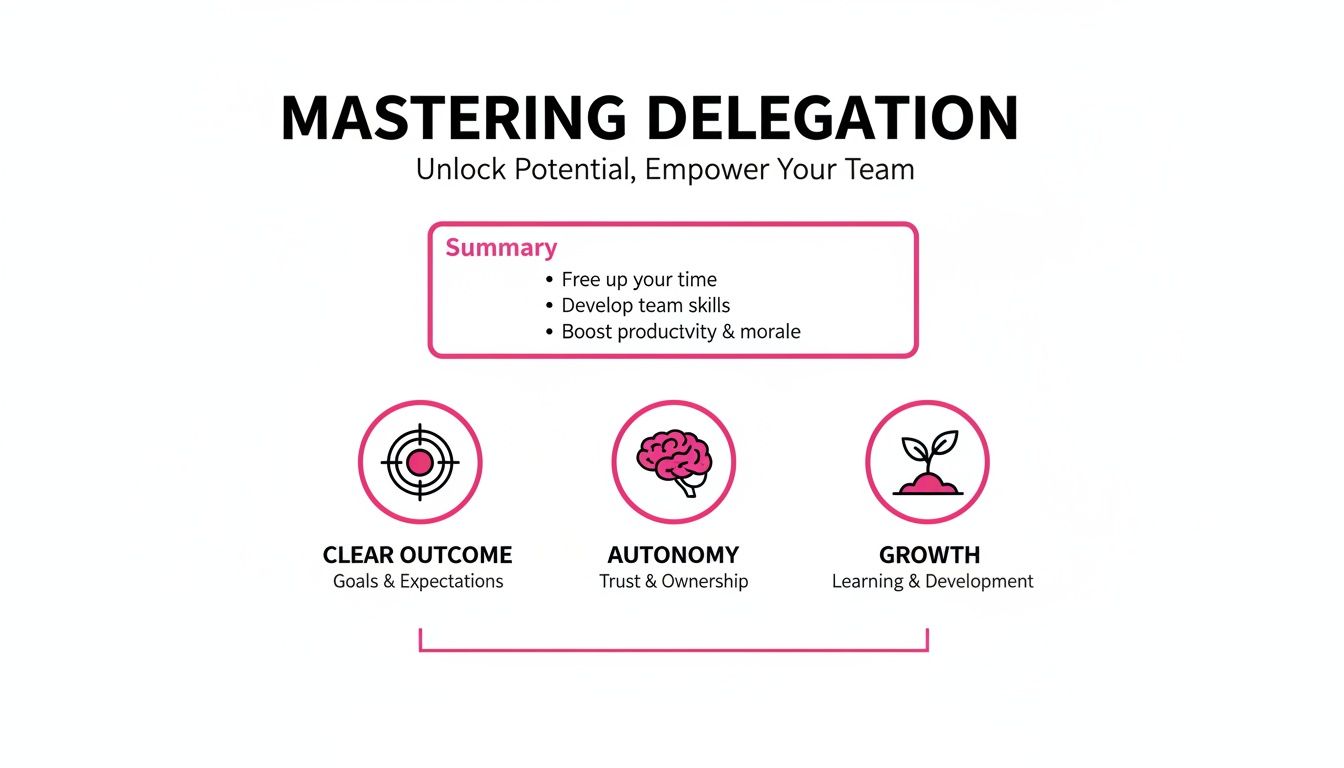
This shift from top-down critiquing to collaborative coaching is where the magic happens.
A Dead-Simple Framework for Feedback That Works
To stop giving useless advice, you need a system. Forget fuzzy platitudes and adopt the brilliantly simple Situation-Behavior-Impact (SBI) model. It's a game-changer for structuring your thoughts and delivering a message that someone can actually do something with.
Here’s the breakdown:
- Situation: First, set the scene. Get specific. When and where did this happen? (e.g., "In yesterday's project sync...")
- Behavior: Next, describe exactly what you saw or heard. No judgments, no mind-reading. Just the facts. (e.g., "...you jumped in to help Alex debug that tricky API issue.")
- Impact: Finally, explain the result. How did their action affect the team, the project, or you? (e.g., "...which unblocked the entire feature and saved us a ton of time.")
This little framework strips the emotion and guesswork out of the conversation. It transforms a throwaway comment like "nice work" into a powerful, repeatable lesson.
SBI isn't just for course correction—it’s even more powerful for reinforcing good habits. When you tell someone exactly what they did right and why it mattered, you’re giving them a roadmap to do it again.
Stop Relying on a Faulty Memory
Here’s the biggest barrier to giving great feedback: we forget stuff. By the time your weekly 1-on-1 comes around, the critical details from Monday morning are already a distant memory. This is where a continuous log of work becomes your managerial superpower.
Having a simple, shared record of updates and accomplishments gives you concrete examples to ground your conversations. No more fuzzy recollections! Instead, you can pull up a specific entry: "Hey, I saw in your WeekBlast log you shipped that new landing page. Tell me about the A/B test results."
This practice transforms feedback from a stressful, high-stakes event into a productive, low-key chat about real work. It’s less about judgment and more about genuine development. If you want to dive deeper, we have some great tips on building better performance review documentation that actually supports growth.
Old School vs Modern Feedback Loop
The annual review is a relic. Modern management is about creating a continuous feedback loop that fosters real-time learning and psychological safety, not once-a-year anxiety.
| Characteristic | Old School Annual Review | Modern Continuous Feedback |
|---|---|---|
| Timing | Once a year, backward-looking. | Daily/weekly, forward-looking. |
| Focus | Judging past performance, often tied to compensation. | Developing future skills and potential. |
| Source | Top-down from manager. | Multi-directional: manager, peers, and self-reflection. |
| Tone | Formal, high-pressure, and often dreaded. | Informal, conversational, and integrated into daily work. |
| Data | Relies on manager's memory and subjective notes. | Anchored in specific, logged work and data points. |
| Outcome | Causes anxiety, defensiveness, and surprise ratings. | Builds trust, accelerates growth, and improves performance steadily. |
Ultimately, the modern approach treats feedback not as an event, but as an essential ingredient of a healthy, high-performing team.
Becoming A Coach Instead Of Just A Boss
The best managers I've ever known all have a secret identity. Sure, by day, they're leaders. But behind the curtain, they're something else entirely: talent developers. This is the single biggest leap any great leader makes—they stop being a traffic cop and start being a coach who helps people find their own way forward.
Think about it. A boss gives answers. A coach asks great questions. A boss tells you what to do; a coach helps you discover what you’re capable of. Mastering this shift is one of the most powerful team management skills you can ever develop, transforming those dull, routine check-ins into genuine growth moments.
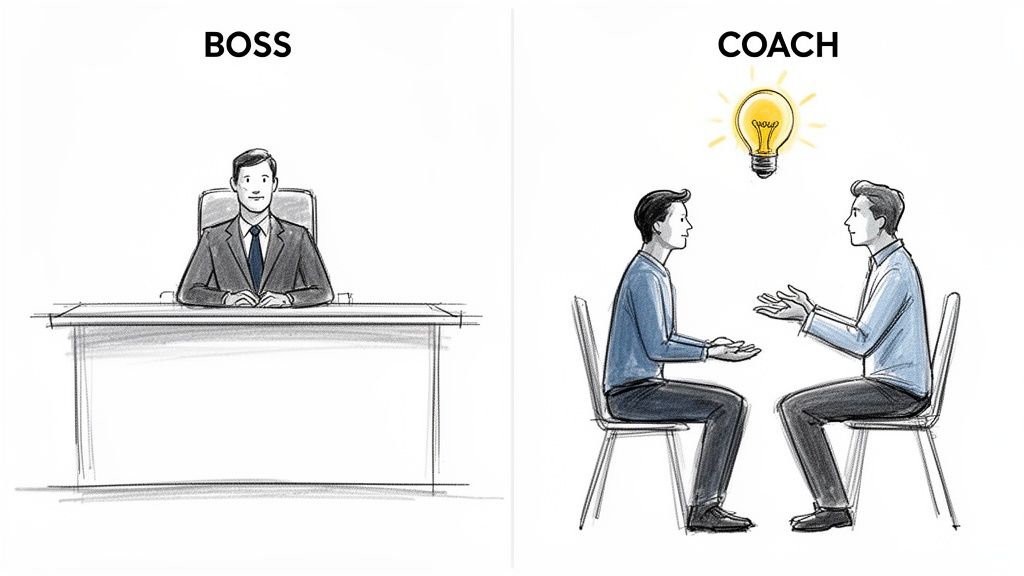
The good news? This change doesn't demand a personality transplant. It's built on small, consistent habits that slowly reframe your conversations around development, not just status reports.
From Taskmaster To Talent Multiplier
So, what does this actually look like day-to-day? It’s all about weaving curiosity into the fabric of your leadership style. Instead of playing hero and solving every problem that lands on your desk, you start guiding your team members to find their own solutions.
This simple pivot does wonders. It builds their critical thinking skills, boosts their resilience, and—most importantly—gets you out of the bottleneck business. You're no longer the team's single point of failure.
Here are a few dead-simple coaching habits you can try in your very next 1-on-1:
- Lead with a Win: Kick things off with, "What was your biggest win this week?" or "What are you most proud of?" This instantly sets a positive, forward-looking tone.
- Ask, Don't Tell: When a team member brings you a problem, fight every instinct to jump in with the fix. Instead, try questions like, "What have you already tried?" or "If you had to guess, what would the next step be?"
- Focus on the Future: Turn feedback into fuel for what's next. After a project ends, ask, "What’s one thing you learned from this that you’ll carry into the next project?"
These tiny shifts empower your team to think for themselves, take ownership, and build the confidence to tackle bigger stuff without you holding their hand.
A coaching mindset is rooted in one core belief: your team's potential is your greatest asset. Your job isn't to have all the answers; it's to create an environment where they can discover them on their own.
Closing The Coaching Gap
For all its benefits, there's a massive "coaching gap" in most companies. It's kind of shocking. While 58% of organizations recommend employees get coached multiple times a year, a measly 30% actually do. And it gets worse: only 12% of leaders feel like they're even equipped to provide decent coaching. You can dive into the full research about performance management trends if you want to see just how big the problem is.
This is where having a simple, running log of recent work becomes your superpower. When you can quickly glance at someone's recent wins and struggles, you don't need to be a world-class coaching guru to have a great conversation. You can just start with the facts: "Hey, I saw you shipped the beta on Tuesday. What was the toughest part of getting that out the door?"
This simple act grounds your coaching in reality, making it instantly more relevant and a whole lot more effective.
Your Weekly Routine for Better Team Management
Knowing the theory is one thing, but actually doing it is where the magic happens. Great team management skills don't just appear overnight; they're built through a steady, consistent rhythm of practice. Think of it like a workout routine for your leadership muscles.
You wouldn't expect to get fit after one trip to the gym, right? The same goes for management. You need a weekly plan that turns big ideas like "coaching" and "feedback" into small, repeatable habits. This template is designed to do just that—it’s simple, flexible, and helps you lead from the front instead of constantly putting out fires.
A High-Impact Weekly Cadence You Can Steal
Here’s a practical schedule to get you started. The whole point is to create predictable touchpoints that build momentum and keep everyone on the same page, all without cramming more meetings onto the calendar.
Monday Morning (15 mins): Async Kickoff. Dive into your team’s shared work log. See what they wrapped up last week and what they’ve flagged as priorities for this one. Drop a single, focused message in your team channel highlighting the top 1-2 goals for the week. Boom—instant clarity.
Wednesday/Thursday (25 mins per person): Coaching-Focused 1-on-1s. Use their work log as your cheat sheet. Instead of the tired old "What's the status?" try asking, "I saw you shipped X. What was the toughest part of that?" or "What can I do to help you crush Y this week?"
Friday Afternoon (10 mins): Celebrate and Close. Do a final scan of the week’s progress. Find a few specific wins and give public, genuine praise for the great work you saw. This tiny gesture ends the week on a massive high and shows people you're paying attention.
This routine flips your role from a progress-checker to a progress-enabler. You'll spend way less time chasing status updates and far more time actually coaching, unblocking, and celebrating your team's work.
This rhythm also gives your team the one thing they crave most: uninterrupted focus time. By leaning on a central log for updates, you can check out detailed guides on how to perfect your async updates and finally say goodbye to the soul-crushing daily stand-up meeting.
Got Questions? We've Got Answers.
Even the best guides leave a few questions unanswered. Let's tackle some of the most common things people ask about putting these team management skills into practice.
"I'm Not a Manager. How Can I Practice These Skills?"
Great question. You don't need a fancy title to start building your leadership muscles. In fact, the best way to get noticed for a leadership role is to start leading right where you are.
Got a small project coming up? Offer to take the lead. Tired of aimless meetings? Volunteer to wrangle the agenda and send out a summary afterward. Every time you give a teammate a thoughtful piece of feedback or truly listen to their point of view, you're laying the groundwork. Leading by example is the ultimate resume-builder, no matter your job title.
"What's the #1 Most Critical Skill for Managing a Remote Team?"
If I had to pick just one, it's asynchronous coordination. Hands down. It's the secret sauce that lets a team work together beautifully across different time zones without being chained to their calendars.
Think of it as the art of moving work forward without needing everyone in the same (virtual) room at the same time. This superpower is built on a few key habits:
- Writing with absolute clarity: When you can't rely on a nod or a smile, your words have to do all the heavy lifting.
- Trusting your people: You have to empower your team to run with their tasks without constant check-ins. It's about autonomy, not micromanagement.
- Having one source of truth: A central hub for updates, like a shared project board or work log, is non-negotiable. It stops the "who's doing what?" chaos dead in its tracks.
When you master async work, you’re not just managing tasks; you’re building a culture of trust. You’re telling your team you care about their results, not just their online status. That simple shift is a game-changer.
"How Do I Actually Know If I'm Getting Better at This?"
You can't just guess—you need to look for real signals. Your progress will show up in both conversations and data.
For the qualitative side, just ask! Use your 1-on-1s to get direct feedback. A simple, "What's one thing I could do differently to make your life easier this week?" can give you incredible insights.
On the quantitative side, watch metrics like team retention and how often projects are hitting their deadlines. An even better, more subtle sign? You'll notice a sharp drop in those frantic, last-minute "fire drill" meetings. When your team is humming along, that's the best proof there is.
Ready to build a culture of clarity and finally ditch those soul-crushing status meetings? With WeekBlast, your team can share updates on their own time, creating a permanent, searchable history of every win. It's the perfect tool to start building better habits today.


