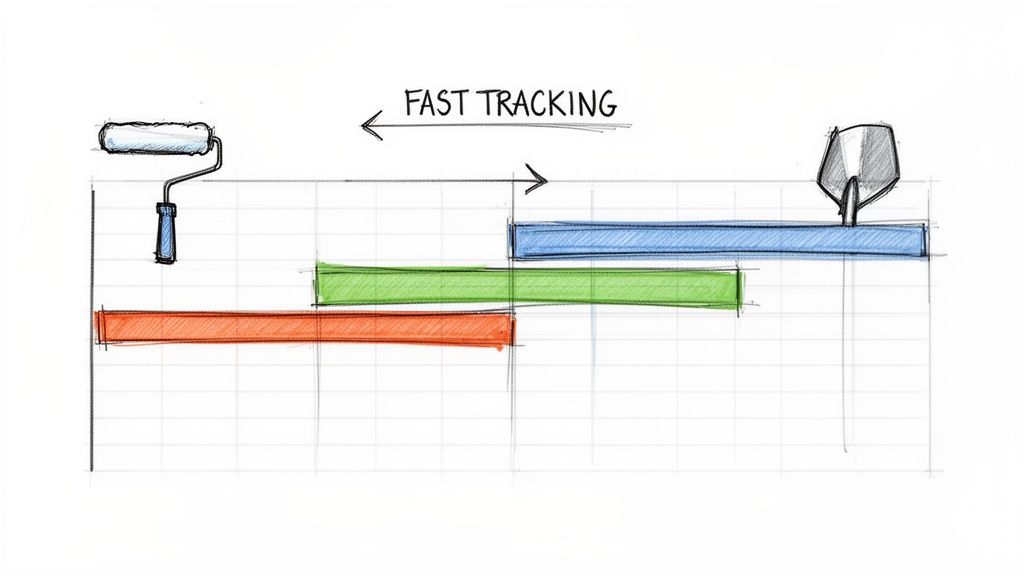
So, what exactly is fast tracking? In project management, it's a smart technique to shorten your project's timeline. The trick is to take tasks or entire phases that you'd normally do one after the other and run them in parallel instead.
Instead of waiting for one task to be 100% complete, you kick off the next one as soon as you possibly can. It’s a strategic play to deliver faster without pumping more money into the budget.
Unpacking the Concept of Fast Tracking
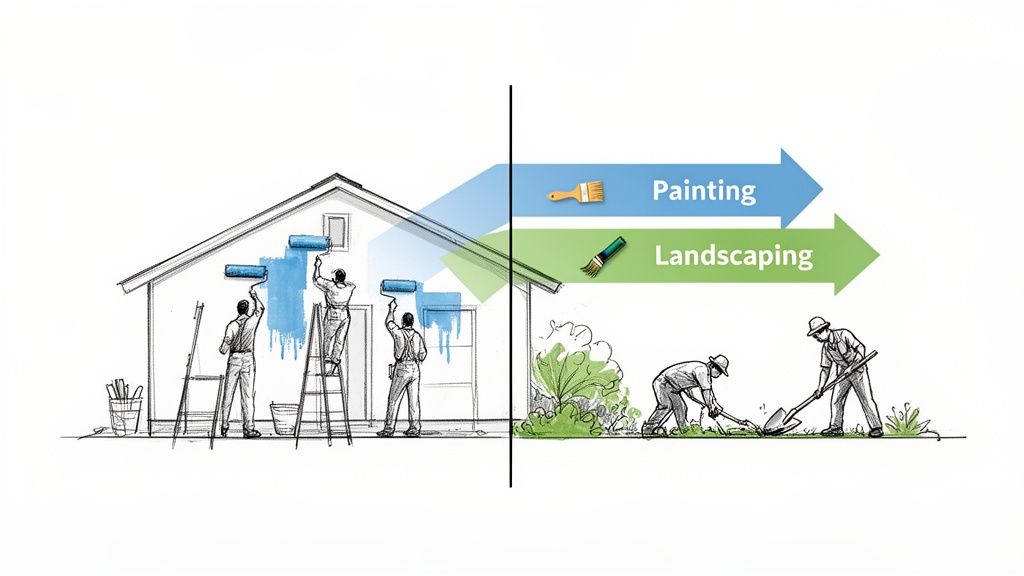
Think about building a new house. The traditional, step-by-step way is to finish the foundation completely before you even think about putting up the frame. And that frame has to be totally done before the electricians can start running wires. Each step depends on the last one finishing, which is safe and predictable, but it can also be very, very slow.
Fast tracking flips that linear model on its head. It’s a bit like starting the landscaping in the front yard while the painters are still putting the final coat on the back of the house. You hunt for tasks that can overlap without causing chaos and get them running at the same time. This is all about re-shuffling the sequence of your work, not throwing more people or money at the problem.
The Core Idea: Parallel Execution
The whole philosophy behind fast tracking boils down to one thing: parallel execution. Instead of a rigid A → B → C workflow, you’re aiming for a world where B can start while A is still underway, and C can kick off before B is finished.
Of course, this approach comes with a trade-off. You're swapping the certainty of a linear plan for the speed of an overlapping one. This demands a much higher level of coordination and communication, because a decision in one active task can instantly affect another. For example, if the landscaping crew accidentally hits a water line, it could force the painters to stop everything until it's fixed.
Fast tracking is a calculated risk. It's a strategic decision to compress the timeline by managing increased complexity and the potential for rework, rather than by bloating the project's budget.
Why It Matters More Than Ever
In so many industries, being first to market can make or break a company. Research from the Project Management Institute (PMI) shows that when done right, fast tracking can slash project schedules by up to 25%. It can also boost how well you use your resources by about 30% and improve on-time delivery rates by around 20%.
These numbers are a big deal, especially when you learn that globally, only 48% of projects actually hit their original goals for time, scope, and budget. This makes schedule compression techniques more important than ever. You can explore more research on project delivery success rates to get the full picture.
At the end of the day, fast tracking isn't a chaotic scramble to the finish line. It’s a disciplined and strategic tool you pull out when deadlines are tight and the budget is locked. It helps teams hit ambitious targets by intelligently rethinking how the work gets done, turning a long, single-file line into several shorter, parallel paths.
Understanding Fast Tracking Versus Crashing
When a project starts to slip behind schedule, you've got two main levers to pull to speed things up: fast tracking and crashing. On the surface, both seem to do the same thing, which is to shorten the timeline. But dig a little deeper, and you'll find they are fundamentally different strategies, each with its own set of trade-offs.
Getting this choice right is crucial. It all comes down to whether you have more room to maneuver with your schedule or your budget.
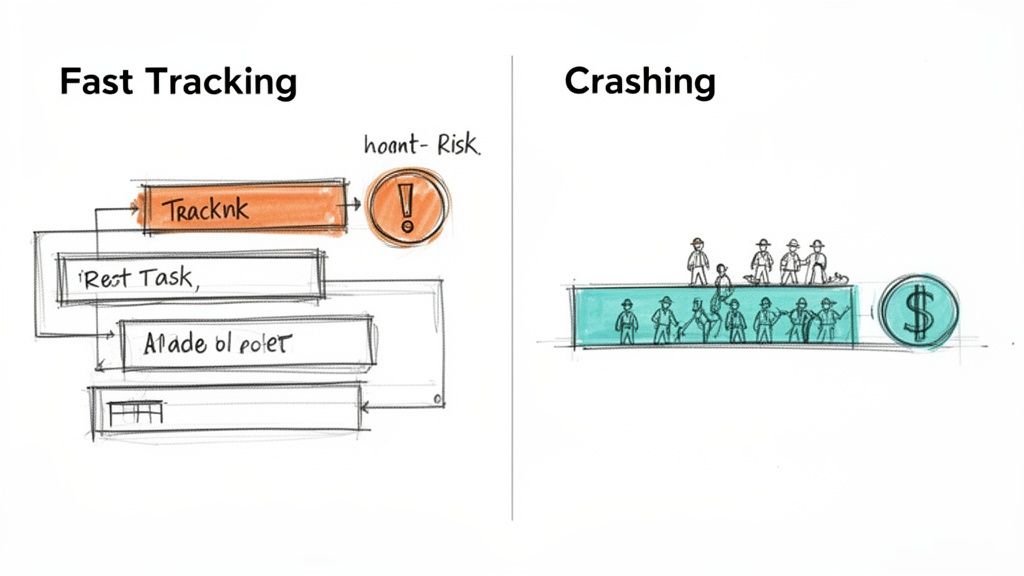
So, what's the real difference? Fast tracking is all about being clever with your schedule. You look for tasks that were originally planned to happen one after the other (sequentially) and figure out how to run them at the same time (in parallel). It doesn't cost more money upfront, but it does trade the certainty of a linear plan for a healthy dose of risk and a much bigger management headache.
Crashing, on the other hand, is the brute-force approach. You throw more resources at the problem to get it done faster. This could mean paying your team for overtime, hiring extra contractors, or bringing in more efficient machinery. Crashing is a direct trade: you spend more money to save time.
Different Philosophies in Action
Let’s use a software development project as an example.
Imagine your team is building a new app. Fast tracking would be like letting the quality assurance (QA) team start testing the login and user profile features while the development team is still busy coding the payment gateway. The work overlaps.
Crashing that same project would mean hiring two more senior developers to jump in and help the current team finish writing the code faster. More hands on deck, but a bigger payroll.
One is a strategic reshuffle; the other is a resource surge. Both can work, but they'll impact your project's health in completely different ways.
The choice between fast tracking and crashing often boils down to a simple question: Do you have more flexibility in your budget or in your workflow? Your answer will point you to the right technique.
To help you decide, it’s best to compare them side-by-side across the factors that matter most in any project.
Fast Tracking vs Crashing At a Glance
This table breaks down the core differences between the two main schedule compression techniques.
| Dimension | Fast Tracking | Crashing |
|---|---|---|
| Primary Method | Reorders tasks to run in parallel. | Adds more resources to tasks. |
| Cost Impact | Generally minimal to no direct cost increase. | Always results in a direct cost increase. |
| Risk Level | Moderate to high (rework, communication failures). | Low to moderate (quality control, new resource integration). |
| Best Scenario | When the budget is fixed, but the schedule is flexible. | When extra budget is available and tasks are resource-dependent. |
| Main Trade-Off | Trading time for increased risk and complexity. | Trading time for increased cost. |
As you can see, there's no single "best" option. It's not about which technique is superior, but which one is the right tool for the job given your project's specific constraints. Are you cash-strapped but can handle some managed chaos? Fast tracking might be your answer. Got some budget to spare and need to hit a hard deadline? Crashing is probably the way to go.
By carefully weighing these dimensions, you can make a strategic choice that gives your project the best possible chance of getting back on track without derailing it completely.
When to Use Fast Tracking and When to Avoid It
Knowing when to fast track a project is a bit like a chef deciding whether to turn up the heat. Do it at the right time with the right ingredients, and you get a perfectly cooked meal, faster. Get it wrong, and you end up with a burnt mess. This technique is a potent tool in your project management arsenal, but using it carelessly can quickly derail a project.
Fast tracking isn’t some magic bullet you can fire at any problem. It's a strategic call you make based on your project's specific situation, its constraints, and what your team can realistically handle. The big question you have to ask is: does the time I'll save outweigh the extra risk and management headaches I'm about to create? Getting a feel for the best-case scenarios and the absolute no-go situations is key to making that call with confidence.
Ideal Scenarios for Fast Tracking
Fast tracking really shines in a few specific situations. If you find your project ticking several of these boxes, it might be a perfect candidate for overlapping tasks to speed things up. Think of these as the green lights telling you the potential reward is worth the calculated risk.
Consider fast tracking when:
- You're behind schedule with a fixed budget: This is the classic scenario. The project is slipping, but there's no more money for extra resources or overtime. Fast tracking lets you claw back time on the schedule without inflating direct costs, making it the go-to move when your wallet is tied.
- Tasks have flexible dependencies: The technique is tailor-made for projects where the workflow isn't a rigid, one-after-the-other sequence. For instance, in software development, you can often kick off QA testing on one feature while the next one is still being coded. The less one task absolutely must wait for another to finish, the safer it is to overlap them.
- External pressures demand speed: Sometimes the market won't wait. If you have to launch a product to beat a competitor or hit a firm regulatory deadline, the risk of fast tracking might be the lesser of two evils. In these cases, the cost of being late is far worse than the cost of any potential rework.
- Your team is experienced and communicates well: A veteran team that already has a good rhythm is much better equipped to handle the chaos of parallel work. They know each other’s processes and can coordinate on the fly, which is absolutely critical when things get complicated.
The decision to fast track is fundamentally a trade-off. You are consciously accepting higher risk and greater management complexity in exchange for a compressed timeline. This makes it a strategic choice, not a last-ditch effort.
Red Flags When You Should Avoid Fast Tracking
Just as there are good times to hit the accelerator, there are also flashing red lights telling you to back off. Pushing ahead with fast tracking in these situations usually ends in confusion, team burnout, and expensive mistakes that can push your finish line even further out. Spotting these red flags is a crucial skill for any project manager.
Steer clear of fast tracking if:
- The critical path is rigid: Some projects just have hard-and-fast sequences. You can't start putting up the walls of a house before the concrete foundation is completely set. Trying to force an overlap here is not only impossible but will guarantee failure.
- The project is already high-risk or complex: If you're already juggling new technology, vague requirements, or a high degree of uncertainty, adding the complexity of fast tracking is like throwing gasoline on a fire. Get the project stable first before you even think about speeding it up.
- Your team is already struggling: Is communication breaking down? Is morale in the basement? If your team is already overworked and stressed, fast tracking is the last thing they need. The added pressure and need for intense coordination will likely break a team that's already on the edge.
- The cost of rework is extremely high: In some fields, mistakes aren't just costly; they're catastrophic. Think medical device manufacturing or aerospace engineering. The potential for errors introduced by fast tracking is simply too dangerous to justify the time saved.
In the end, deciding whether to fast track comes down to having a deep, honest understanding of your project's unique landscape. To get a bigger picture, you can master your project management strategy by exploring various methodologies and learning when to apply each one. By carefully weighing these green lights and red flags, you can make a smart decision that sets your project up for success, not a preventable disaster.
How to Implement Fast Tracking Successfully
Moving from theory to practice is where fast tracking really proves its worth. Pulling off this kind of schedule compression isn’t about just starting tasks earlier. It demands a disciplined, systematic approach to handle the extra complexity and risk you're taking on. Get the steps right, and you can confidently hit the accelerator on your project timeline without everything spinning out of control.
This whole process is so much more than just shuffling tasks around on a Gantt chart. It forces you to dig deep into your project's structure, get ahead of potential problems with proactive risk management, and seriously ramp up your communication. When you implement fast tracking in project management the right way, you turn what could be a high-risk gamble into a smart, calculated advantage.
Identify and Analyze the Critical Path
First things first: you have to find your project's critical path. Think of this as the longest chain of dependent tasks that dictates the absolute minimum time your project will take. If any single task on this path gets delayed, your final deadline gets pushed back. That’s why these tasks are your number one priority.
Once you’ve mapped it out, you can't just start overlapping things at random. The real trick is to closely examine the dependencies between these crucial tasks. You're looking for the "soft" dependencies, the ones based on team preference or standard procedure, not the "hard" ones that are physically impossible to change (like trying to paint the walls before the foundation is poured). It's those flexible links in the chain that give you the safest opportunities to overlap work.
This diagram breaks down a simple decision-making flow for spotting those fast tracking opportunities.
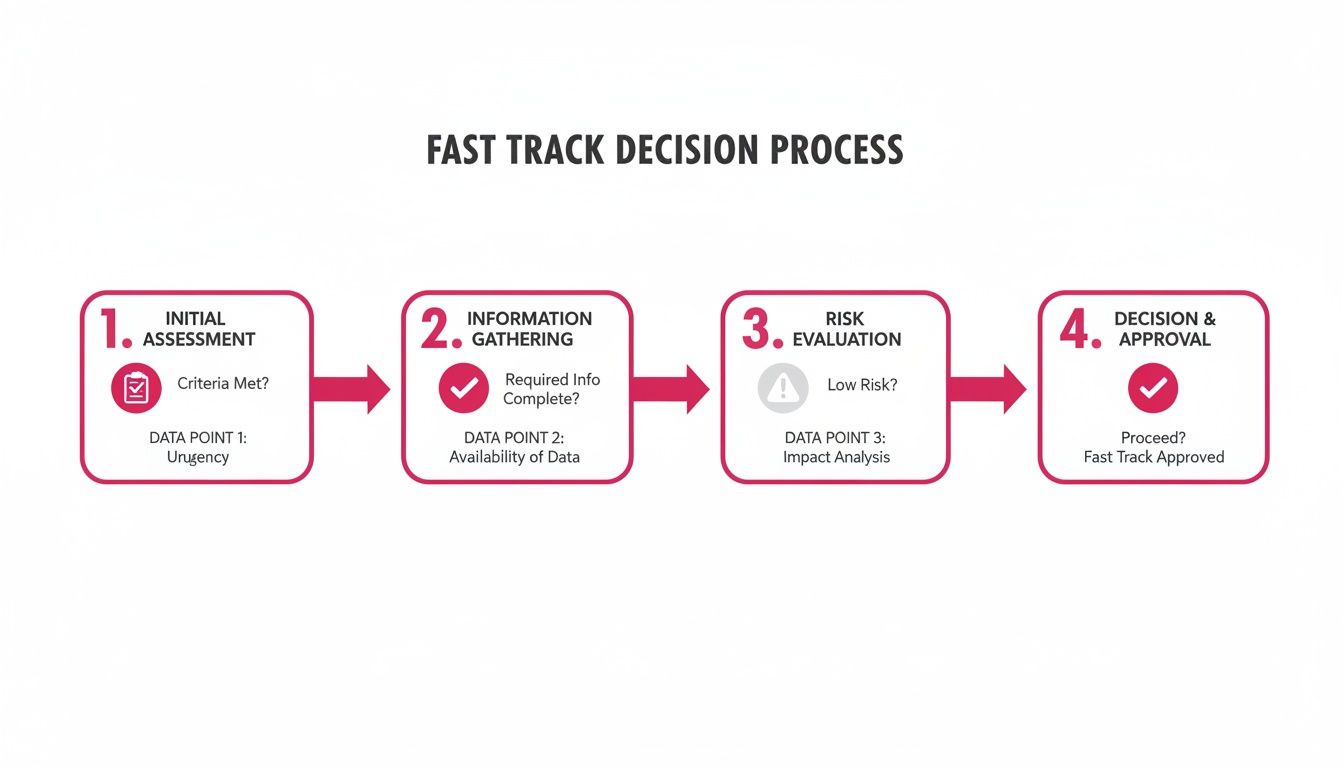
As you can see, a good decision always comes down to finding tasks with wiggle room in their dependencies and having rock-solid risk mitigation plans ready to go.
Proactively Manage Increased Risk
Let’s be clear: fast tracking automatically increases risk. When tasks that should be sequential are suddenly running in parallel, the chance of rework goes through the roof. Why? Because teams are often forced to make decisions with incomplete information. A last-minute change to a design task that’s running alongside development can trigger a cascade of expensive fixes and backtracking.
To fight this, proactive risk management isn't just a good idea; it's non-negotiable. This means you need to:
- Brainstorm what could go wrong: Get the team in a room and list every possible problem that might pop up from overlapping specific tasks.
- Create contingency plans: For every risk you identify, come up with a clear "if this, then that" response. For instance, if the final API documentation is late, the front-end team will build with mock data for two days before hitting pause.
- Assign risk owners: Every potential issue needs someone whose job it is to watch for triggers and pull the lever on the backup plan if needed.
This structured approach to risk management helps turn potential chaos into a set of manageable problems, giving your team the confidence they need to move forward at a faster clip.
Revise and Communicate the New Schedule
Okay, so you've figured out which tasks to overlap and how you'll handle the risks. Now it's time to make it official by revising the project schedule. This new plan needs to be clearly documented, showing the updated timelines, the specific task overlaps, and any adjusted milestones. This document is now the single source of truth for everyone involved.
But a new plan is totally useless if no one knows about it. During a fast-tracked project, you have to over-communicate. It’s critical that every single team member and stakeholder understands:
- The new schedule and what, exactly, has changed.
- The reasoning behind the decision to fast track.
- The urgent need for constant, clear communication and collaboration.
This level of transparency builds trust and gets everyone on board and aligned with the new, faster strategy.
Fast tracking demands a shift from periodic status updates to a continuous flow of information. The goal is to create an environment where everyone has real-time visibility into progress and roadblocks across parallel workstreams.
Embrace Asynchronous Tools for Coordination
The sheer complexity of fast tracking puts a ton of pressure on your communication channels. Just adding more meetings is never the answer, since that just creates a different kind of bottleneck. This is where modern asynchronous communication tools become absolutely essential. They are perfect for keeping multiple, parallel workstreams in sync without the constant pings and meeting alerts.
Instead of waiting for the next scheduled check-in, team members can log their progress, flag challenges, and post decisions in a shared feed or a central work log. This creates a living, searchable record of the project's journey. Now, anyone can check the status of a dependent task whenever they need to, which cuts down on all those "are you done yet?" interruptions that kill focus and productivity.
For teams already using agile methods, this approach slots in perfectly. To see how this fits into bigger planning cycles, you can read our guide on agile release planning. Using async tools helps weave scattered updates into a clear, unified story of progress, keeping everyone on the same page without the chaos.
Real World Examples of Fast Tracking
It's one thing to talk about fast tracking in theory, but seeing how it plays out in the real world is where the lessons really sink in. This isn't a strategy you apply lightly; it's a high-stakes move that can either save a project or drive it straight into the ground.
Ultimately, the line between a triumphant finish and a chaotic mess comes down to planning, execution, and communication. By looking at a couple of examples, one success and one failure, we can see what makes the difference when you start overlapping project phases.
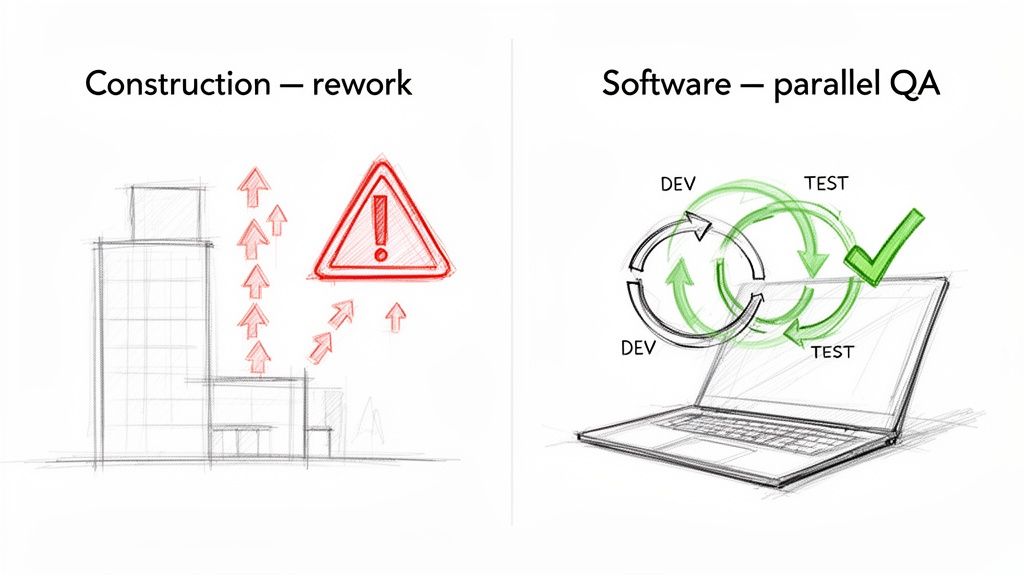
Cautionary Tale: A Construction Project in Crisis
Picture a massive construction project under intense pressure to finish ahead of schedule. The project manager makes a bold call: start building the foundation and lower levels while the architects are still finalizing the designs for the upper floors. On paper, it looks like a genius move to shave months off the timeline.
But the problems started almost immediately. The construction crew, working off preliminary drawings, had to make educated guesses about things like structural loads and where utilities would run. When the final, updated designs came in, they were significantly different. The result was a nightmare of demolition and rework.
The domino effect was brutal. Walls that were already up had to be torn down. Plumbing was rerouted. Key structural supports had to be reinforced after the fact. All this rework led to huge delays and sent the budget spiraling out of control. The two teams were working in parallel, but with no single source of truth, their promising strategy completely fell apart.
This isn't just a hypothetical. A detailed analysis of a case study from 1980 documented this exact scenario. The total project delay swelled to 324 days, a shocking 40% of the original 27-month schedule. Digging deeper, 213.5 days (or 66%) of that delay was a direct consequence of the poorly executed fast tracking.
Success Story: A Software Launch Ahead of Schedule
Now, let's flip the script. A software team is in a race to launch a new feature before a competitor beats them to it. The deadline is absolute. Instead of the old-school approach of coding the entire feature before handing it off to QA, they decide to use fast tracking in project management.
Here’s how they did it: they broke the massive feature down into smaller, independent modules. As soon as the developers finished coding the first piece, say, the user login system, they pushed it straight to the Quality Assurance (QA) team for testing. While QA was validating the login, the developers were already hard at work on the next module, like the payment gateway.
So, why did this work so well?
- Robust Automated Testing: The team had a solid suite of automated tests ready to go. This meant QA could verify each new module quickly and efficiently, allowing them to keep pace with development.
- Clear Communication: Developers and testers used a shared asynchronous work log, like WeekBlast, to stay in constant contact. If QA found a bug, the right developer was notified instantly and could jump on a fix while the code was still fresh in their mind.
- Decoupled Architecture: The software was built from the ground up to be modular. Each piece could be developed and tested on its own without breaking everything else, which was absolutely essential for running workstreams in parallel.
The software team's win highlights a core truth: fast tracking thrives when you have tight feedback loops, modular work, and crystal-clear communication. The construction project failed because it had none of those things.
These two stories show us that fast tracking is about much more than just rejiggering a schedule. It requires building a project ecosystem that can handle the intensity of parallel work. Success hinges entirely on anticipating risks, keeping communication lines wide open, and having a plan that’s built for the realities of overlapping tasks.
Common Myths About Fast Tracking Debunked
Let's be honest, the term "fast tracking" can make a lot of project managers nervous. It often brings up images of chaos, runaway costs, and panicked teams. But these fears are usually rooted in misunderstanding.
When done right, fast tracking isn't a desperate gamble; it's a calculated, strategic move. It's time to clear the air and dismantle some of the most persistent myths that keep teams from using this powerful technique.
Myth 1: Fast Tracking Always Inflates Costs
This is probably the biggest misconception out there. The fear is that if you start overlapping tasks, you're just asking for expensive rework that will blow your budget. While the risk of rework certainly goes up, fast tracking itself is meant to be a budget-neutral strategy.
The key difference here is between fast tracking and crashing. Crashing is when you throw more money at a problem, like hiring extra people or paying for overtime. Fast tracking is about rearranging the work you've already planned, using the resources you already have.
It all comes down to smart risk management. In fact, a surprising study that looked at aggressive fast tracking across 108 construction projects found something fascinating. When managed correctly, there was no significant spike in changes, delays, or costs. You can learn more about these project findings and see how real-world data pushes back against this common anxiety.
Myth 2: It's a Chaotic and Undisciplined Approach
Another common belief is that fast tracking is just a mad dash for the finish line. Nothing could be further from the truth. Pulling it off successfully actually demands more discipline, planning, and communication than a standard, linear project plan.
Think about it: a normal sequential plan has natural buffers and clean handoffs built in. When you start running tasks in parallel, those safety nets disappear.
To keep things from descending into chaos, your team has to double down on:
- Rigorous planning to figure out which tasks can safely overlap.
- Proactive risk management to have contingency plans ready before you need them.
- Constant communication to ensure everyone working in parallel stays perfectly in sync.
A well-executed fast-tracked project is a sign of a highly disciplined and coordinated team, not a desperate one. It demands a higher level of project management maturity to pull off successfully.
This structured approach is what turns potential chaos into controlled, effective acceleration. Once you grasp this, you can start to see fast tracking not as a risk, but as a valuable tool in your project management arsenal.
Frequently Asked Questions
Even when you've got the basics down, a few practical questions always pop up when it's time to actually consider fast tracking a project. Let's tackle some of the most common ones to clear up any lingering doubts before you put this technique into play.
Think of this as the final check-in, designed to firm up your understanding of the strategy's real-world quirks.
Can Fast Tracking Be Used on Any Project?
Not really. Fast tracking is a great fit for projects where tasks have "soft" dependencies, meaning you can logically overlap them without things falling apart. It's a tough sell for projects with hard, unmovable sequences. You can't start framing a house, for example, until the concrete foundation has fully cured.
It also works best with seasoned teams who are great communicators. When you're running tasks in parallel, strong communication in project management isn't just a nice-to-have; it's the glue holding the whole thing together.
Does Fast Tracking Always Increase Risk?
In short, yes. It absolutely introduces more risk, but that risk is manageable. The biggest danger is rework. When you're working in parallel, you're often forced to make decisions based on incomplete information from another task that's still in progress. A small change over there can cause a massive ripple effect, forcing your team to undo and redo their work.
The key is having a solid risk management plan from the get-go. With good contingency planning and crystal-clear communication channels, you can keep these risks in check. The idea isn't to avoid risk entirely, but to see it coming and have a plan to handle it.
The success of a fast-tracked project isn't measured by the absence of risk, but by the team's ability to manage the risks it knowingly creates. It’s a calculated trade-off of certainty for speed.
How Is Fast Tracking Different from Crashing?
This is a critical point that trips a lot of people up. Fast tracking is all about rearranging the schedule, doing things in parallel that you'd normally do one after another. You’re using the same resources, just changing the sequence. Crashing is about throwing more resources at the problem, like paying for overtime or bringing in extra people to get a task done faster without changing the order.
- Fast Tracking: You trade time for an increase in risk and coordination headaches.
- Crashing: You trade time for a direct hit to your budget.
So, the choice really boils down to what you have more of: flexibility in your budget or flexibility in your task dependencies. They’re just two different levers you can pull to shorten a project timeline.
Ready to tame the chaos of parallel workstreams? WeekBlast replaces endless status meetings and confusing email threads with a simple, asynchronous work log. Keep your fast-tracked projects perfectly in sync and give everyone the real-time visibility they need without the noise. Learn how WeekBlast brings clarity to complexity.


