A project post-mortem is simply a meeting held after a project wraps up to talk about what happened. It’s a chance for the team to look back at the entire process (the good, the bad, and the ugly) and figure out what can be learned for next time.
Why Your Post-Mortem Feels Like a Waste of Time
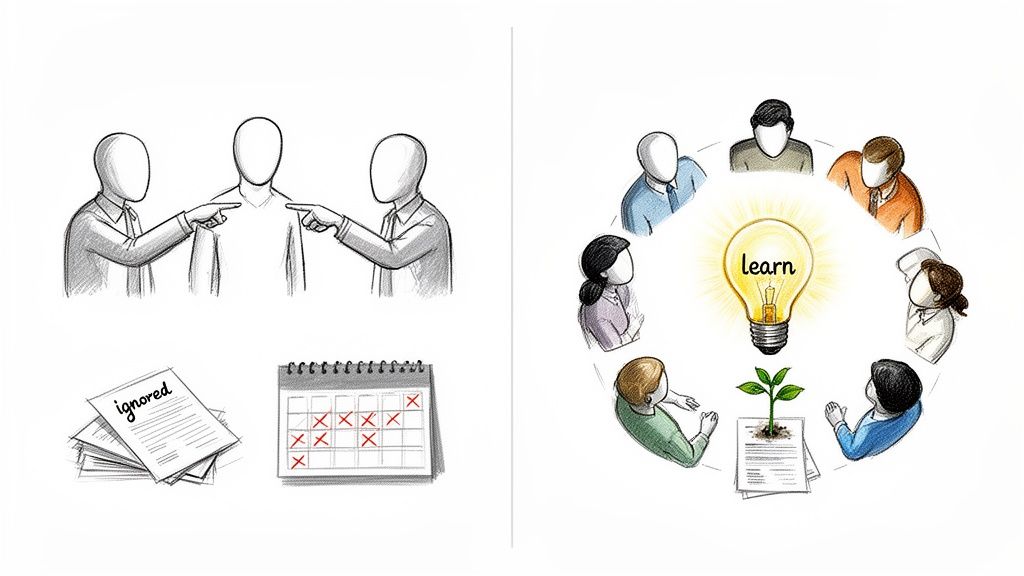
Let's be honest. Most of us dread the post-mortem invitation. It often feels like you're either walking into a blame game or you're about to spend two hours creating a report that no one will ever read again. The whole thing can feel like a box-ticking exercise, not a real opportunity to get better.
This is exactly why so many teams see post-mortems as a chore. As soon as the conversation shifts from "what happened?" to "who did this?", the walls go up. People get defensive, crucial information gets buried, and you never actually get to the root of the problem.
The Shift to Blameless Learning
A truly effective project post-mortem is built on one simple, game-changing idea: it has to be blameless. The goal isn't to pinpoint who messed up, but to understand why the mistake was possible in the first place. This subtle shift changes the entire dynamic from an interrogation to a collaborative investigation.
Think about it: a staggering 75% of projects worldwide don't quite hit their original targets. This isn't just a hunch; it's a well-documented reality across almost every industry. A well-run, blameless post-mortem can directly address this by turning those near-misses and outright failures into a playbook for future success.
Here's what that approach looks like in practice:
- Assume Positive Intent: Work from the assumption that everyone did the best job they could with the information, tools, and time they had.
- Focus on Systems, Not People: The conversation should be about the process, the communication gaps, and the tools, not about individual mistakes.
- Create a Safe Space: It's absolutely critical to build an environment where people can be honest without fearing they'll be thrown under the bus. Improving team visibility is a huge part of building this trust long-term.
From Required Meeting to Cultural Investment
When you get the blameless part right, the post-mortem stops being a dreaded meeting and starts becoming an investment in your team's growth. It’s no longer about documenting failure; it's about building a smarter, more resilient team.
The table below breaks down the key elements that make a post-mortem truly effective.
Key Elements of a Successful Post Mortem
| Principle | Why It Matters | Goal |
|---|---|---|
| Blameless Culture | Encourages honesty and prevents defensiveness. | Create a safe space for open dialogue and genuine reflection. |
| Focus on Systems | Identifies root causes within processes, not people. | Improve workflows, tools, and communication channels. |
| Actionable Outcomes | Ensures the discussion leads to tangible improvements. | Assign clear owners and deadlines for follow-up tasks. |
| Assume Good Intent | Builds trust and fosters a collaborative spirit. | Understand the context behind decisions, not just the results. |
These principles aren’t just nice-to-haves; they are the foundation of a process that delivers real value instead of just going through the motions.
A post-mortem isn't about documenting what went wrong. It's about creating a clear, actionable plan for what will go right next time, based on the hard-won lessons of the past.
Ultimately, a great post-mortem isn't about looking backward to assign blame. It's about looking forward, armed with a shared understanding of how to be better, together.
Laying the Groundwork for a Post-Mortem That Actually Works
A truly great post-mortem doesn't just happen. The value it delivers, the real, actionable insights, is a direct result of the prep work you do long before anyone even walks into the room. If you skip this part, you're setting yourself up for a session that devolves into finger-pointing, vague complaints, or worse, a complete waste of everyone's time.
The first, and maybe most critical, decision is who will lead the meeting. It's tempting to hand the reins to the project manager, but that's usually a mistake. They are simply too close to the work to be neutral. Their job in a post-mortem is to be a participant, sharing their experience, not directing the flow of the conversation.
Get the Right People (and Facilitator) in the Room
Your facilitator should be someone who can maintain a healthy distance from the project's nitty-gritty details. This neutrality is their superpower. Think about a scrum master from another team, a manager from a different department, or a dedicated program manager. Their goal is to keep the conversation on track, make sure everyone gets a chance to speak, and steer the group toward a blameless, forward-looking discussion.
Once you have a facilitator, it's time to build your guest list. This isn't about inviting the whole company. It’s about assembling a small, focused group that represents the project from all angles.
- The Core Team: These are the people who were in the trenches, the engineers, designers, marketers, and anyone else with their hands on the keyboard.
- Key Stakeholders: You need the product owner or a client rep who can speak to the original goals and whether the outcome hit the mark.
- Cross-Functional Partners: Did you work closely with support or sales? Invite one person from that team. They see the project from a completely different and valuable perspective.
I've found that a group of 5 to 10 people is the magic number. It's intimate enough for everyone to contribute meaningfully, yet large enough to give you a 360-degree view of what really happened.
Gather Your Data Before You Talk
A post-mortem based on feelings and hazy memories is doomed. To ground the conversation in reality, you need to collect hard data before the meeting. This means pulling together both the numbers and the human experience to get the full story.
Quantitative data tells you what happened. These are the cold, hard facts that are tough to argue with.
- Budget vs. Actuals: Did we spend what we thought we would?
- Timeline Adherence: How did our initial schedule stack up against reality?
- Scope Creep: How many new requests or changes piled on after kickoff?
- Key Performance Indicators (KPIs): Did we actually move the needle on the business goals we set out to achieve?
Qualitative data tells you why it happened. This is where you get the context, the nuance, and the human side of the project. The best way I’ve found to get this is through a simple, anonymous pre-meeting survey. Anonymity is non-negotiable here; it gives people the safety to be brutally honest without fear of reprisal.
Your goal with pre-meeting data is to walk into the room with a shared set of facts, not a jumble of conflicting opinions. This simple step shifts the entire tone from "arguing about what happened" to "understanding why it happened."
The survey doesn't need to be an epic questionnaire. Just a few sharp questions will do the trick.
A Few Questions I Like to Ask
- On a scale of 1-10, how would you rate this project's success? Why that number?
- What's one thing that went so well we should absolutely do it again?
- What was the single biggest pain point or roadblock you ran into?
- If we had a time machine, what’s one thing you’d tell us to do differently?
- Where did our process or communication feel broken or just plain clunky?
Build a Timeline Based on Facts, Not Memory
Let’s be honest, human memory is fickle. Trying to recall a specific decision made two months ago during a stressful launch is a recipe for disaster. So, instead of relying on memory, reconstruct the project's history using the artifacts created along the way.
This is where having a tool that keeps a running log of progress is a lifesaver. For example, if your team uses a weekly check-in tool like WeekBlast, you have an unbiased, week-by-week record of the entire project. You can scroll back through those updates to build a factual timeline of key milestones, unexpected hurdles, and critical decisions as they actually occurred.
This data-driven approach stops the meeting from getting bogged down in "he said, she said" debates. It allows the team to skip the drama and get right to the important work: learning.
Running a Blameless Post Mortem Meeting
Once you’ve done the prep work, the real magic of the post mortem project happens in the meeting itself. Facilitating this session is a delicate art. Your job is to steer a conversation that unearths real, actionable insights without letting it dissolve into a blame game.
A solid agenda and a genuine commitment to psychological safety are your best tools.
The entire meeting stands or falls on your ability to create a blameless environment from the very first minute. You set the tone. One of the most powerful ways to do this is to kick things off with what’s known as the "prime directive" of retrospectives. It’s a simple statement that frames the entire discussion perfectly.
"Regardless of what we discover, we understand and truly believe that everyone did the best job they could, given what they knew at the time, their skills and abilities, the resources available, and the situation at hand."
Reading this out loud immediately shifts the focus from individual performance to the system, the processes, the context, the environment. It gives everyone in the room permission to speak openly about what really happened, free from the fear of being singled out. That’s the foundation of a productive meeting.
A Structured Agenda for a Productive Conversation
A clear agenda isn't just about bureaucracy; it's about respect for everyone's time. It keeps the conversation on track and ensures you cover all the critical ground. Without a structure, it’s easy for discussions to wander, for the loudest voices to dominate, and to run out of time before you get to the most important part: the action items.
Here’s a sample agenda I’ve used for a 90-minute session that you can adapt:
- Welcome & Prime Directive (5 minutes): The facilitator sets the stage, walks through the agenda, and reads the prime directive aloud. This reinforces the "blameless" rule right from the start.
- Timeline Review (15 minutes): Present the objective, fact-based timeline you put together during your prep. This isn't a debate; it's about getting everyone on the same page about the sequence of events.
- What Went Well? (15 minutes): Always start with the positives. This isn't just about morale. It’s a strategic move to identify successful patterns and behaviors you absolutely want to repeat.
- Areas for Improvement (30 minutes): This is the heart of the meeting. Use the data from your pre-meeting survey to kick off the discussion about the challenges, friction points, and roadblocks.
- Generate Action Items (20 minutes): Now, turn all that great discussion into a concrete plan. Every significant issue you uncovered should have a clear action item and an owner assigned to it.
- Closing (5 minutes): Wrap things up by summarizing the key takeaways and the assigned actions. Thank everyone for their honesty and set clear expectations for what happens next.
This flow illustrates how the prep work feeds directly into the meeting, ensuring you walk in armed with the right data and the right people.
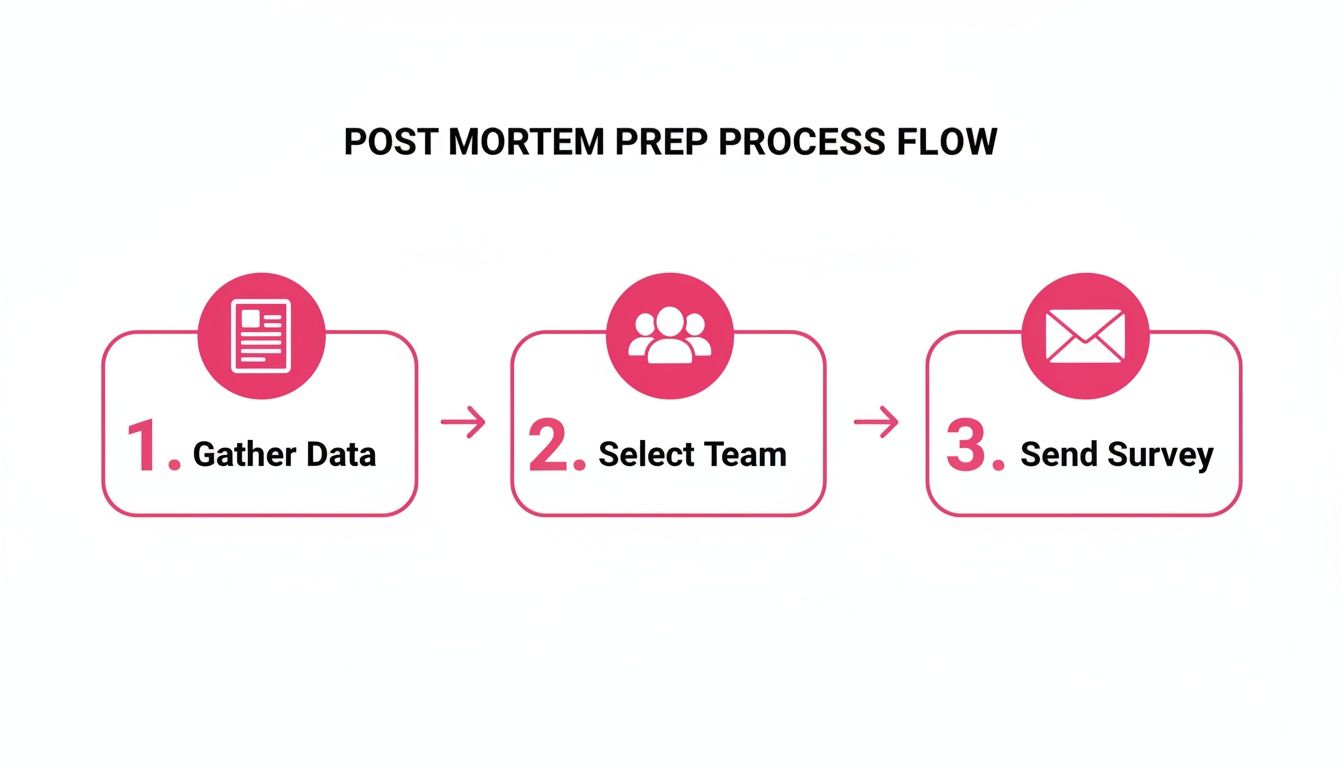
As you can see, a successful meeting doesn't happen by accident. It's built on a foundation of careful data gathering, thoughtful team selection, and getting feedback before everyone walks into the room.
Uncovering Root Causes, Not Just Symptoms
During the "Areas for Improvement" part of the agenda, your most important tool is curiosity. The goal here is to get past the surface-level symptoms to find the real root causes. A classic mistake is stopping the investigation too soon. For example, if a key feature shipped late, it’s tempting to stop at "the developers missed the deadline." A true blameless post-mortem demands you dig deeper.
This is where a technique like the "5 Whys" is invaluable. It’s a simple but incredibly effective way to peel back the layers of an issue. Instead of asking questions that sound like accusations, you frame them to be about the process.
So, instead of asking, "Why was this late?" you might ask:
- "What conditions caused the timeline to shift for this feature?" (Answer: We ran into a lot of unexpected technical debt.)
- "Why wasn't this technical debt on our radar earlier?" (Answer: There wasn't a formal code review process for that part of the codebase.)
- "Why didn't we have a code review process for it?" (Answer: In the early days, we prioritized shipping speed over process.)
- "Why was speed the main priority back then?" (Answer: The business pressure to hit an aggressive launch date was the number one driver.)
- "Why did that business pressure override our technical best practices?" (Answer: Our project planning process doesn't do a good job of accounting for the long-term cost of tech debt.)
And just like that, a problem that looked like an individual or team failure is revealed to be a systemic issue in how you plan projects. This is the kind of insight that leads to real, lasting change. It's about fixing the process, not blaming the people. For more ideas on running great meetings, our guide on how to structure an all-employee meeting has some useful tips.
Navigating Difficult Conversations with Empathy
Even in the best-run, blameless environments, these conversations can get tricky. People are invested in their work, and when a project has rough spots, emotions can run high. As the facilitator, your role is to be the calm, neutral guide in the room.
Here are a few things I've learned for managing the human side of the post-mortem:
- Validate Feelings: If someone expresses frustration, acknowledge it. A simple, "I can absolutely see why that was frustrating for you," can de-escalate tension and makes people feel heard.
- Reframe Blaming Language: If you hear something like, "John's team just dropped the ball," gently redirect the conversation. You could say, "Let's dig into the handover process between those teams. What could we do to make that connection smoother next time?"
- Make Sure Everyone Contributes: Keep an eye out for quieter folks. Directly and kindly invite them to share their perspective. "Sarah, from where you sat on the design team, what was the impact of this issue on your work?"
- Use a "Parking Lot": If a topic comes up that’s important but is taking you off-agenda, don't shut it down. Acknowledge it and put it in a "parking lot" (just a spot on the whiteboard) to address later. This validates the point while keeping the meeting on track.
By blending a tight agenda with empathetic facilitation, you can turn the post mortem project meeting from something people dread into one of your most powerful tools for continuous improvement.
Asking Questions That Uncover Real Insights
The whole point of a post-mortem can be won or lost based on the quality of your questions. Toss out a generic prompt like "What went wrong?" and you'll get vague, defensive answers that don't lead anywhere. A post-mortem that actually sparks change relies on asking the right questions.
Think of it this way: great questions are surgical. They aren't a sledgehammer. They help the team carefully dissect a project to find the hidden assumptions, busted processes, and communication breakdowns that really drove the outcome. This is how you stop talking about symptoms and start fixing root causes.
Questions for Planning and Scoping
So much of a project’s fate is sealed in the very beginning. A flawed plan or a fuzzy scope creates problems that can lie dormant for weeks, only to explode later. These questions are designed to put that critical starting point under the microscope.
- How well did the initial project brief actually map to the work we ended up doing?
- Were our original goals and success metrics crystal clear, or were they a bit hazy and open to interpretation?
- Let’s be honest: Did we nail the estimate for time and resources? If not, where did our forecast go sideways?
- Who were the key stakeholders we probably should have talked to at kickoff but didn't?
- What were the big assumptions we made at the start that turned out to be completely wrong?
A single, well-phrased question can unlock a systemic issue. Asking, "What assumptions did we make?" is worlds more powerful than, "Why was this late?" The first encourages reflection on the process; the second just puts people on the defensive.
Questions for Process and Execution
Once the project is rolling, it's all about the day-to-day grind, the workflows, the tools, the communication. This is where you find the friction that slows things down and burns people out. Your job here is to pinpoint those bottlenecks and clumsy handoffs.
- Where did our workflow feel slick and easy? And where did it feel like wading through mud?
- Did our tools actually help us, or did they just get in the way? Any tasks that felt way harder than they should have been because of the software?
- Pinpoint the moment the actual timeline started drifting from the planned one. What was going on right then?
- How did we handle curveballs and scope changes? Was our process for that smooth or chaotic?
- When you needed information, was it easy to find, or did you have to go on a digital scavenger hunt every time?
Questions for Team Collaboration
At the end of the day, projects are run by people. The way a team talks, handles disagreements, and has each other’s backs is a huge piece of the puzzle. These questions are meant to open up a safe discussion about the human dynamics that were at play.
- When did we feel like a truly cohesive unit? And when did it feel like we were all working on different planets?
- Was there a time you needed help but didn't feel comfortable asking? What was that situation like?
- How would you rate the quality of the feedback we gave each other on this project?
- Did everyone feel like they had a real voice when important decisions were being made?
- What’s one conversation we should have had but didn’t?
Don’t Forget to Dissect Your Wins
A post-mortem project isn't just for autopsies on failed initiatives. It’s just as crucial, maybe even more so, to figure out why your big successes worked so well. If you can’t pinpoint what made a project a smashing success, you can’t replicate it. You’re just hoping lightning strikes twice.
When a project goes right, you just flip the script on your questions. Instead of "where can we improve?", you're digging into "what was the magic ingredient here?". It's about finding out what made that collaboration so seamless or those goals so clear. For example, a post-mortem on a hit project might reveal that a specific communication plan cut down on last-minute surprises by 70%. That’s a golden nugget you want to capture for the next project. You can learn more about the factors that drive project success rates with effective management.
Here’s what to ask when you knock one out of the park:
- What was the single biggest thing that made this project a success?
- Which part of our process felt supercharged and let us move faster than we expected?
- What did we do differently with our team communication this time around?
- Was there a specific decision or moment that you see as the turning point for the better?
- If we could bottle up one element from this project to use on every project from now on, what would it be?
Turning Your Findings Into Lasting Change
A fantastic post-mortem meeting can feel like a huge win, but let's be honest, the real victory comes later. All those brilliant insights are completely useless until someone acts on them. This is where so many teams drop the ball, and it’s what separates a true learning culture from one that just goes through the motions.
Without a solid system for follow-through, your post-mortem report becomes just another file collecting digital dust in a shared drive. The whole point is to turn those great conversations into documented, assigned, and tracked actions that genuinely improve how your team works.
From Insights to Action Items
First things first: you need to translate your findings into specific tasks. Vague goals like "improve communication" are a recipe for inaction because nobody knows where to start. A real action item has to be concrete, measurable, and have a single person's name attached to it.
For instance, if the team flagged scope creep as a major issue, a weak takeaway is "manage scope better." A strong action item sounds like this: "Draft a formal change request process document and share it with the team for feedback." See the difference? We went from a general complaint to a specific, achievable task.
The most common failure point of any post-mortem project isn't a lack of good ideas; it's a lack of clear ownership. Every single action item must have one person's name next to it.
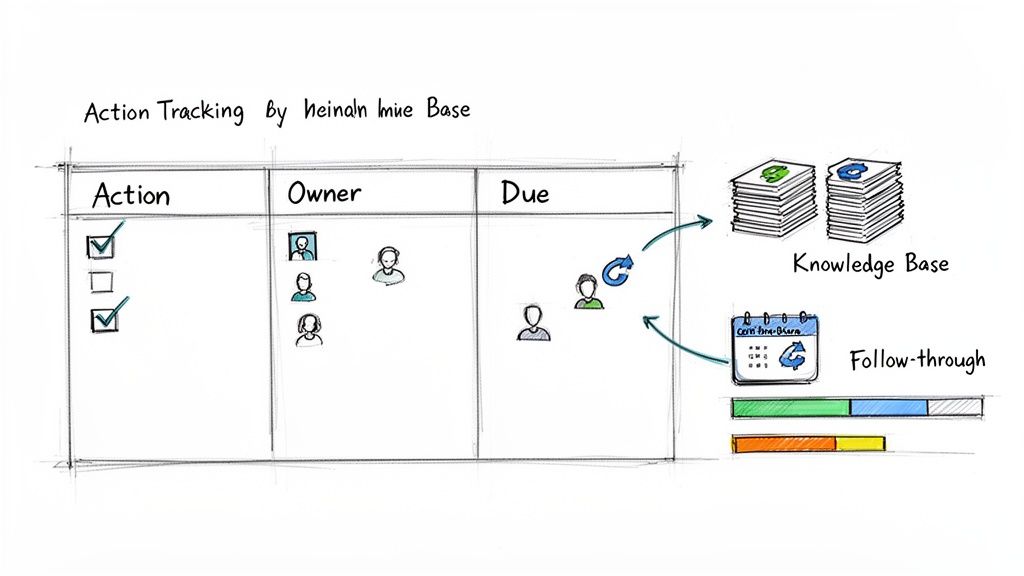
To keep everything organized, a simple tracking template is your best friend. It creates instant accountability and makes it dead simple to see what needs doing, who's on the hook, and when it’s due.
A simple tracker is all you need to get started. It forces clarity and ensures that good ideas don't get lost in the shuffle after the meeting ends.
Post Mortem Action Item Tracker
| Action Item | Identified Issue | Owner | Due Date | Status |
|---|---|---|---|---|
| Create a shared calendar for all team deadlines. | Key dates were missed due to poor visibility. | Maria Garcia | June 15 | In Progress |
| Research and propose a new design handoff tool. | Friction between design and development teams. | David Chen | June 30 | Not Started |
| Add a "technical debt" review to our sprint planning. | Unexpected bugs delayed the final feature release. | Aisha Khan | June 10 | Completed |
| Update the client onboarding checklist. | Client expectations were not properly set at kickoff. | Sam Jones | June 20 | In Progress |
This structure provides a single source of truth that the team can always reference to see what progress we're making on the lessons we learned the hard way.
Integrating Actions into Your Workflow
Okay, so you have a list of action items. That's a great start, but it's still just a list. To make sure these tasks don't get pushed aside, you have to weave them directly into your team’s existing workflow. Don't invent a whole new process just for post-mortem follow-ups.
Instead, treat these action items like any other piece of work:
- Put them in your project management tool. Create tickets in Jira, Asana, or whatever you use. Assign them, set deadlines, and link back to the post-mortem doc for context.
- Talk about them in regular meetings. Take five minutes in your weekly sync or stand-up to review the status of open action items. This keeps them top-of-mind and maintains momentum.
- Time-box the work. Encourage owners to block off time on their calendars to actually work on these improvement tasks.
This approach makes getting better a normal part of the job. It sends a powerful message that continuous improvement isn't some extra chore, it's a core part of what you do. To formalize these improvements even further, check out our guide on what is process management.
Building an Organizational Knowledge Base
The final piece of the puzzle is sharing what you've learned outside your immediate team. It’s a huge waste when one team figures something out and that knowledge never leaves the room. Your goal should be to build an organizational memory.
Create a central, searchable spot where all post-mortem reports live. This could be a folder in a shared drive, a dedicated space in your company wiki, or even a specific channel in Slack. The key is to make it a habit: when a new project kicks off, part of the planning should be to review findings from similar past projects.
This simple step helps the entire organization learn from itself, transforming each post-mortem project from an isolated event into a lesson for the whole company.
Answering the Tough Questions About Post-Mortems
Look, even with the best intentions, you’re going to get pushback when you roll out a formal post-mortem process. It’s natural for people to be skeptical. The key is to have thoughtful, direct answers ready. This isn’t just about getting another meeting on the calendar; it’s about proving this is a powerful tool for getting better.
It's a surprisingly common struggle. In the IT world, a staggering 20% of companies don't do post-mortems at all, and over 50% only bother with them for less than half their projects. It's no wonder so many projects stumble over the same preventable hurdles. You can find more data on why IT projects often fail without these learning loops over on pmi.org.
Let's dive into the questions you're almost guaranteed to hear.
How Do We Justify the Time Investment to Leadership?
This is the big one, and it's a completely fair question. The trick is to stop talking about it as a cost and start framing it as an investment with a tangible return.
You have to connect the dots for them. Explain how a couple of hours spent in a post-mortem can save hundreds of hours down the road by making sure the team doesn't repeat the same expensive mistakes. If you have a real-world example, use it. Something like, "Remember Project X? We burned 50 extra hours fixing that deployment issue. The two-hour post-mortem we ran afterward means we'll never make that same mistake and lose those 50 hours again."
The time spent in a post-mortem isn't a loss of productivity. It's a direct investment in future productivity, efficiency, and team morale.
Don't be afraid to point out the cost of not doing them, either. Without a structured way to learn, the same problems will just keep popping up, slowly draining budgets, pushing back deadlines, and chipping away at your clients' trust.
What If No One Wants to Participate?
If you're getting radio silence or seeing a lot of crossed arms, that’s usually a red flag for a bigger issue: a lack of psychological safety. Team members won't speak up if they think the post-mortem is just a meeting to point fingers. They’ll either stay quiet or not show up at all.
Your job is to be the champion of a blameless culture. It has to be non-negotiable.
- Kick off with the Prime Directive. I mean it, say it out loud at the start of every single meeting: "Regardless of what we discover, we understand and truly believe that everyone did the best job they could, given what they knew at the time, their skills and abilities, the resources available, and the situation at hand."
- Lead by example. If you led the project, be the first one to admit where you messed up and what you learned. Vulnerability from leadership is contagious.
- Keep the focus on the process, not the person. If a conversation starts to drift toward blaming an individual, gently steer it back. Ask, "What in our process allowed this to happen?" or "How could our workflow have caught this earlier?"
Once people genuinely feel safe and see that the goal is to improve, not to punish, they'll start to open up. Participation will follow trust.
Ready to build a factual, unbiased project timeline for your next post-mortem? With WeekBlast, you get a permanent, searchable archive of every update. Stop relying on memory and start your meetings with a clear, data-driven narrative of what really happened. Explore how WeekBlast can improve your project reviews.


