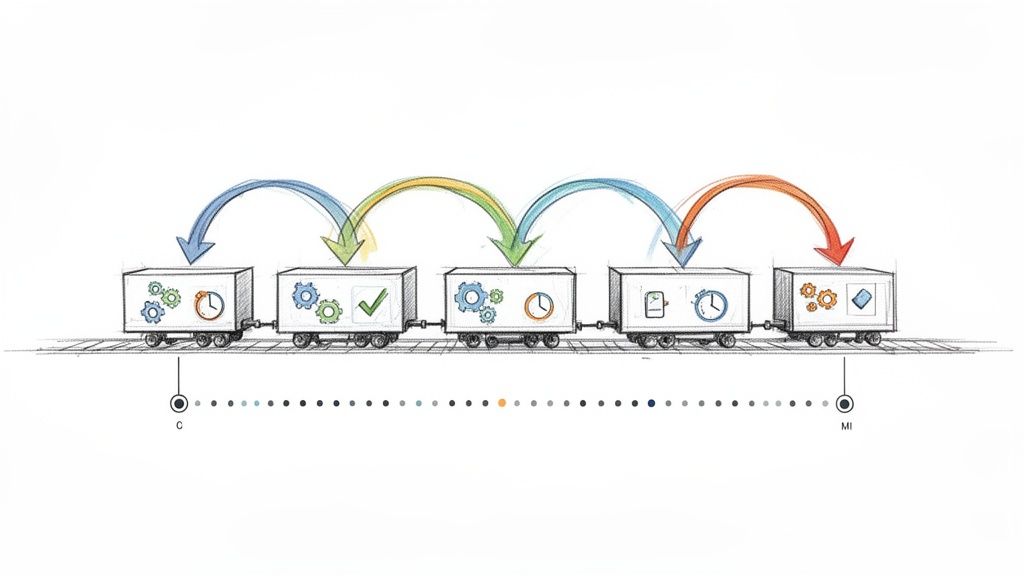
Agile release planning is how you map out a series of smaller, incremental product updates instead of betting everything on a single, massive launch. It's the practical bridge between a high-level product vision and a realistic delivery schedule, making sure your team ships value to users faster and more predictably. At its core, this approach is all about being able to adapt based on what you learn from the real world.
Moving Beyond Rigid Traditional Roadmaps
Let's be real, the old-school, year-long, static roadmap rarely survives the first quarter. I've seen countless teams pour weeks into crafting a beautiful plan, only to watch it become obsolete after one unexpected market shift or a crucial customer request. That rigid approach promises predictability, but what it often delivers are delays and features that miss the mark.
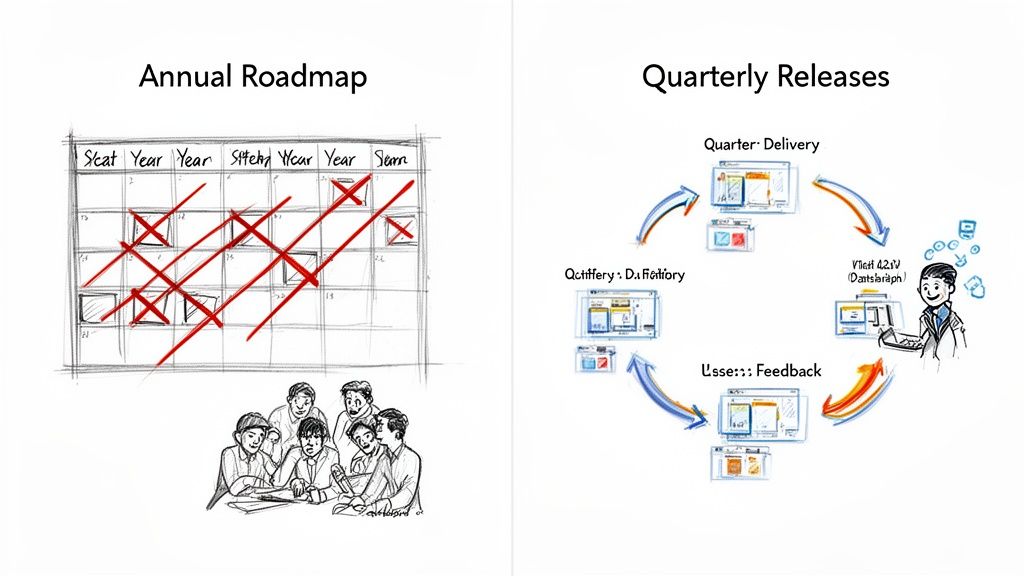
Traditional planning treats a project like building a bridge: every single detail has to be defined upfront, and any change is a crisis. The problem? Software isn't a bridge. It’s a living, breathing solution in a market that never sits still. When you lock into a year-long plan, you’re basically forcing your team to ignore valuable new information and stick to assumptions that are likely already outdated.
This is where agile release planning comes in with a completely different mindset. Instead of one huge, high-stakes launch, it breaks the work down into smaller, manageable, and valuable increments. This iterative model doesn't just tolerate change; it treats it as a competitive advantage.
The Power of Iterative Delivery
Think about a team that consistently misses deadlines on its big annual plan. Morale is in the gutter, stakeholders are losing patience, and the product always seems to be a step behind what users actually need. It’s a frustrating cycle.
Now, imagine that same team switches to quarterly agile release planning.
Suddenly, their focus shifts from a distant, almost mythical finish line to a series of achievable milestones. Every few months, they ship a tangible piece of value to their users. This simple change unlocks some powerful benefits almost immediately:
- Faster Feedback Loops: Real users get their hands on new features much sooner, giving you invaluable feedback that shapes the very next planning cycle.
- Reduced Risk: By releasing in smaller batches, you limit the blast radius of any single failure. Bugs are easier to catch and fix, and you can kill a bad idea before you've sunk a massive investment into it.
- Improved Team Morale: There’s nothing more motivating than shipping working software. It builds momentum and a genuine sense of accomplishment, which is something a perpetually-red Gantt chart can never do.
This isn't just a feel-good theory; the numbers back it up.
Agile methodologies have a massive impact on project outcomes. Teams using agile see a 75% success rate, a huge leap from the 56% success rate for traditional project management.
This effectiveness has fueled a massive industry-wide shift. While only 37% of software teams were using agile in 2020, that number shot up to 86% by 2021. Today, an overwhelming 97% of organizations use agile practices in some form. You can dig into more of these agile statistics to see the full story.
Why Agile Release Planning Works in the Real World
The real strength of agile release planning is its pragmatism. It starts with the honest admission that we can't possibly know everything at the beginning of a project. Instead of pretending we do, it creates a framework for learning and adapting as we go.
I like to think of it as navigating a ship. A traditional plan is like setting a single, unchangeable course from New York to London and just hoping for clear skies. An agile release plan is like having the same destination but using a modern GPS, real-time weather reports, and satellite data to adjust your route. You might swerve to avoid a storm or jump on a newly discovered current, but you're always making intelligent moves toward your goal.
This method allows your team to pivot based on what actually matters: customer feedback, competitor moves, and new business opportunities. It’s a strategic approach that aligns the work your team is doing directly with delivering tangible value, making it a cornerstone for any high-performing product organization.
2. From Business Vision to Release Goals
A release plan that isn't tied to a clear purpose is just a wish list of features. To make your agile release planning truly matter, you have to draw a straight line from the company's big-picture goals right down to the user stories in your team's backlog.
This isn't about fluffy mission statements. It's about giving the entire release a clear "why." When the development team understands they aren't just building a "new dashboard widget" but are actually "slashing customer confusion during onboarding," their whole perspective shifts. It turns them from ticket-takers into genuine problem-solvers who care about the outcome.
Turning Ambition into Action with OKRs
A fantastic framework for making this connection is Objectives and Key Results (OKRs). OKRs give you a simple, no-nonsense way to translate broad company ambitions into measurable targets for your release.
- Objective: Think of this as the inspirational, qualitative goal. It answers, "What are we really trying to do here?" It should be ambitious enough to be motivating.
- Key Results: These are the hard numbers that prove you actually hit your objective. They answer, "How will we know we pulled it off?" They need to be specific, measurable, and tied to a timeframe.
When you set OKRs for a release, everyone suddenly has the same definition of success. The focus shifts from simply shipping code (output) to delivering a real business impact (outcome). If your team is just getting started with this mindset, understanding the basics of the new product development process can provide some solid grounding for setting these goals.
Let's look at how this plays out in the real world.
A Practical Example: Slashing Early Customer Churn
Picture this: a B2B SaaS company is bleeding customers. Their big-picture vision is to become an indispensable tool, but the reality is that a worrying number of new users are bailing within their first 90 days.
Leadership sets a company-wide objective for the quarter.
Company Objective: Significantly improve the new user experience to increase customer loyalty.
That’s a good start, but it's way too fuzzy for a product team to execute on. This is where the Product Owner steps in during release planning to translate that vision into a concrete goal using OKRs.
Release Objective: Make it painfully easy for new users to find value in their first week.
Now, how will they measure that? They define the key results.
Key Results:
- Boost the new user activation rate by 15%.
- Cut support tickets from users in their first 30 days by 25%.
- Drop customer churn in the first quarter by 5%.
Boom. The team now has a clear, measurable mission. This isn't just about building stuff anymore; it's about moving specific numbers. Every single feature idea can now be held up against a simple test: "Will this help us hit one of our key results?"
Scoping the Release Backlog
With these crystal-clear goals, prioritizing the backlog suddenly becomes a whole lot easier. The team can now pinpoint the epics and user stories that will deliver the biggest bang for the buck against their KRs.
The conversation shifts from a chaotic debate over the "coolest" features to a strategic discussion. The team might quickly agree that a guided onboarding tour, better in-app tutorials, and a proactive chat support feature are the highest-impact items to tackle first.
The table below shows how this creates a perfect line of sight from the C-suite's objective all the way down to the code being written.
Connecting Business Goals to Your Release Scope
| Business Objective | Release Goal (Key Result) | Scoped Features (User Stories) |
|---|---|---|
| Improve customer loyalty | Increase user activation by 15% | As a new user, I want a step-by-step product tour so I can learn the core features quickly. |
| Reduce support costs | Decrease support tickets by 25% | As a new user, I want access to context-sensitive help articles so I can solve problems myself. |
| Stabilize revenue | Reduce Q1 churn by 5% | As a trial user, I want to receive proactive tips via email so I can discover advanced functionality. |
This structured approach guarantees that every sprint and every feature directly contributes to a meaningful business outcome. It gets everyone, from executives to engineers, rowing in the same direction, turning your release plan from a simple document into a powerful strategic weapon.
2. Finding Your Rhythm: Cadence and Prioritization
With your release goals locked in, it's time to figure out the tempo. Your release cadence is the heartbeat of your development cycle, that steady, predictable rhythm for shipping value to customers. Finding the right cadence isn't about blindly following a "best practice." It's about discovering a pace that works for your team, your product, and your market.
Some teams absolutely crush it with a fast-and-furious two-week cycle. This is perfect when you're in a competitive space and need to get feedback, iterate, and adapt on the fly. On the other hand, bigger organizations or teams wrestling with gnarly, complex systems often find a quarterly cadence (sometimes called a Program Increment or PI) makes more sense. That longer runway gives them the space they need to coordinate across multiple teams and tackle bigger, meatier features.
There's no one-size-fits-all answer. A startup launching a new app might push updates weekly to stay ahead of the curve. An enterprise firm managing a complex trading platform might settle on a six-week cycle to accommodate exhaustive testing and compliance hurdles. The goal is to find a sustainable rhythm that delivers meaningful value without burning everyone out.
Making the Hard Calls on What to Build
Okay, you've got your cadence. Now for the tough part: deciding what actually makes it into the release. Your backlog is probably overflowing with fantastic ideas, but you can't build them all at once. This is where prioritization becomes your most valuable skill.
You need a way to cut through the noise and focus your team’s energy on what will make the biggest impact. Two of my go-to techniques for this are User Story Mapping and the MoSCoW method. They bring much-needed structure to the often-messy process of scoping.
- User Story Mapping: This is a fantastic visual exercise. You get the team together and literally map out the entire user's journey, from their first click to their final goal. It gives everyone a bird's-eye view and makes it crystal clear what the essential, non-negotiable steps are.
- The MoSCoW Method: This is a simple but powerful framework for bucketing features into four categories: Must-Have, Should-Have, Could-Have, and Won't-Have (for this release). It forces you to have honest, decisive conversations about what's truly necessary.
The point of prioritization isn’t to see how many features you can cram into a release. It's about shipping the smallest possible thing that delivers the maximum value and helps you hit your goals.
These techniques transform scope discussions from a battle of opinions into a data-driven conversation about value. And to make them even more effective, you need solid user stories. If you need a refresher, check out this excellent user story template and examples.
Let's See It in Action
Imagine you're a product manager tasked with building a new "Project Dashboard" for your B2B software. The brainstorming session was a huge success, generating dozens of ideas from custom widgets to fancy reporting exports. The problem? The full vision is way too big for a single quarter.
Instead of just cherry-picking features, you get the team in a room for a user story mapping session. Using a digital whiteboard, you map out the user's core journey: Log In → Create a Project → Add Tasks → Assign Teammates → View Progress.
Under each of those big steps, you start slotting in the specific user stories. Almost immediately, the "walking skeleton" of the feature becomes obvious, the absolute bare minimum required for the dashboard to be useful. Everything else can wait.
With that core journey defined, you then apply the MoSCoW method to get even more specific about this first release:
- Must-Have: View a list of my projects. See a basic "tasks complete" status.
- Should-Have: Filter projects by team. See a simple burndown chart.
- Could-Have: Add our company logo to the dashboard.
- Won't-Have (this time): Export reports to PDF. Integrate with Google Calendar.
What have you accomplished? You’ve successfully sliced a massive, intimidating epic into a tangible, valuable first release that’s laser-focused on the user’s primary goal. The team now has a clear, realistic scope and a shared understanding of not just what they're building, but why.
3. Map Dependencies Before They Become Blockers
Once you've got a prioritized backlog, the game shifts from high-level strategy to the realities of execution. This is where the nitty-gritty details of agile release planning can make or break your release. It all kicks off with solid iteration planning, where you pull the most important work into upcoming sprints. But the real secret sauce? Proactively hunting down and managing dependencies.
Too many teams work in their own little worlds, only to discover a critical blocker the day before a feature is supposed to go live. That discovery triggers a frantic scramble, creating stress, delays, and a whole lot of friction between teams. The goal is to make cross-team coordination a natural, upfront part of the process, not a last-minute fire drill.
This visual map shows how different agile practices, like User Story Mapping and the MoSCoW method, all feed into building a reliable release cadence, which is the foundation for managing dependencies effectively.
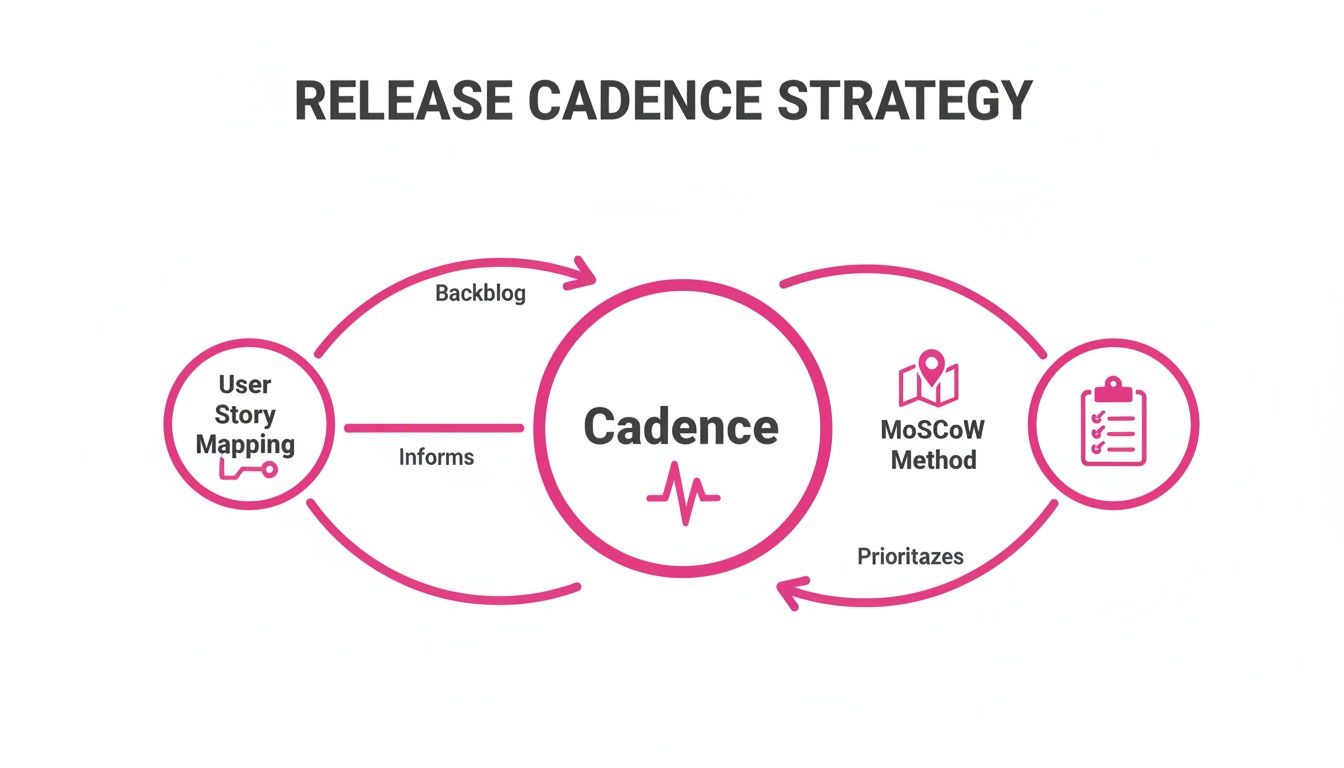
As the diagram shows, a predictable rhythm is born from structured prioritization and a deep understanding of the user's journey. With that in place, you can finally get a handle on how all the work connects.
Run Iteration Meetings That Actually Work
Let's be honest, iteration planning meetings can feel like a chore. They shouldn't. A good one is a focused, energetic session that gets the team aligned and ready for the sprint. The Product Owner brings the highest-priority stories to the table, and the team digs in, collaboratively figuring out what it will really take to get them to "done."
The key here is to move beyond just passively accepting tickets. The team needs to ask the hard questions, break big stories into smaller, manageable tasks, and collectively commit to a realistic sprint goal. This shared ownership is what transforms a simple to-do list into a cohesive mission. A great meeting ends with everyone walking out clear and confident about what they need to accomplish over the next couple of weeks.
But even a perfectly planned sprint can get knocked off course by outside forces. That’s why dependency mapping isn't a "nice-to-have," it’s a core responsibility.
Visualize How the Work Connects
Think of dependencies as the invisible threads connecting the work of different teams. When you’re building anything significant, it's rare that one team has everything it needs. The front-end team is waiting on an API from the back-end team, who in turn needs the platform team to spin up some new infrastructure. Sound familiar?
Leaving these connections to chance is a recipe for disaster. You have to make them visible to everyone. Two incredibly effective (and surprisingly simple) tools for this are the dependency matrix and the program board.
- Dependency Matrix: This is just a simple grid that maps teams against each other. In each intersecting cell, you note any dependencies between the two teams. It gives you a quick, at-a-glance view of potential hotspots.
- Program Board: A staple of the Scaled Agile Framework (SAFe), this is a much more visual tool. It lays out the features planned for a release and uses lines, often literal colored string on a physical board, to connect dependent items between teams.
Proactively mapping dependencies shifts the conversation from "We're blocked!" to "Here's what we need to coordinate." It turns a reactive problem into a proactive planning exercise.
A Real-World Dependency Scenario
Let’s say three teams are working together on a new mobile feature that lets users upload a profile picture.
- The Mobile Team is building the UI for iOS and Android.
- The Back-End Team is creating the API endpoint to handle the image.
- The Platform Team needs to set up the cloud storage (like Amazon S3) where the images will actually be stored.
During a joint planning session, they sketch this out on a program board and the connections immediately jump out.
- The Mobile Team can't finish their upload feature until the Back-End Team delivers a stable API.
- The Back-End Team can't even start the API until the Platform Team gives them the credentials and configuration for the S3 bucket.
By making this visible, they create a clear, logical sequence of events. The Platform Team commits to having the S3 setup done in Sprint 1. This unlocks the Back-End Team to deliver the API in Sprint 2. Now, the Mobile Team knows they can safely plan their integration work for Sprint 3.
Without this simple mapping exercise, the Mobile Team might have started their work in Sprint 1, only to find themselves sitting on their hands for weeks, waiting for the other pieces to fall into place. By making dependencies explicit, these teams turned potential chaos into a coordinated, predictable plan.
Keeping Everyone Aligned on the Release Plan
A brilliant release plan is completely worthless if it’s gathering dust in a spreadsheet no one ever reads. Let's be honest, the best plans are living things, built on a foundation of clear and consistent communication. Without that, you get crossed wires, last-minute surprises, and stakeholders popping up to ask the dreaded, "So... what's the status of that feature?"
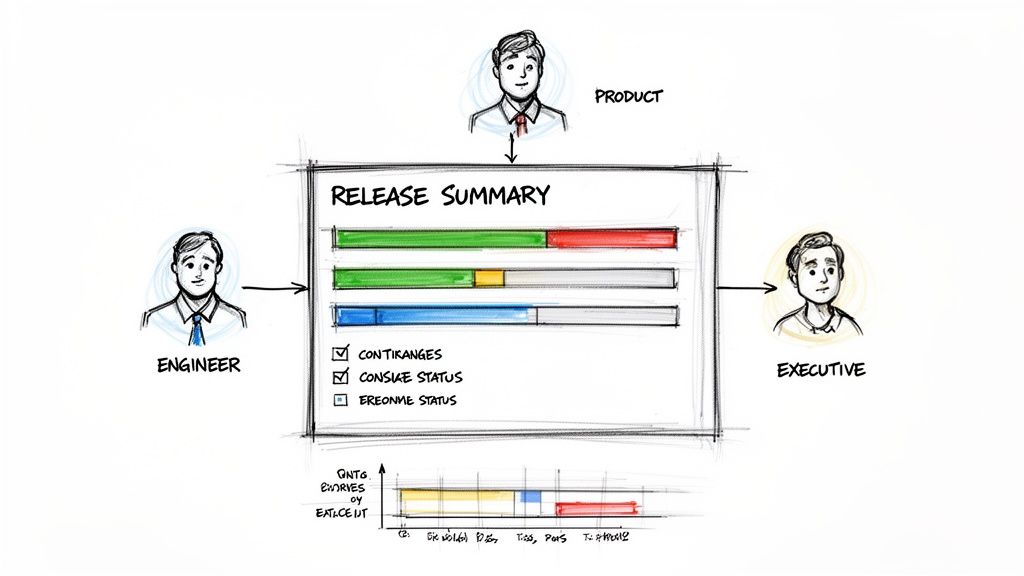
True alignment doesn't happen by accident. It's the result of a deliberate communication strategy, one that kicks off with a bang and maintains a steady drumbeat of updates all the way through the release cycle.
Tailoring Communication for Your Audience
Not everyone needs the same firehose of information. Drowning an executive in technical jargon is just as bad as giving an engineer a vague, high-level summary. The real skill is tailoring your message to who's listening.
Here’s a simple way I’ve learned to break it down:
- For Executives: They care about the big picture. Stick to progress against business goals, major milestones, significant risks, and the overall timeline. Keep it brief, visual, and always tie it back to the why of the release.
- For Product and Marketing Teams: They need the specifics to prep for launch. Give them clear feature descriptions, user benefits, and reliable target dates for key deliverables so they can do their magic.
- For the Development Team: They live and breathe the details. They need full access to the plan, including user stories, technical specs, dependencies, and sprint-level goals. Total transparency here is what builds ownership and drives execution.
A solid communication plan isn't about more meetings; it's about getting the right information to the right people at the right time. It kills ambiguity and replaces assumptions with a shared sense of clarity.
Getting this right is becoming a massive focus for companies. The enterprise agile planning market, which is full of tools designed to improve this exact kind of visibility, is expected to explode from USD 1.58 billion to USD 4.69 billion by 2033. It's a clear signal that the industry is betting big on tools that foster better alignment. You can read more about this booming enterprise agile market to see where things are headed.
From Kickoff to Ongoing Alignment
Alignment begins with a powerful kickoff meeting. This is your moment to get the team fired up, hammer home the release goals, and make sure everyone knows their part. But that initial energy fades fast. The real challenge is keeping that momentum going.
The secret is finding a lightweight, repeatable way to keep everyone in the loop. Forget about those long, soul-crushing status meetings that everyone dreads. A simple, asynchronous weekly summary can be exponentially more effective.
Example Weekly Release Summary
Imagine sending out a quick, scannable update every Friday. It’s not a chore; it's a powerful ritual for building transparency and trust.
Release Name: Q3 Onboarding Experience Overhaul
Status: On Track
Key Accomplishments This Week:
- Completed backend API for user profile creation (Back-End Team)
- Finalized UI mockups for the new guided tour (Design Team)
- Deployed initial tracking analytics to the staging environment (Front-End Team)
Focus for Next Week:
- Begin building the guided tour UI components (Front-End Team)
- Integrate front-end with the new user profile API (Mobile & Front-End)
- Draft initial help documentation for the new flow (Product)
Risks & Blockers:
- None this week.
This simple format turns a tedious task into a valuable part of your workflow. It keeps stakeholders informed without drowning them, celebrates the small wins, and raises red flags before they become full-blown crises. Great communication is the bedrock of successful projects, and there are many ways to nail it. For more strategies, check out our guide on improving communication in project management.
Common Questions About Agile Release Planning
Even with a great framework, jumping into agile release planning can feel a little different, and it's totally normal for questions to pop up. Teams often wonder how this new, more fluid approach stacks up against old-school methods or where familiar roles fit into the new picture.
Let's tackle some of the most frequent questions I hear. Getting these cleared up is a huge step in building the confidence your team needs to really own the process and move from rigid roadmaps to a smarter, more adaptive way of working.
How Is This Different From a Traditional Project Plan?
The short answer? Flexibility. A traditional project plan is usually a massive document locked in from the start, detailing a fixed scope, budget, and timeline. It's designed to be followed to the letter, which is precisely why it often shatters the moment it makes contact with reality.
Agile release planning, on the other hand, creates a living forecast. It gives you a high-level direction for a release, but it’s built with the expectation that things will change. The whole point is to ship valuable stuff in small batches and learn from feedback, not to blindly follow a plan someone wrote three months ago.
I like to think of it like a road trip. The traditional plan is a paper map with every single turn printed out beforehand. Agile planning is your GPS; it knows the destination but will reroute you on the fly to avoid a surprise traffic jam or a closed road.
What Is the Product Owner's Role in Release Planning?
The Product Owner is the captain of the ship. They're the one person who holds the vision for the release and makes sure every piece of work actually delivers real business value. Their leadership isn't just a "nice to have"; it's the foundation of a successful release.
During planning, the Product Owner is right there in the trenches with the development team. They're the go-to for clarifying what users need, answering tricky questions, and making the tough calls when a trade-off is necessary. In short, they own the "what" and the "why," freeing up the development team to crush the "how."
Can You Do Agile Release Planning Without Sprints?
You bet. Sprints are a signature part of Scrum, but the core ideas behind release planning work just as well with other agile flavors. Take Kanban, for example, which focuses on a continuous flow of work instead of fixed-length iterations.
In a Kanban world, you might group a set of related features for a release and use the team's historical data, like cycle time, to forecast when they’ll be done. The release cadence feels more organic because you ship when a meaningful batch of value is ready. The fundamental practices of setting goals, grooming the backlog, and managing scope are just as important as ever.
How Do You Handle Scope Creep in a Release Plan?
This is where agile really shines. Instead of treating scope creep like a crisis, an agile release plan is built to embrace change. When a new idea or requirement pops up, it doesn't throw everything into chaos. It simply kicks off a conversation.
The Product Owner takes the lead, evaluating the new request against what's already in the backlog. If it's important enough to pull into the current release, something of a similar size has to be pushed out. This trade-off keeps the release on track while ensuring the team is always working on the highest-value items. It turns "scope creep" from a problem into a healthy, ongoing discussion about priorities.
A solid agile release plan lives and dies on clear communication. WeekBlast gives your team a simple, human-first way to share progress and keep everyone in the loop without another meeting. It helps you build a searchable history of what you've shipped, making it easy to track accomplishments and keep stakeholders aligned.
Learn more and start your free trial at WeekBlast.com.


