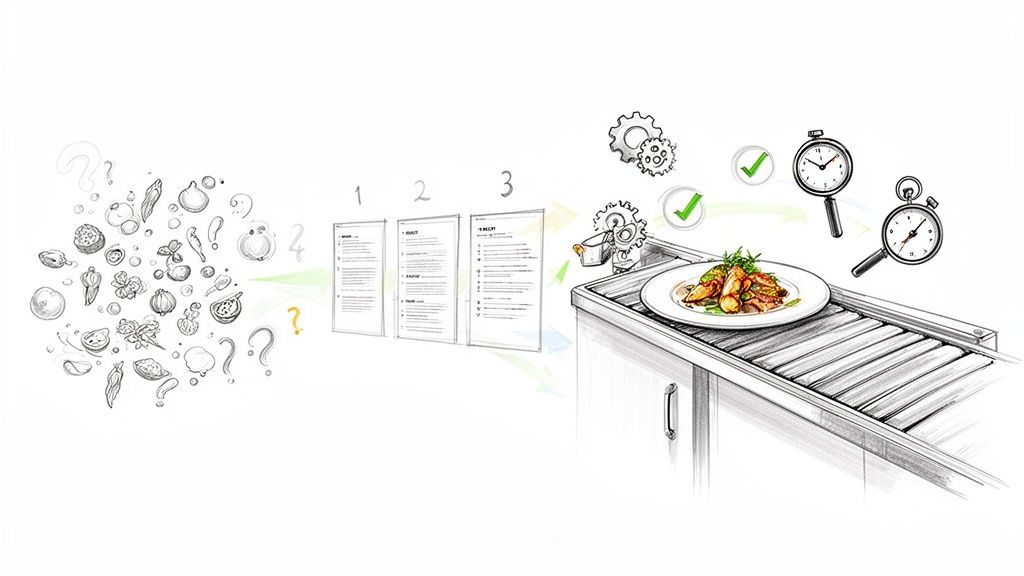
Think of your business like a professional kitchen. When an order comes in, there isn't a frantic scramble. Instead, a well-defined process kicks in, from the prep cook chopping vegetables to the line cook firing up the grill, all the way to the final plating. Each step is clear, repeatable, and designed for efficiency. That, in a nutshell, is process management.
It’s the discipline of making your team's workflows visible, measurable, and consistently repeatable. Instead of relying on gut feelings or how things have "always been done," you create a clear roadmap that everyone can follow. It’s not about adding needless rules; it's about removing the friction and guesswork that slow everyone down.
What Is Process Management Really?
So, what are we actually talking about when we say "process management"? It's the simple act of taking the invisible, often chaotic, way your team gets things done and turning it into a structured, reliable system. You move from a state of "What should I do next?" to confidently executing tasks with purpose.
This isn't just a niche idea, it's a massive trend. The market for Business Process Management (BPM) is on a tear, projected to double from $4.4 billion to $8.9 billion. That’s because companies are realizing it's the key to making new technology actually work. A recent report found that 85% of organizations now bake BPM into their digital strategies to stay nimble and constantly improve. You can find more insights on BPM trends and their business impact online.
From Chaos to Clarity
Let's be honest, without clear processes, most teams operate in a state of controlled chaos. Deadlines slip, the quality of work is all over the place, and when something goes wrong, the blame game starts. Everyone might be working hard, but they're pulling in different directions. It’s a recipe for wasted effort and duplicated work. Trying to grow or even onboard a new person becomes a nightmare because all the critical knowledge is locked away in a few people's heads.
Process management changes all that by creating a single source of truth. When you map out how work gets done, you build a shared understanding that empowers the whole team. New hires can contribute meaningfully from day one, colleagues can easily cover for each other, and leaders can finally see exactly where things are getting stuck.
By defining the "how," you free your team to focus on the "what" and "why." A well-managed process removes the mental load of figuring out administrative steps, allowing for deeper focus on creative and strategic work.
The difference between a team with managed processes and one without is night and day. The table below lays out just how stark that contrast is, showing the immediate stability and value that a little structure can bring.
Managed vs. Unmanaged Processes at a Glance
| Characteristic | Without Process Management (Chaos) | With Process Management (Clarity) |
|---|---|---|
| Workflow | Inconsistent and unpredictable; relies on individuals. | Standardized and repeatable; system-driven. |
| Accountability | Unclear; finger-pointing is common. | Clearly defined roles and responsibilities. |
| Quality | Varies wildly from one project to the next. | Consistent, predictable, and high-quality output. |
| Efficiency | Wasted time, duplicated efforts, frequent bottlenecks. | Smooth handoffs, minimal rework, and optimized flow. |
| Onboarding | Slow and dependent on key team members. | Fast and scalable; new hires become productive quickly. |
| Improvement | Difficult to identify problems or make lasting changes. | Data-driven insights make continuous improvement possible. |
Ultimately, moving from chaos to clarity isn't just about being more organized, it's about creating a foundation for sustainable growth and a less stressful work environment for everyone.
The Five Stages Of The Process Management Lifecycle
Process management isn't something you set up once and then forget about. It's a living, breathing cycle of continuous improvement. Think of it less like a project with a finish line and more like a feedback loop that keeps your workflows from getting stale or inefficient. This ongoing cycle helps your processes evolve right along with your team and your goals.
The whole system is built around five core stages: Design, Model, Execute, Monitor, and Optimize. Each stage flows logically into the next, creating a powerful engine for improvement. To make this tangible, let's walk through these stages from the perspective of a software team trying to launch a new feature.
This is all about moving from a state of chaos to one of clarity.
By working through the lifecycle, teams can systematically untangle messy workflows and create a clear, predictable path for getting things done.
Stages 1 And 2: Design and Model
It all starts with the Design stage. This is your whiteboard or brainstorming phase. Here, the team identifies an existing process that needs fixing or sketches out a completely new one. For our software team, this means mapping out every single step it takes to ship their new feature, from writing the first line of code all the way to final user testing.
Next up is the Model stage, where you turn that plan into a visual representation. This is more than just a simple to-do list. It’s a flowchart that clearly shows who does what, the order of operations, and where things might get stuck. The team could create a diagram showing how code travels from a developer’s computer, to the quality assurance (QA) team, through a staging environment, and finally, into production.
This modeling step is absolutely critical because it gets everyone on the same page. When the entire workflow is laid out visually, it’s so much easier to spot flaws or find opportunities for improvement before you’ve even started the real work.
Stages 3 And 4: Execute and Monitor
With a clear model agreed upon, the team jumps into the Execute stage. This is where the rubber meets the road and the actual work gets done. Developers start coding, QA engineers begin testing, and the product manager coordinates the entire release. The process model you built acts as the playbook, making sure everyone follows the same steps every time.
As soon as work begins, the Monitor stage kicks in. While the process is running, the team gathers data to see how it's actually performing. They might track metrics like how long it takes to fix a bug, how many test builds fail, or the total time from a code commit to deployment. This is all about collecting hard numbers to see how your process holds up in the real world.
Stage 5: Optimize
Finally, you reach the Optimize stage. Armed with data from the monitoring phase, the team looks for bottlenecks and weak spots. Maybe they discover that bug reports are getting lost in transit between QA and the right developer. To fix this, they could introduce a new tagging system in their issue tracker that automatically assigns bugs, cutting down on delays.
This single optimization then feeds right back into the Design stage, closing the loop. The team now has a slightly better, more dialed-in process for their next feature release. This is the heart of effective process management, a cycle of small, consistent improvements that add up over time. If you want to dig deeper into this structure, our guide on the new product development process is a great next step.
Why Smart Process Management Matters
Knowing the lifecycle of a process is one thing, but the real magic happens when you see how it smooths out your team's day-to-day grind. Smart process management isn't about adding red tape; it’s about cutting it away. It directly tackles the most common sources of workplace friction, creating an environment where people can actually focus on what they do best.
The whole point is to eliminate that endless stream of "What are you working on?" messages and kill off time-wasting status meetings. When processes are clear, everyone shares the same picture of project progress, which builds trust and lets people work more autonomously.
Boosting Team Efficiency And Morale
A well-defined process brings a sense of calm and focus to the workday. Instead of constantly reacting to interruptions or hunting for information, team members can just get on with their tasks. That clarity leads to some pretty big wins.
- Higher Efficiency: Work flows smoothly from one person to the next, with fewer bottlenecks holding things up.
- Better Quality: A consistent process means the final product meets a reliable standard, every single time.
- Improved Morale: People are happier and more engaged when they feel competent and know exactly what’s expected of them.
- Increased Agility: A clear system makes it much easier to pivot when something unexpected pops up, without everything descending into chaos.
Think about a product team with a locked-in feature-release process. They can ship updates faster and with fewer bugs. At the same time, their manager gets a bird's-eye view of who's doing what, making it easy to offer support exactly where it's needed. This is the difference between constantly putting out fires and proactively getting things done.
A great process acts like a silent project manager, guiding the team and keeping everyone aligned without the need for constant check-ins. It empowers individuals to take ownership of their work within a predictable framework.
Embracing Modern Process Automation
Business process management (BPM) isn't standing still, either. Technology is pushing it forward in exciting ways. We're seeing trends like hyperautomation, which blends artificial intelligence (AI) and robotic process automation (RPA), making work more efficient than ever. In fact, Gartner predicts that 85% of companies embracing these trends will see a 30% increase in efficiency. These tools are fantastic for simplifying complex workflows, something that’s especially helpful for remote teams that need to work asynchronously. You can find more insights on the future of BPM solutions on Rootstack.com.
By setting up a solid process foundation, you're building a system that not only helps your team today but is also ready for whatever comes next. This foundation is a critical piece of a much larger operational puzzle. If you're curious about how this fits into the big picture, check out our guide on building a successful project management strategy. In the end, good process management creates a positive feedback loop: clarity drives efficiency, and that efficiency boosts team morale.
Choosing The Right Process Methodology For Your Team
Once you've got the basics of process management down, the next logical question is, "Which framework should we use?" Think of methodologies not as rigid, unbreakable rules, but as different toolkits. A carpenter doesn't use a sledgehammer to hang a picture frame, and your team shouldn't force a one-size-fits-all system onto every project.
The goal is to find a philosophy that fits your team's specific goals, culture, and the nature of your work. Forcing a complex, data-heavy system on a small, fast-moving creative team is a recipe for frustration. The right approach should empower your team, not bury them in bureaucracy.
Three Core Process Philosophies
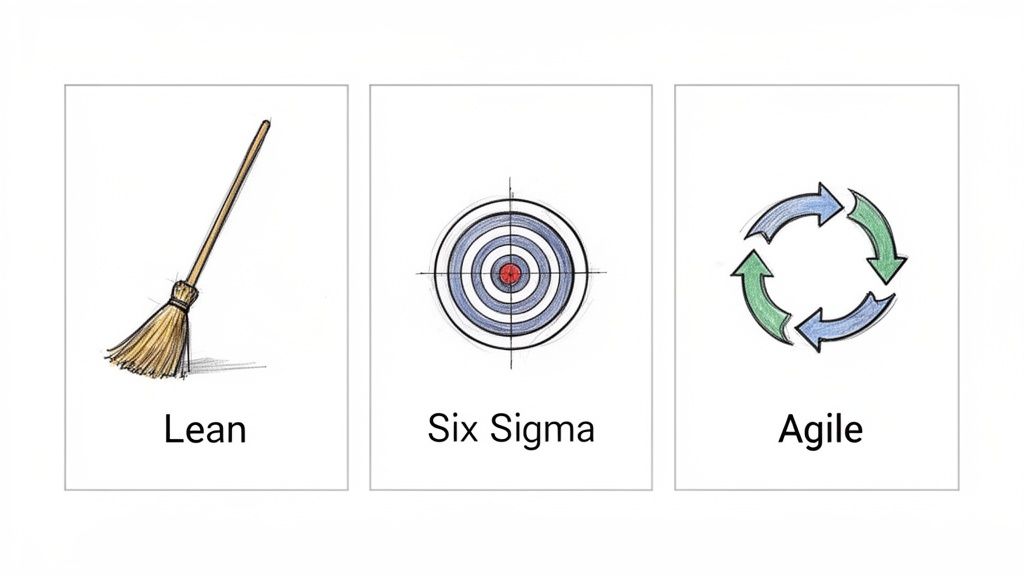
While countless methodologies exist, most can be traced back to three foundational schools of thought: Lean, Six Sigma, and Agile. Getting a handle on their core purpose is the first step to picking, or even blending, the ideas that will actually help you.
- Lean is all about waste elimination. Born in the world of manufacturing, its entire focus is on trimming the fat. Lean targets anything and everything that doesn't add direct value to the customer, think pointless meetings, redundant approval steps, or time spent just waiting for information.
- Six Sigma is obsessed with perfection. This is a deeply analytical approach that uses statistical methods to hunt down and snuff out defects. The end goal is to make a process so consistent and reliable that the error rate is practically zero, guaranteeing top-notch quality every single time.
- Agile prioritizes iterative progress and flexibility. Famously used in software development, Agile is built around breaking big, intimidating projects into small, manageable cycles called "sprints." This allows teams to adapt to changes on the fly and deliver real value to customers much faster.
The most effective approach often isn't choosing one methodology but blending principles from several. A team might use Lean principles to cut down on meeting time while using Agile sprints to manage their project timelines.
Finding The Right Fit For You
The best way to start is by pinpointing your biggest pain point. Are you struggling with inconsistent quality? Are projects moving too slowly? Or is your team unable to pivot when priorities shift? Your answer will point you toward the methodology that can make the biggest immediate impact.
For instance, a customer support team bogged down by long ticket resolution times could use Lean to map their workflow and slash unnecessary steps. A marketing team launching a new campaign, on the other hand, might embrace an Agile approach to test different messages in short, focused cycles.
To help you get started, we've put together a simple comparison table. Think of it as a quick guide to match your team’s challenges with the right set of principles. This practical approach to what is process management helps ensure you adopt a system that truly serves your team.
Which Process Methodology Fits Your Team?
| Methodology | Best For | Core Principle | Example Use Case |
|---|---|---|---|
| Lean | Teams looking to increase speed and efficiency by removing non-essential steps. | "Eliminate waste." | A manufacturing team redesigning its assembly line to reduce unnecessary movement and delays. |
| Six Sigma | Organizations that need to deliver near-perfect quality and consistency. | "Reduce defects." | A financial services firm working to eliminate errors in its client transaction processing system. |
| Agile | Teams in dynamic environments where requirements change frequently. | "Iterate and adapt." | A software development team building a new mobile app in two-week "sprints" to incorporate user feedback. |
Ultimately, the "best" methodology is the one your team will actually use. Start small, borrow the concepts that make sense, and focus on solving real problems.
Putting Process Management Into Practice
Theory is a great starting point, but the real test is turning those ideas into action. The good news is that implementing process management doesn't have to be some disruptive, top-down overhaul that burns everyone out. The key is to take a human-first, lightweight approach that solves real problems without adding a bunch of unnecessary rules.
You can get started today by picking just one workflow that consistently causes friction. Is it the way you handle customer feedback? Or maybe the clunky process for publishing a new blog post? By focusing on a single, high-impact area, you can demonstrate value quickly and build momentum for bigger improvements down the road.
Start Small and Document Simply
The goal here is clarity, not a hundred-page manual no one will ever read. Once you've chosen a workflow to fix, just document it in the simplest way possible. A shared document with a bulleted list or a basic flowchart is often all you need to get things rolling.
This first step immediately creates a shared understanding. When the process is actually written down, it’s no longer trapped in one person's head. This makes it so much easier for everyone to spot potential gaps or suggest a better way of doing things.
The best process documentation is alive and accessible. It should be a tool that helps your team, not a dusty artifact that sits on a shelf. The goal is progress, not perfection.
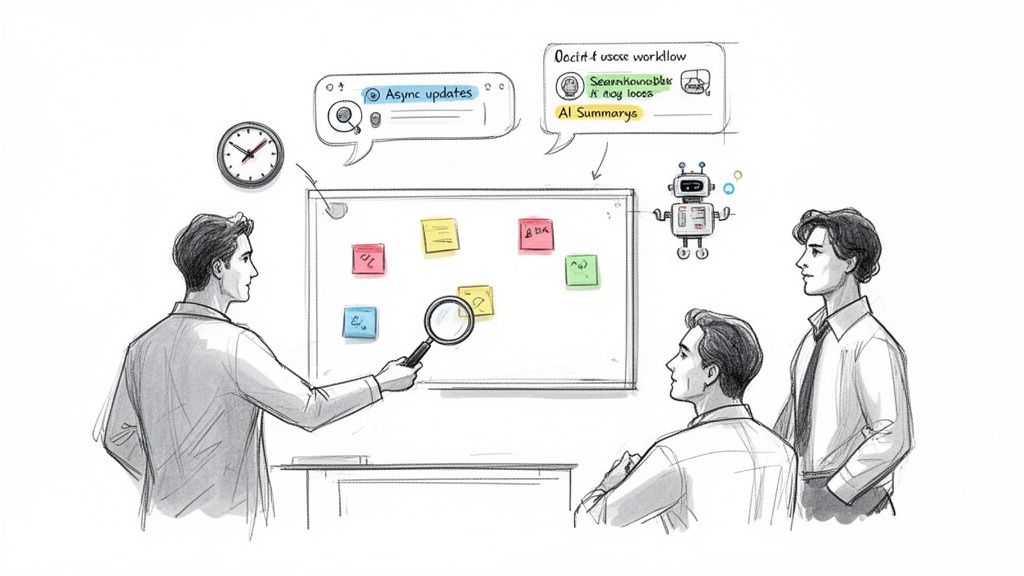
This is where collaborative problem-solving really shines, often with simple visual aids to map out and refine how work actually gets done.
Embrace Asynchronous Communication
A core part of modern process management is breaking free from the cycle of constant meetings and interruptions. This is where lightweight tools built for asynchronous updates, like WeekBlast, can make a huge difference. Instead of pulling everyone into a daily stand-up, team members can just post quick, bullet-point updates on their progress when it makes sense for them.
These updates create a searchable, permanent log of what's been accomplished, giving managers and teammates the visibility they need without derailing anyone's focus. It's a simple change that protects deep work while keeping everyone on the same page. You can find more ideas for cutting down on manual work in our guide on automating data entry.
Artificial Intelligence is also playing a bigger role in process optimization. In many tools, AI can help predict trends and flag inefficiencies. For WeekBlast users, AI-generated summaries offer a similar benefit, turning simple weekly logs into monthly and yearly overviews that provide deep process insights, all without a single meeting. This allows teams to spot bottlenecks and analyze progress through streaks and stats, turning simple updates into a powerful narrative for performance reviews.
Common Questions About Process Management
Even when the concept of process management clicks, a few practical questions almost always come up. It's one thing to understand the theory, but making it work for your team can feel like a big leap. Let's tackle some of the most common hurdles people face right from the start.
A frequent worry I hear is that process management is just for big, faceless corporations. That it’s all about bureaucracy and red tape. Nothing could be further from the truth. In my experience, a small team or startup actually stands to gain the most. A simple, lightweight process is the very thing that helps you grow without everything descending into chaos later.
Then there's the creativity myth, the idea that adding any kind of structure will kill innovation. It’s usually the other way around. A good process gets the boring, repetitive tasks out of the way. It automates the administrative slog, freeing up your team's brainpower for the kind of creative problem-solving that actually moves the needle.
Is Process Management The Same As Project Management?
This is a big one, and it's crucial to get the distinction right. They’re related, sure, but they solve completely different problems.
Project management is for one-off, temporary initiatives. It has a clear beginning and a definite end. Think about launching a new website or organizing a conference; once the site is live or the event is over, the project is complete.
Process management, on the other hand, is about the ongoing, repeatable work that keeps your business running. This is the stuff you do over and over, like how you publish blog posts every week or how the sales team brings a new client into the fold. It’s all about making those routine operations better, faster, and more reliable for the long haul.
Here's an easy way to remember it: project management helps you build a single, custom car. Process management helps you design and run the assembly line that can build thousands of cars flawlessly.
How Quickly Can We See Results?
The good news is you don't have to wait a year to see a payoff. The trick is to forget about boiling the ocean and instead start with one single workflow that's a known pain point.
For instance, maybe your customer support team is constantly tripping over a confusing ticketing system. Just by mapping out that one process and making a few smart tweaks, you could see a tangible improvement in team morale and efficiency in a matter of weeks.
These early wins are incredibly powerful. They prove the value of thinking this way and build the momentum you need to tackle bigger challenges. The goal isn't a massive, one-time overhaul; it's about making small, smart improvements that compound over time.
Frequently Asked Questions
Getting started with process management often brings up a few key questions. Here are some quick answers to the most common ones we encounter.
| Question | Answer |
|---|---|
| Is process management only for large corporations? | Not at all. Any team, regardless of size, can benefit. For small teams and startups, lightweight process management provides a crucial foundation for scaling effectively without introducing chaos. It's about clarity, not bureaucracy. |
| Will process management make my team less creative? | Quite the opposite. A good process handles the repetitive, administrative work, which frees up mental energy for creative problem-solving and innovation. It provides a stable framework so your team can focus on what truly matters. |
| How long does it take to see results? | You can see immediate benefits by starting small. Improving a single, high-impact workflow, like your customer support ticketing process, can show positive results in clarity and efficiency within a few weeks. |
| What's the difference between process management and project management? | Project management focuses on completing a unique, temporary project with a defined start and end date. Process management focuses on improving ongoing, repeatable workflows that are central to your business operations. |
Hopefully, that clears up some of the initial uncertainties. The key is to see process management not as a rigid set of rules, but as a practical toolkit for making work-life smoother and more effective for everyone.
Ready to bring clarity to your team's workflows without the heavy overhead? WeekBlast replaces endless status meetings with a simple, high-speed work log, giving everyone the visibility they need to stay in sync. Start your free trial today at WeekBlast.com.


