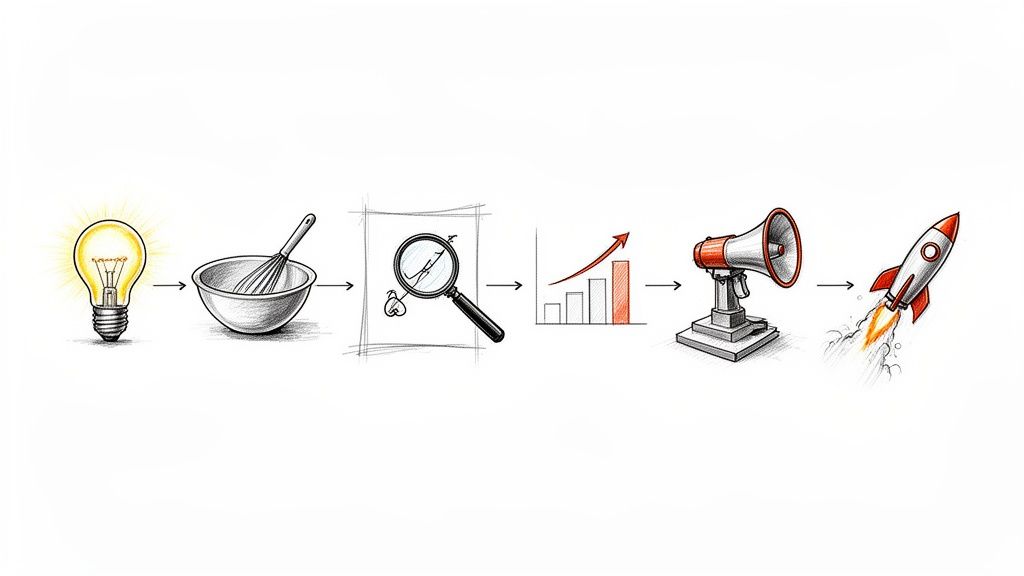
So, what exactly is the new product development (NPD) process? In a nutshell, it’s a systematic journey that takes a spark of an idea and carefully nurtures it into a product ready for the world. It’s the game plan, the blueprint, the recipe that guides you from "what if?" to launch day.
Think of it as the proven formula for turning a flash of genius into something real that customers will love and buy.
Why a Product Development Process Is Your Secret Weapon
Ever tried to build a complex piece of IKEA furniture without the instructions? You might have all the parts and a vague idea of the final product, but you'll probably end up with a wobbly bookshelf, a pile of leftover screws, and a major headache. That’s what building a product without a process feels like.
The new product development process is your instruction manual. It’s not about stifling creativity with bureaucracy; it’s about giving your brilliant ideas a fighting chance to survive the chaotic journey to market. A good process is what separates the one-hit wonders from the companies that innovate successfully, again and again.
The High Stakes of Innovation
Let's be real: launching a new product is a high-stakes gamble. The numbers don't lie. Startups face a jaw-dropping 90% failure rate for new launches. It’s not just the little guys, either. Even big, established companies often miss the mark, with 28% of their product launches failing to hit the goals set by their own leadership.
Why? Often, it's because teams are flying blind. A whopping 35% of companies admit to cramming in features just to close a sale, not because they solve a real customer problem. If you want to dig deeper, you can explore more of these sobering product development statistics.
A solid NPD process is your shield against becoming another statistic. It forces you to pause and ask the tough questions at every turn:
- Is this idea even worth pursuing? It weeds out the duds before you sink time and money into them.
- Will anyone actually pay for this? It pushes you to get out of the building and validate your assumptions.
- Can we realistically build it? It matches your ambition with your team's resources and technical capabilities.
- How do we launch for maximum impact? It ensures you have a solid business case and go-to-market plan.
Simply put, a formal process transforms guesswork into a strategic, evidence-based plan. It's the difference between hoping you hit the target and having a laser sight aimed squarely at the bullseye, making sure every bit of effort pushes you closer to a successful launch.
Your Product's Journey, From Cocktail Napkin to Customer's Hands
So, how does a brilliant idea actually become a real-life product? It's not magic, and it's definitely not a chaotic scramble (or at least, it shouldn't be). The new product development process is a methodical, stage-by-stage journey that shepherds an idea from a spark of inspiration to a full-blown market launch.
Think of it as a roadmap. Following this structured path is what separates the runaway successes from the expensive flops gathering dust in a warehouse. It’s the framework that takes raw, untamed creativity and molds it into something focused, validated, and ready for customers.
This simple flow chart cuts through the noise, showing the core journey from a bright idea, through the all-important screening phase, to a successful launch.
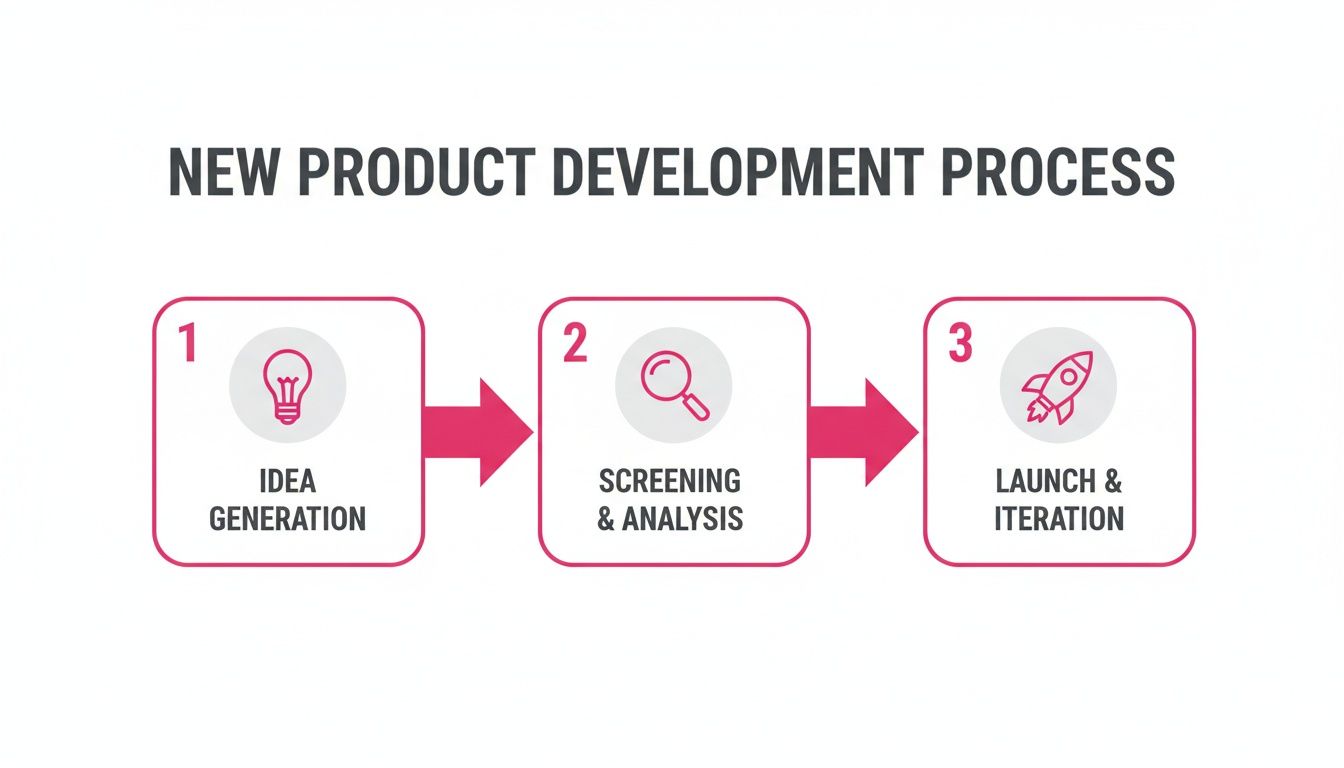
What this really drives home is that innovation isn't just about that one "eureka!" moment. It's about the grit and discipline to systematically test, refine, and prove that spark is strong enough to light up the market.
Stage 1: Idea Generation
Welcome to the "no bad ideas" zone. Seriously. This first stage is a creative free-for-all where the only goal is quantity. You're casting the widest net possible, hoping to catch a ton of potential product concepts.
Inspiration can strike anywhere, so keep your eyes and ears open:
- Customer Feedback: Your users' complaints, wishes, and weird workarounds are a goldmine of problems waiting to be solved.
- Internal Brainstorms: Get everyone in a room (or a Zoom). Your engineers, marketers, and support staff all see the business from different angles. Mash those perspectives together and see what happens.
- Competitor Analysis: What are your rivals crushing? More importantly, where are their blind spots? What are their customers complaining about online?
- Market Trends: Keep an eye on shifts in technology, culture, and what people are suddenly buzzing about.
The real challenge, especially for distributed teams, is capturing these fleeting thoughts before they vanish. This is where a tool like WeekBlast comes in handy. Anyone—from a salesperson on a client call to an engineer fiddling with a new API—can log an idea in seconds. This creates a living, searchable library of potential innovation, primed and ready for the next stage.
Stage 2: Idea Screening
Okay, the brainstorming party is over. Now it's time to be the tough but fair bouncer at the door. Stage one gave you a mountain of ideas; stage two is about pragmatically filtering that mountain down to a few promising hills.
You're not doing a deep financial analysis just yet. This is more of a gut check, a quick run-through of the big questions. Does this idea even remotely align with our company's mission? Do we have the technical skills to pull it off? Is there a real, painful problem here that people would pay to solve? This is where you weed out the non-starters so you can focus on the real contenders. We have a whole guide on how to prioritize tasks that dives deeper into sorting the signal from the noise.
Stage 3: Concept Development and Testing
The ideas that survived the first cut now get to graduate. You'll flesh out each one into a proper product concept—a clear, concise document that details the target audience, the core features, and the unique value it offers. In plain English: what problem are you solving, and who are you solving it for?
Once you have a solid concept, you must test it with real people. This step is completely non-negotiable. Don't just ask your mom; get it in front of your target audience. You can do this with:
- Surveys and questionnaires
- Focus groups
- One-on-one customer interviews
- Simple landing page tests to see if people will sign up
The feedback you get here is pure gold. It might give you the green light to proceed, or it might send you back to the drawing board. Either way, you're learning before a single line of code has been written, saving yourself a world of pain later on.
Stage 4: Business Analysis
With a validated concept in your back pocket, it's time to talk dollars and cents. This is where you put on your CFO hat and build a rock-solid business case. You're trying to answer the make-or-break financial questions. What's the real cost to develop and launch this thing? What's our best guess on revenue? What’s the projected profitability and return on investment (ROI)?
This isn’t back-of-the-napkin math. It involves a serious look at market size, pricing strategies, and how you’ll actually get the product to customers. You’re building a detailed financial model that justifies the massive investment of time and money that’s about to happen.
This analytical rigor is what elevates a cool idea into a viable business opportunity. It's the critical checkpoint ensuring your product has a realistic shot at making money before you commit the full team to building it.
Stage 5: Product Development
Let's build! This is the stage everyone gets excited about. The product concept finally leaps off the page and transforms from mockups and documents into a real, tangible thing. Designers craft the user experience, and engineers bring it to life with code.
Unsurprisingly, this is often the longest and most expensive part of the whole process. The goal here is usually to build a Minimum Viable Product (MVP). That’s a bare-bones version of the product with just enough features to be useful to early adopters, who can then give you crucial feedback to guide what you build next.
For engineering teams, the biggest headache is keeping everyone in the loop without being constantly interrupted. Using a high-speed work log like WeekBlast, developers can post quick, asynchronous updates on their progress. This gives product managers and other stakeholders the visibility they need without derailing focused work, all while creating a perfect historical record of the entire build.
Stage 6: Test Marketing
Before you bet the farm on a massive, global launch, you need a dress rehearsal. Test marketing, often called a beta launch, means releasing the product to a small, controlled segment of your target market.
This isn't just about finding bugs. It's about testing your entire go-to-market strategy in a real-world setting. You’re validating your marketing messages, your pricing model, and your sales process. The data you gather here is invaluable for fine-tuning your approach and fixing any glaring problems before the whole world sees it.
Stage 7: Commercialization
This is it. The big one. Launch day! Commercialization is the all-hands-on-deck, coordinated push to introduce your new product to the wider market. This means production is ramped up, the final marketing campaigns are live, and your sales and support teams are trained and ready to go.
The way we do this is changing fast. By 2025, digital tools are expected to boost product development efficiency by 19% and shrink time-to-market by 17%. And while 41% of industrial companies use data analytics, only 5% are applying it across the board, showing a huge opportunity for improvement. You can see more on how AI and data are reshaping product development in this PwC forecast.
Of course, a successful launch isn't the finish line. It's the starting gun for the next phase: gathering customer feedback, obsessively tracking performance, and constantly iterating to ensure your product doesn't just launch, but thrives.
Assembling Your Product Development Dream Team
Ever seen a heist movie? You can't just have one person crack the safe, drive the getaway car, and handle the crowd control. It takes a crew, each a specialist in their own right, all working together like a well-oiled machine. Launching a new product is a lot like that. It's a team sport, not a solo mission.
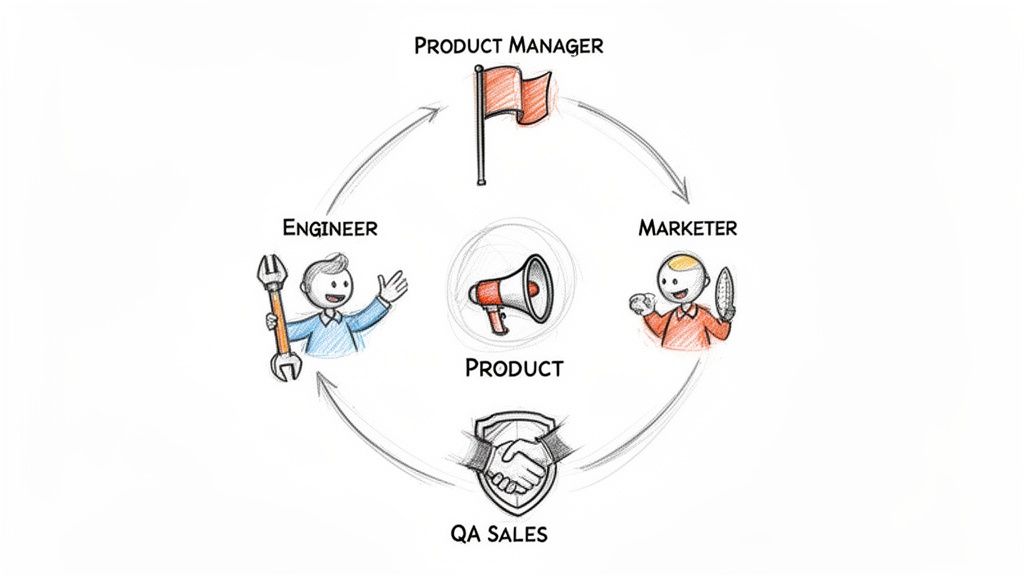
To pull off the new product development process, you need to assemble a cross-functional "dream team." Everyone needs to know their part and how it plugs into the grand plan. From that first lightbulb moment to the big launch day, these are the key players who make the magic happen.
The Visionaries and The Builders
At the core of any product, you have two fundamental forces: the people who dream it up and the people who actually bring it to life. This is the dynamic duo that turns "what if?" into "what is." If they aren't in sync, the best ideas in the world will just collect dust.
Let's meet them:
- Product Managers (The Visionaries): These are the captains of the ship. They're obsessed with the "what" and the "why." They live and breathe customer needs, set the product vision, and make the tough calls on what gets built next. Think of them as the voice of the customer and the strategic compass for the whole team.
- Engineers & Developers (The Builders): Here are your architects and your construction crew, all rolled into one. They take the PM's vision and turn it into something real, functional, and reliable. Their job is to transform blueprints and wireframes into a product that actually works.
The Storytellers and The Advocates
Okay, you've started building something cool. Now what? You need people to figure out how to talk about it and get it in front of the right customers. This is where your outward-facing crew members shine, building the bridge from your awesome creation to the market that’s waiting for it.
Their roles are absolutely critical:
- Marketers (The Storytellers): These folks craft the story. Their mission is to understand the market, zero in on the target audience, and create messaging so compelling that people can't help but say, "I need that!"
- Sales (The Advocates): These are your champions on the front lines. They're the ones building relationships, listening to customer pain points, and showing exactly how your product makes life better. The feedback they bring back from the field is pure gold.
Cross-functional collaboration isn't just a fluffy buzzword; it's the engine of great products. When marketing gets the technical challenges and engineering gets what the market wants, you build better stuff, faster. It's that simple.
The Guardians and The Modern Challenge of Sync
Last but not least, you need the people who ensure your product doesn't fall flat on its face. The guardians of quality are your last line of defense before a customer ever clicks a button, making them essential for building trust and a solid reputation.
- Quality Assurance (QA) (The Guardians): The QA team’s job is basically to break things so your customers don’t have to. They are relentless, hunting down bugs, flagging usability issues, and making sure the product meets the highest standards before it sees the light of day.
Here's the rub in today's world: keeping this diverse, often-remote team on the same page is a huge challenge. How does a marketer quietly check on a feature's progress without derailing an engineer's deep work? How does a PM get the 30,000-foot view without scheduling yet another soul-crushing status meeting?
This is where the right tools stop being a "nice-to-have" and become a necessity. Take WeekBlast, for example. It gives every team member a dead-simple way to share their progress and blockers asynchronously. Suddenly, you have a single, searchable history of everything that's happening. A sales lead can see real-time updates from QA, and a manager can get an instant AI-powered summary of the entire week's progress.
This is how you get that seamless, cross-team visibility that keeps the dream team moving as one, no matter where they're logging in from. To see it for yourself, check out how WeekBlast works for product teams of all shapes and sizes.
Navigating the Gates: Your Go/No-Go Decision Points
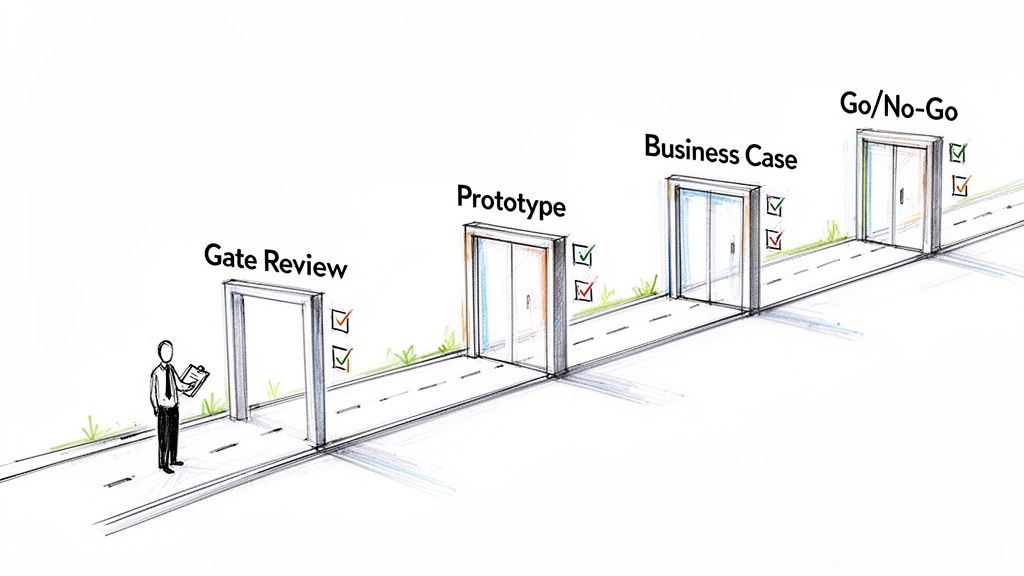
Every stage of the new product development journey ends with a critical checkpoint. This isn't just some casual status meeting; it's a formal stage-gate review, a make-or-break moment where the project's entire future is on the line.
Think of it like a boss level in a video game. You can't just stumble into the next zone unprepared. You have to prove you’ve gathered the right intel, leveled up your strategy, and are ready for whatever comes next. These gates are where you decide whether to push forward, pivot based on what you've learned, or wisely put an idea on the shelf.
What Actually Happens at a Gate Review
A gate review is a sit-down where the project team lays out all their findings and deliverables for a group of decision-makers, often called the "gatekeepers." This crew is usually made up of senior leadership, product heads, and key players from finance, marketing, and other departments.
The team's mission is to present a rock-solid, evidence-backed case explaining why the project deserves more time, money, and people to advance. The gatekeepers' job is to poke holes in that case, ask the tough questions, and make the final call. The outcome isn't always a simple "yes" or "no." Sometimes it's a "yes, but..." sending the team back to nail down a few more details.
The Deliverables You Need to Get Past the Gate
To get the green light, you need to show up with proof of your progress. The exact artifacts depend on which stage you're wrapping up, but they always represent tangible work and validated learning.
For instance, to pass the gate after the Concept Development stage, you might bring:
- Customer Interview Summaries: Real quotes and core insights pulled directly from conversations with your target audience.
- Survey Results: Hard numbers that validate the problem you're trying to solve and show there’s a real market for it.
- A Refined Value Proposition: A crystal-clear statement explaining who the product is for, what it does, and why it's a better choice than anything else out there.
Move on to the gate after the Business Analysis stage, and the stakes get much higher. You’ll need a more formidable package:
- A Detailed Business Case: This is the big one, complete with financial projections, cost breakdowns, and a potential ROI.
- Low-Fidelity Prototypes: Early mockups or wireframes that start to make the concept feel real and testable.
- Initial Go-to-Market Strategy: A first draft of your plan for launching, marketing, and selling the product.
Making a go/no-go decision without a clear, accessible history of progress is like trying to solve a mystery with half the clues missing. Gut feelings are good, but data-driven decisions are better.
Making Gate Decisions with Data, Not Drama
The single biggest headache in any gate review is piecing together a coherent story of everything that’s happened so far. Weeks, or even months, of work—the wins, the setbacks, the user feedback—get lost in a black hole of scattered emails and forgotten Slack threads. This makes it a nightmare for managers to present a clear picture and for leaders to make a truly informed decision.
This is where having a continuous, searchable log of progress becomes a game-changer. Imagine a product manager prepping for a gate review. Instead of a frantic scavenger hunt for information, they use a tool like WeekBlast to pull up the project’s entire history in an instant. The searchable archive lets them find specific customer feedback logged weeks ago or review an engineer’s notes on a prototype challenge without breaking a sweat.
Even better, with AI-powered summaries, a manager can generate a concise narrative of the team's progress over the last month in just a few seconds. This transforms the gate review from a stressful scramble into a confident, data-backed presentation. It ensures every go/no-go decision is based on the full story. For more on this, check out our thoughts on improving communication in project management.
Common Mistakes That Derail Product Launches
Even brilliant teams with the best intentions can watch a promising product trip and fall flat on its face. The road to a successful launch is littered with potential missteps, but the most common ones are surprisingly easy to spot—and sidestep—if you know what you're looking for.
Think of these pitfalls like classic video game bosses. Each has a specific weakness. Once you learn the pattern, you can dance around their attacks and land the winning blow. Let's break down the most notorious launch-killers and how to defeat them.
The Siren Song of Feature Creep
It almost always starts with a seemingly harmless request. “Just one more thing…” says a key stakeholder. “It would be perfect if it just did this,” a big potential customer suggests. Fast-forward a few weeks, and your sleek, focused product has morphed into a bloated monster that does a little bit of everything but nothing particularly well.
Welcome to feature creep, the silent killer of timelines and budgets.
The real problem here is a shaky definition of "done." Without a crystal-clear understanding of the core problem you're solving, it’s far too easy to get distracted by shiny new ideas. This doesn't just push back your launch date; it muddies your core message and leaves users wondering what your product is even for.
The secret to fighting feature creep? Tie every single proposed change back to the original, validated customer problem. If it doesn't directly solve that core need, it goes on the "someday/maybe" list. No exceptions.
Ignoring the Voice of the Customer
This one is a true tragedy. You spend months, maybe years, building something you think people want, only to find out you were solving a problem nobody actually had. Teams get so wrapped up in their own clever solutions that they forget to ask the most important question: "Does anyone care?"
They skip the early feedback loops and concept testing, running on pure assumption. The result is a product that launches to the sound of crickets.
- Lost Insights: A game-changing piece of feedback from a customer call gets mentioned once in a busy Slack channel and then disappears forever.
- Echo Chambers: Without a constant stream of outside perspective, it’s easy for a team to convince themselves they’re building the next big thing, completely insulated from market reality.
This is why capturing every single crumb of user feedback is so critical. For example, a tool like WeekBlast lets any team member log customer insights directly from their email or Slack. This creates a permanent, searchable history, making sure that crucial wisdom from the front lines never gets lost in the shuffle.
Internal Misalignment and Communication Breakdowns
Ever feel like your product, marketing, and engineering teams are speaking different languages? Marketing is busy crafting a beautiful story about a feature that engineering secretly shelved last week. Sales is out there making promises the product team knows they can't keep.
This kind of internal chaos is a direct flight to a messy and disappointing launch.
When teams work in their own little bubbles, you end up with a lot of painful, "Wait, I thought we all agreed..." conversations. The root cause is the lack of a single source of truth for decisions, which leads to duplicated effort and finger-pointing. Having a permanent, chronological log of decisions and progress—like the one WeekBlast automatically builds—cuts through the noise. It’s an undisputed record that keeps everyone on the same page about what’s happening, why, and what’s coming next.
Common NPD Pitfalls and How to Avoid Them
Spotting these issues is half the battle. Here’s a quick-glance table to help you recognize these common product development traps and proactively steer your team clear of them.
| Common Mistake | Potential Impact | Prevention Strategy with WeekBlast |
|---|---|---|
| Feature Creep | Bloated product, delayed launch, diluted value proposition, and confused users. | Create a dedicated "Future Ideas" project in WeekBlast. When a new idea comes up, log it there with context. This acknowledges the idea without derailing the current sprint. |
| Ignoring Customer Feedback | Building a product nobody wants, low adoption rates, and wasted engineering resources. | Use WeekBlast to create a "Customer Feedback" log. Every time someone on the team talks to a user, they post a quick update. This builds a searchable history of real-world insights. |
| Siloed Teams | Misaligned priorities, inconsistent messaging, wasted work, and internal friction. | WeekBlast’s asynchronous updates give every team a window into what others are doing. Marketing can see product's progress, and sales knows what features are actually shipping. |
| Poor Documentation | Key decisions get lost, new team members struggle to get up to speed, and "why did we do that?" becomes a common question. | Every WeekBlast update is time-stamped and saved forever. It becomes a living document of the project's history, from initial idea to final launch, accessible to everyone. |
Ultimately, avoiding these pitfalls isn't about having a perfect process; it's about building a system of communication and visibility that makes it hard for things to go off the rails. When everyone has access to the same information, you can catch these problems before they sink your launch.
Got Questions About New Product Development? We've Got Answers.
Even with a perfect roadmap, the journey from idea to launch is never a straight line. It's full of twists, turns, and tough questions. It's only natural to wonder how all these stages and theories actually work when the rubber meets the road.
So, let's dive into some of the most common questions that pop up during the new product development process. No jargon, no fluff—just clear, straightforward answers to help you get from a bright idea to a breakout success.
Agile vs. NPD: What's the Difference, Really?
This one trips a lot of people up, but it's simpler than it sounds.
Think of the new product development process as the entire strategic map for an epic cross-country road trip. It lays out the major destinations, from "Dream up a route" (Ideation) all the way to "Arrive and unpack" (Commercialization). It's the big-picture plan.
Agile development, on the other hand, is the souped-up jeep you're driving on one specific, rugged part of that journey—the actual "Product Development" stage. Frameworks like Scrum are the engine, letting you drive in short, iterative sprints. You can stop, check the GPS, and reroute based on real-time road conditions (like user feedback or a technical roadblock).
They aren't enemies; they're partners. NPD provides the grand strategy—the "what" and the "why." Agile gives you the flexible, fast-moving execution plan—the "how" of building it right.
How Can a Tiny Startup Handle a Full-Blown NPD Process?
For a lean, fast-moving startup, the full seven-stage process can look like a mountain of soul-crushing corporate bureaucracy. Don't worry, you don't have to adopt it wholesale. The key is to adapt its principles, not copy-paste its structure. You need the startup edition—lean, mean, and built for speed.
- Idea Generation isn't a month-long corporate offsite. It's a single, high-energy whiteboard session fueled by coffee and ambition.
- Idea Screening isn't a formal committee meeting. It’s a 30-minute huddle where you gut-check ideas against your mission and ask, "Does this really solve the problem?"
- Business Analysis isn't a 50-page report that no one will read. A simple lean canvas will do the trick perfectly.
The core discipline is what matters: validate before you build. The goal is to make smart, evidence-based decisions without getting bogged down. It’s about being deliberate, not bureaucratic.
What Are the Most Important Metrics to Track?
The numbers you obsess over should change as your product matures. You wouldn't use the same dashboard for designing a car as you would for selling it off the lot, right?
Here’s a quick guide to what to watch, and when:
- Early Stages (Concept & Analysis): Right now, you're measuring potential. Focus on predictive metrics like Customer Validation Scores from surveys or a Projected Return on Investment (ROI) from your business case. You're trying to answer: "Is this idea even worth pursuing?"
- Development Stage: It's all about efficiency and quality now. Track operational metrics like Cycle Time (how long it takes to turn an idea into code) and Bug Rates. Is the build healthy and moving at a good clip?
- Testing & Launch: As you get closer to the market, your focus shifts to real-world customer behavior. Keep a close eye on your Customer Acquisition Cost (CAC), Adoption Rate, and early engagement metrics. Are people signing up, and are they sticking around?
- Post-Launch: The product is live! Now the real business metrics kick in. You'll be watching Time to Revenue, Customer Lifetime Value (CLV), and the all-important Net Promoter Score (NPS). Is this thing actually making money and delighting customers?
The secret is a balanced scorecard—a mix of metrics that tell you what might happen and what is actually happening.
How Does a Tool Like WeekBlast Fit into All This?
In modern product development—especially with remote or hybrid teams—your biggest enemy is fragmentation. Information gets buried in chaotic Slack threads, lost in forgotten meeting notes, or trapped in one person's inbox. It's a recipe for disaster.
WeekBlast acts as the central nervous system that connects all the moving parts. Instead of scattered, frantic communication, it creates a simple, chronological, and searchable story of your project.
An engineer can fire off a quick email update on a prototype's progress. A product manager can log key feedback from a customer interview in seconds. This automatically builds a permanent archive of the project's journey—a goldmine for stage-gate reviews and keeping everyone aligned without another "quick sync" meeting. Its AI summaries can even condense a month of progress into a clean report, replacing shoulder taps with silent, always-on visibility.
By keeping a clean, accessible record of progress, WeekBlast lets your team focus on what they do best: building amazing products, not hunting for information. See how it can bring clarity to your process.


