Learning how to prioritize isn't about working harder; it's about working smarter. It’s the art of figuring out what truly matters versus what just feels urgent, so you can pour your energy into the stuff that actually creates momentum and gets you closer to your goals.
The Unspoken Chaos of an Unprioritized To-Do List
Let's be real. Staring at a massive, jumbled to-do list feels like trying to drink from a firehose. It’s a one-way ticket to overwhelm, where every single task is screaming for attention at the same time. You’re paralyzed before you even start.
This chaos isn't just in your head—it has real-world consequences. Ever had one of those frantic, 10-hour days where you feel completely wiped out, only to look back and realize you never even touched the one project that actually moves the needle? That's the frustrating cycle of being busy but not productive.
The Trap of False Urgency
One of the biggest villains in this story is confusing what's urgent with what's important. A buzzing phone, a last-minute meeting request, that email with the little red exclamation point... they all hijack your attention. These tasks give you a quick hit of "I did something!" but they rarely contribute to your long-term goals.
And this isn't just you—it’s a massive problem in modern workplaces. The average worker wastes a jaw-dropping 51% of their day on tasks that have little to no real value. A big reason for this is that goals are often fuzzy, with 63% of employees saying they aren't even sure what they're supposed to be responsible for. If you want to dive deeper into the numbers, check out these eye-opening time management statistics from MyHours.
Without a clear system, the loudest task always wins your attention, not the most important one. This guarantees you'll always feel one step behind, constantly putting out fires instead of building something that lasts.
Failing to prioritize isn't just a minor inconvenience; it slowly chips away at productivity, morale, and your bottom line. We see the same patterns over and over again.
The High Cost of No Prioritization
| Symptom | Consequence | Solution |
|---|---|---|
| Feeling "Busy" but Unproductive | You work long hours but key projects stall. Morale drops as effort doesn't translate to results. | Implement a system to identify high-impact tasks that directly support major goals. |
| Constant Firefighting | You're always in reactive mode, dealing with "urgent" but unimportant issues. No time for strategic work. | Use a framework like the Eisenhower Matrix to distinguish between urgent and important. |
| Missed Deadlines & Low-Quality Work | Rushing to finish everything at once leads to mistakes and compromises on quality. | Break down large projects into smaller, prioritized tasks and allocate dedicated focus time. |
| Team Burnout and High Stress | Overwhelm from a chaotic workload leads to chronic stress, decreased engagement, and employee turnover. | Provide clarity on priorities and protect the team's time for focused work. |
A solid prioritization process is your best defense against this kind of daily chaos. It's about taking back control.
Why Prioritization Is Your Best Defense
Learning to prioritize is your shield against the never-ending stream of demands. It's about making deliberate, conscious choices about where to invest your most valuable resource—your time.
When you get this right, you can:
- Slash Stress and Overwhelm: Knowing exactly what to work on next eliminates that mental juggling act.
- Make Meaningful Progress: You can be sure your effort is going into activities that actually align with your big-picture objectives.
- Boost Your Focus and Efficiency: You can finally carve out uninterrupted blocks of time for deep work instead of getting derailed by every little distraction.
Ultimately, mastering prioritization isn't about some secret productivity hack. It's about building a reliable system that brings clarity and intention to your work, letting you achieve more with way less stress.
Find Your North Star Before You Make a Move
It’s so tempting to dive headfirst into a cool new prioritization framework, hoping it’s the magic wand that will finally tame your chaotic to-do list. But here's the thing: that’s like meticulously folding a road map without having a clue where you’re actually going.
Before you can figure out what to do first, you need to be crystal clear on why you're even doing it.
This isn’t about just memorizing the company mission statement. It’s about building your own internal compass, one that links the small stuff you do every day to the bigger picture you're trying to achieve. The whole point is to turn those fuzzy, high-level objectives into concrete, measurable outcomes that can guide your every move.
From Vague Ideas to Clear Outcomes
Let’s take a classic, fuzzy goal: "Improve customer satisfaction." It sounds great, but what does that actually look like on a Tuesday afternoon? It's too vague to act on. The trick is to break it down into something tangible you can actually check off.
For instance, "Improve customer satisfaction" could become:
- Slash ticket response time to under four hours. Now you know to prioritize tasks that grease the wheels of your support workflow.
- Hit a 90% positive feedback rating on all post-interaction surveys. This steers you toward focusing on the quality of your support, not just the speed.
- Publish three new knowledge base articles for common issues by the end of the month. Boom. A clear, project-based deliverable.
Just like that, you have a set of clear destinations. Now, when a new task lands on your desk, you can ask one simple question: "Does this get me closer to one of these outcomes?" If the answer is a hard no, it naturally falls to the bottom of the list.
Your goals are the filter through which every single task must pass. Without that filter, everything seems equally urgent, and you're right back to fighting the loudest fire instead of solving the most important problem.
This alignment is an absolute game-changer, especially when you’re part of a team. Understanding how your work connects to the grand plan is crucial, which is why having solid team visibility is non-negotiable for keeping everyone rowing in the same direction.
Connect Your Work to the Bigger Picture
Make it a habit to ask "why" before you even think about "what." If your boss asks you to pull a report, ask what decision it's going to inform. If you get invited to a new project, take a minute to understand its ultimate purpose.
This context is gold. It turns a reactive to-do list into a proactive, strategic plan.
When you know your destination, every step you take feels more purposeful. You stop wasting precious energy on side quests and start building real, unstoppable momentum toward the things that truly matter.
Picking Your Prioritization Weapon of Choice
Alright, you’ve got your goals. Now comes the fun part: taming the wild beast that is your daily to-do list. The key isn't just working harder, it's about working smarter, and that's where a good prioritization framework comes in.
Think of these frameworks as different pairs of glasses. Each one helps you see your tasks with a specific kind of clarity, bringing what truly matters into focus. The right one for you depends entirely on your job, your team, and the kind of chaos you’re trying to organize.
There’s no magic bullet, but a few battle-tested systems can be game-changers. Let's dig into four of the most popular ones and see how they actually play out in the real world, beyond the textbook definitions.
The Eisenhower Matrix: Putting Out Fires Before They Start
First up, the granddaddy of them all: the Eisenhower Matrix. This simple 2x2 grid is a godsend for anyone who feels like they're constantly "firefighting." It forces you to ask two brutally honest questions about every task that lands on your plate: Is it urgent? And is it actually important?
This little trick is a lifesaver for managers, leaders, or really anyone whose day can get hijacked by other people's emergencies. It helps you carve out and protect time for the deep, strategic work that moves the needle.
Here's how it breaks down:
- Quadrant 1: Do (Urgent & Important) — These are the "house is on fire" tasks. A massive client issue, a critical project deadline hitting today. You drop everything and tackle these immediately.
- Quadrant 2: Schedule (Important & Not Urgent) — This is where the magic happens. Think long-term planning, building key relationships, or learning a new skill. These tasks rarely scream for attention, so you have to be disciplined and block out time for them, or they'll get lost in the shuffle forever.
- Quadrant 3: Delegate (Urgent & Not Important) — The masters of disguise. These tasks feel urgent but are really just distractions. A routine report someone else can pull, a meeting you were invited to "just in case." Your mission is to get these off your plate as fast as possible.
- Quadrant 4: Delete (Not Urgent & Not Important) — This is the junk drawer of your work life. Mindless social media scrolling, old tasks that no longer add value. Be ruthless. Eliminate them and don’t look back.
Don't just take my word for it. The Eisenhower Matrix is one of the most effective ways to get a handle on your work. In fact, a whopping 50% of people who use it report feeling in control of their work every single day. That's a massive win, as highlighted in these eye-opening time management findings from byoxon.com.
The RICE Method: When Gut Feel Isn't Good Enough
If you’re a product manager or work in a role where you need to back up your decisions with cold, hard data, the RICE method is your new best friend. It systematically strips emotion and "gut feelings" out of the decision-making process.
Instead, you score every potential project or feature using a simple formula: (Reach x Impact x Confidence) / Effort. The task with the highest RICE score wins. It’s perfect for settling debates over which feature to build next or which marketing campaign deserves the budget.
RICE isn't about what feels important; it's a formula for prioritizing work that will deliver the biggest bang for your buck, backed by numbers. It turns subjective debates into objective decisions.
MoSCoW: For Getting Everyone on the Same Page
The MoSCoW method is a lifesaver for project managers and teams who need crystal-clear alignment on what's getting built. It’s all about managing stakeholder expectations by bucketing every requirement into one of four categories.
- Must-Have: These are the absolute non-negotiables. If these features aren't in the final product, the project is considered a failure. End of story.
- Should-Have: These are important, but not life-or-death. The project can still launch without them, but they add a ton of value.
- Could-Have: Think of these as the "nice-to-have" cherries on top. They'll only get done if there's leftover time and resources. No one will cry if they're left out.
- Won't-Have: This is the bouncer at the door of your project, keeping "scope creep" out. These are features that are explicitly off-limits for the current timeline.
Using MoSCoW upfront prevents so many headaches and misunderstandings down the road. It ensures everyone, from the CEO to the intern, knows exactly what to expect.
Ivy Lee: For When You're Drowning in Options
Feeling paralyzed by a to-do list that scrolls on for eternity? The century-old Ivy Lee method is the cure. It’s elegant, simple, and shockingly effective.
Here's the drill: at the end of each workday, write down the six most important things you need to do tomorrow. That’s it. Just six.
The next morning, you start with task number one. You don't even look at task two until number one is 100% complete. This ruthless single-tasking is a powerful antidote to the myth of multitasking. It's all about building unstoppable momentum, one focused win at a time.
Which Prioritization Framework Is Right for You?
Feeling a little overwhelmed by the options? Don't be. Most people find one that clicks and stick with it. Here’s a quick-glance comparison to help you find your perfect match.
| Framework | Best For | Key Principle | Complexity |
|---|---|---|---|
| Eisenhower Matrix | Leaders, managers, and anyone dealing with daily "fires." | Separating tasks by urgency vs. importance. | Low |
| RICE | Product managers, engineers, and data-driven teams. | Scoring tasks based on Reach, Impact, Confidence, and Effort. | Medium |
| MoSCoW | Project managers and teams needing clear scope definition. | Categorizing features as Must-Have, Should-Have, etc. | Medium |
| Ivy Lee | Individuals feeling overwhelmed or prone to multitasking. | Focusing on only 6 tasks and tackling them sequentially. | Very Low |
Ultimately, the best framework is the one you'll actually use. Try one out for a week. See how it feels. If it’s not working, ditch it and try another. The goal is to find a system that reduces friction, not adds to it.
From Framework to Workflow
Choosing a prioritization framework is a great first step, but it’s a bit like buying a fancy piece of gym equipment. It looks impressive and promises results, but it won’t do a thing for you until you actually build a routine around it. A brilliant plan is useless without execution. This is where we build the bridge from theory to your day-to-day grind.
The whole point isn't to create some rigid, color-coded nightmare of a system that just adds more admin to your life. It’s about creating a simple, sustainable habit that makes sorting through your tasks feel as automatic as grabbing your morning coffee.
Create Pockets of Uninterrupted Focus
One of the most powerful ways to act on your priorities is time blocking. It sounds simple, but it’s a game-changer. You treat your most important tasks like they’re VIP meetings. Instead of just hoping you'll get to that "Important, Not Urgent" strategy doc, you carve out 90 minutes on Tuesday morning and put it on your calendar. That time is now sacred.
Another killer tactic is task batching. When you jump from writing code to answering emails to hopping on a call, you’re forcing your brain to hit the reset button every single time. That constant context switching is the enemy of deep work and a notorious productivity vampire.
Try grouping similar tasks together instead:
- Communication Sprints: Hammer out all your emails, Slack pings, and return calls in one go.
- Deep Work Dives: Block off a couple of hours in the afternoon, turn off notifications, and get lost in that complex project.
- Admin Cleanup: Get all your expense reports, scheduling, and other little operational tasks done at once.
This approach just works with your brain's natural rhythm instead of fighting against it, helping you build momentum and get into a state of flow.
Your Simple 30-Minute Weekly Planning Routine
The secret to making prioritization a real habit is a repeatable routine. You just need to find 30 minutes. That’s it. Carve out a half-hour every Friday afternoon or Monday morning for a weekly planning session. It's a tiny investment that pays off all week long with incredible clarity and focus.
A weekly planning session isn't about micromanaging every minute of your future. It's about setting clear intentions so when the inevitable chaos of the week hits, you can make smart decisions on the fly.
Here’s a simple checklist to run through during your session:
- Review & Reflect: Look at your big goals and what happened last week. What got done? What got punted? Why?
- Brain Dump: List out everything on your plate for the coming week—tasks, projects, meetings, you name it.
- Apply Your Filter: Now, run that raw list through your chosen framework (Eisenhower, RICE, etc.) to see what actually matters.
- Map It Out: Get those top-priority items onto your calendar first. Time block your "Do" and "Schedule" tasks before your week gets hijacked by everyone else’s agenda.
Once this becomes a non-negotiable routine, prioritization stops being a stressful, reactive mess and becomes a calm, proactive habit. And when it comes to keeping your team aligned without drowning in status meetings, you’ll want a tool built for exactly that kind of clarity—it’s a major difference you'll see when comparing WeekBlast vs. Asana.
This flowchart gives you a visual on how these frameworks fit into a practical process.
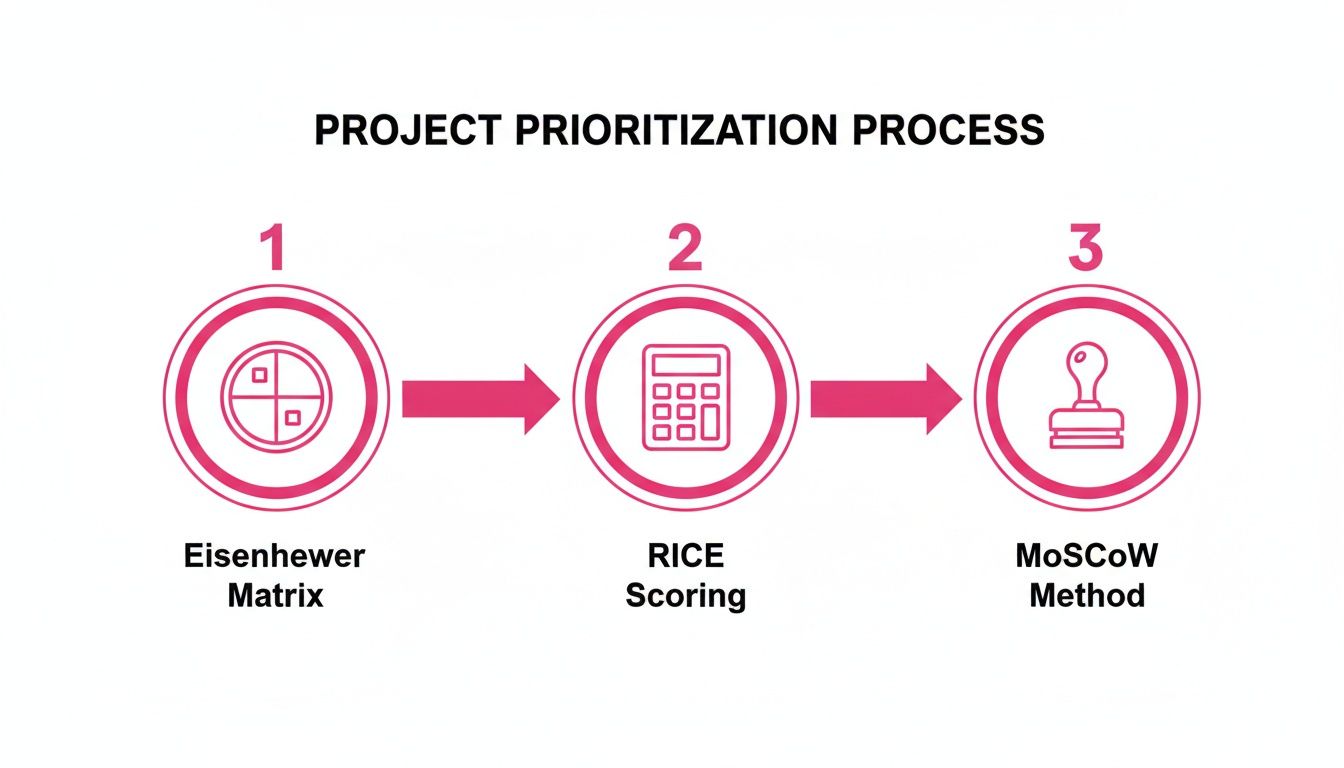
As you can see, the core idea is to apply a consistent filter to everything that comes your way.
In the real world, effective task prioritization is a massive competitive advantage. Research shows that teams who nail this are 1.4 times more likely to smoke their competition. And yet, a wild 82% of people admit they don't use any formal time management system. That gap is a huge opportunity for you and your team to pull ahead, and it all starts with a simple, consistent workflow.
Communicating Your Priorities Without More Meetings
You’ve done the hard work. You’ve wrangled your to-do list, applied a killer framework, and now you know exactly what matters most. But here's the catch: those priorities don't live in a vacuum.
If your manager, team, and key stakeholders are in the dark, get ready for a storm of "Just checking in!" messages and last-minute meeting invites that will blow your perfectly planned week to bits.
The old way of handling this was the soul-crushing weekly status meeting. You know the one—an hour-long snooze-fest where everyone just reads their task list aloud. It’s a colossal waste of everyone’s time.
Thankfully, there’s a much smarter way: make your priorities visible without a meeting. This is all about shifting to a more transparent, async-first workflow. It’s a total game-changer for your focus and sanity.
Adopt a Lightweight Work Log
The secret is to create a single source of truth for what you're working on. I'm not talking about some clunky, enterprise project management tool with a million fields to fill out. No, this is about something lightweight that gives your team the visibility they need with almost zero friction for you.
Think of it as a simple, human-friendly changelog for your workweek. You just jot down your key tasks and log your wins as they happen. It creates a running story of your progress that anyone can follow.
Here’s a great example from WeekBlast that shows just how clear and scannable this can be.
This simple format instantly tells everyone what’s planned, what you're tackling right now, and what's already done. Guesswork gone, clarity in its place.
This kind of always-on visibility is huge for building trust. It lets your manager stay in the loop without ever having to ping you, killing that constant stream of "What are you working on?" questions for good.
By making your priorities transparent, you're not just managing tasks; you're managing expectations. You give everyone the context they need, freeing you up to focus on the deep work that actually matters.
This one habit also pays massive dividends down the road. When performance review season rolls around, you won't be digging through old emails trying to remember what you accomplished nine months ago. You'll have a detailed, week-by-week archive of your contributions, ready to go. We dive deeper into these strategies in our guide to effective asynchronous updates.
At the end of the day, broadcasting your priorities is the final, crucial piece of the puzzle. It protects your focus, nukes needless meetings from orbit, and gets everyone pulling in the same direction.
Got a Minute? Let's Talk About Those Lingering Questions
Look, even with the slickest frameworks in your back pocket, real life has a funny way of throwing a wrench in your perfectly prioritized plans. A surprise project drops, a "quick question" turns into an hour-long ordeal... sound familiar?
Let's dig into some of the most common questions that pop up when the rubber meets the road. We'll cover how to handle those curveballs, get your team to actually use a new system, and know when it’s time to change things up.
What’s the Best Way to Handle Unexpected Tasks?
The best defense is a good offense. I learned this the hard way. Always, and I mean always, build some slack into your schedule. I aim for 15-20% of my day as a buffer for the inevitable chaos.
When a new "urgent" task lands on your plate, resist the knee-jerk reaction to just do it. Pause. Take a breath. Run it through a quick mental Eisenhower Matrix.
Ask yourself:
- Is this really both urgent and important? If it is, it might be worth hitting pause on what you're doing.
- Is it urgent but not important? This is a golden opportunity to delegate. Who on the team can tackle this?
- Is it important but not urgent? Perfect. Acknowledge the request, let them know you’ve got it, and slot it into your schedule for later. This protects your deep work time.
This little mental checkpoint stops low-value "emergencies" from completely derailing your day. You're making a conscious choice, not just reacting to whatever's making the most noise.
How Do I Get My Team to Actually Use a Prioritization Method?
Trying to shove a new system down your team's throat is a surefire way to get a whole lot of eye-rolling and zero adoption. You have to start with the "why."
Don't just march in and announce, "Alright, everyone, we're using the RICE method now!" Nobody likes that. Instead, frame it around a pain point everyone is feeling.
Try opening a conversation like this: "Hey team, I've noticed we're all feeling pulled in a million directions lately. I think if we had a clearer system for our priorities, it could cut down on stress and help us all focus on what really matters. What if we tried..."
Getting buy-in isn't about top-down mandates; it's about solving a problem together. Pitch the new method as an experiment to fix a shared headache, not just another rule from on high.
Even better, run a small pilot. Test it out on one project or with a couple of team members who are open to new ideas. When everyone else sees how it brings clarity and calms the chaos, they'll be lining up to try it themselves.
When Should I Switch My Prioritization Strategy?
Think of your prioritization framework like a tool in a toolbox, not a lifelong commitment. You wouldn't use a hammer to turn a screw, right? The right tool depends on the job at hand. It's time to swap out your strategy when it starts feeling more like a burden than a help.
Think about making a switch if:
- Your Role Changes: The Ivy Lee method might have been perfect for you as an individual contributor. But now that you're a manager juggling team projects, the big-picture view of the Eisenhower Matrix might serve you better.
- The Work Itself Shifts: A team that's been in a chaotic, all-hands-on-deck bug-fixing mode will need a different system once they move into long-term, strategic feature planning. That's when something data-driven like the RICE method can really shine.
- It Just Feels Like a Chore: If your system is creating more admin work than it's providing clarity, ditch it. The goal here is less friction, not more.
At the end of the day, the best strategy is the one you'll actually stick with. Check in with yourself every so often. Is this still working for me? If the answer is no, don't be afraid to experiment with something new until you find what clicks.
Stop losing track of your hard work. WeekBlast gives you a lightweight, high-speed work log to capture wins, share progress, and build a searchable history of your contributions without the hassle of status meetings. Start your free plan today and never forget the work you did.


