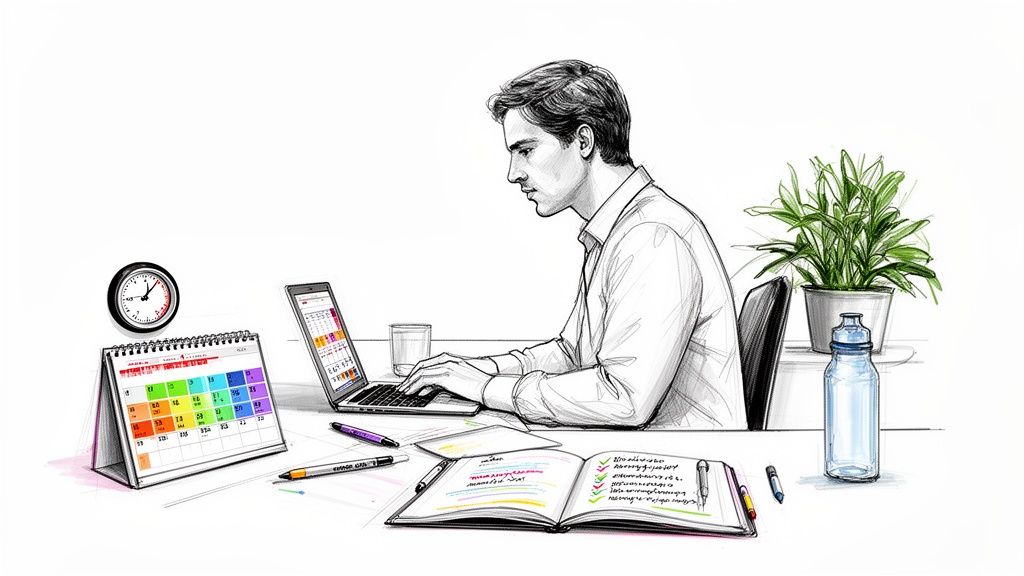
Staying focused isn’t about brute force or willpower. It's about having a game plan—a deliberate system for planning your day, managing your attention, and controlling your environment. The secret is to proactively design your day for deep work instead of just reacting to whatever dings, pings, or pops up next.
But first, let's get real about why your focus is so shattered in the first place.
Why Staying Focused at Work Feels Impossible Right Now
If your workday feels like a frantic game of whack-a-mole with notifications, last-minute requests, and your own wandering mind, you're not imagining things. It's so easy to chalk it up to a personal failing, but the modern work environment is a focus-shredding machine. Your brain isn't broken; it's just completely overwhelmed.
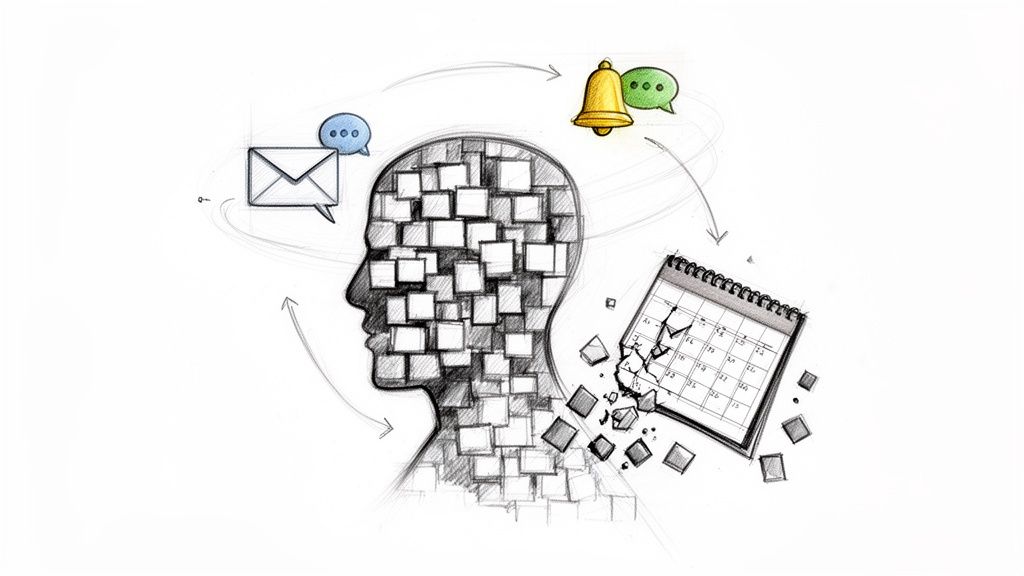
This feeling of being pulled in a million directions isn't your fault. It's a systemic problem. The constant barrage of pings and emails practically forces you into context switching, making your brain jump from one unrelated task to another. Every single one of those switches comes with a cognitive cost, draining your mental battery and making it that much harder to get back into the groove.
The Great Multitasking Lie
For years, we’ve been told that multitasking is a superpower. The truth? It’s a myth. Neuroscience has shown that what we call multitasking is really just rapid task-switching, and it's a productivity killer.
Every time you glance at a Slack notification while trying to code, or check an email while drafting a proposal, you’re fracturing your attention. It leaves you feeling busy, sure, but at the end of the day, you haven't actually accomplished much of anything meaningful.
The data backs this up in a big way. One eye-opening study found that 92% of employers call lost focus their number one workplace challenge, and a staggering 80% of employees admit they struggle to get into a state of deep work. On average, we’re truly productive for less than five hours a day. You can see the full breakdown of workplace focus stats here. This constant fragmentation is a direct path to burnout.
The real challenge isn’t finding more time in your day; it’s protecting the time you already have. Your goal is to create uninterrupted blocks where you can make real progress on meaningful work.
Before we dive into the solutions, it helps to see the enemy clearly. Here’s a quick look at the habits that destroy your focus versus the ones that build it back up.
Common Focus Killers vs Powerful Focus Builders
This table contrasts common unproductive habits with their effective, focus-building alternatives, offering a clear path to reclaiming your workday.
| Common Focus Killer | Effective Focus Builder |
|---|---|
| Reacting to notifications instantly | Scheduling specific times to check email/messages |
| Juggling multiple tasks at once | Single-tasking on one priority at a time |
| Leaving all tabs and apps open | Closing everything unrelated to the current task |
| Vague to-do lists | Defining 1-3 Most Important Tasks (MITs) for the day |
| Working in long, unstructured blocks | Using a timer (like the Pomodoro Technique) |
| A cluttered, distracting workspace | Creating a dedicated, organized "deep work" zone |
| Never taking real breaks | Scheduling short, restorative breaks to recharge |
| Starting the day without a plan | Time-blocking your calendar the day before |
Seeing them side-by-side makes it obvious, right? The goal isn't to become a robot, but to replace bad habits with intentional, powerful ones.
So, How Do We Fix This?
Alright, how do you actually reclaim your focus in a world seemingly built to distract you? It's not about "trying harder." It's about working smarter by building a new system. The strategies in this guide are designed to do just that—protect your most valuable asset: your attention.
Instead of fighting an uphill battle with willpower, you'll learn to:
- Design a proactive schedule that puts your most important work front and center.
- Manage your attention with proven techniques that build mental stamina over time.
- Optimize your environment to cut interruptions off at the pass.
It all starts with a simple but powerful idea: tracking your small wins. By creating a positive feedback loop that rewards focus, you can start to rebuild your attention span one small victory at a time, turning a fragmented day into a string of real accomplishments.
Design Your Day for Deep Work and Real Progress
Stop letting your calendar and inbox run your life. If you want to get anything meaningful done, you have to stop reacting and start designing your day. It’s about building a fortress around your focus, actively protecting your brainpower from the chaos that’s always trying to break in.
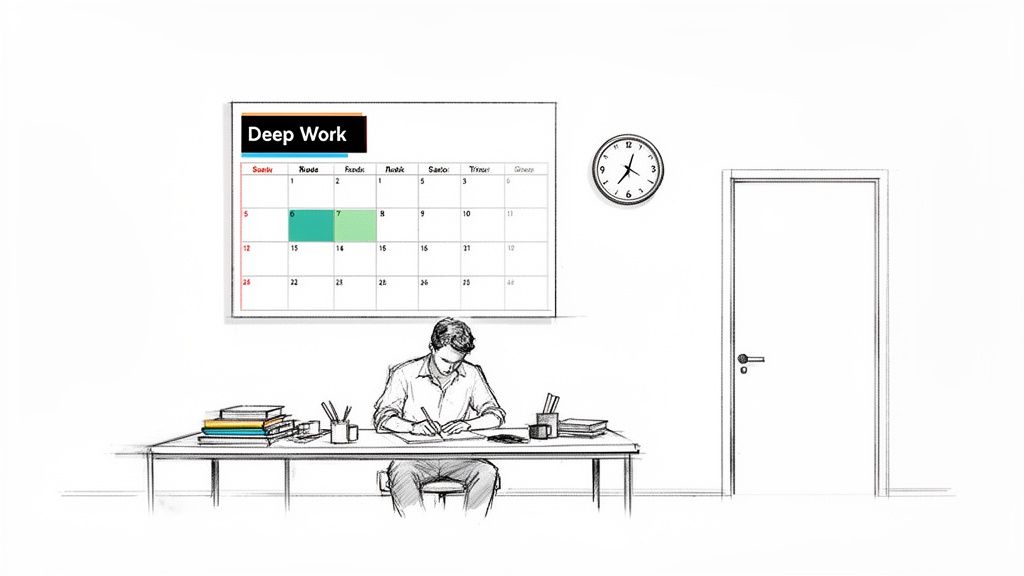
Think of it this way: there’s a world of difference between a developer who just hopes for a quiet afternoon to code and one who carves out a four-hour "do not disturb" session to crush a complex feature. One is wishing, the other is winning.
Master Your Calendar with Time Blocking
Time blocking is your best friend here. It's simple: instead of just having a to-do list, you give every minute of your day a job. You schedule everything—from deep work to checking emails—directly onto your calendar.
This isn’t about becoming a robot. It’s actually the opposite. It frees you from the constant, draining mental gymnastics of figuring out, "What should I do next?"
A marketer's time-blocked schedule might look something like this:
- 9:00 AM - 9:30 AM: Dig into campaign analytics, plan today's tweaks.
- 9:30 AM - 11:30 AM: Deep work. Phone off. Write new ad copy.
- 11:30 AM - 12:00 PM: Email blitz.
When you've already decided what to do and when, all that's left is to execute. You just follow the plan.
Pinpoint Your Most Important Tasks (MITs)
Before you can block your time, you have to know what actually deserves a block. This is where your Most Important Tasks (MITs) come in. Every day, pick the one to three things that, if you got them done, would make the day a huge success.
Your MITs are the pillars of your day. If the world catches fire but you get your MITs done, you still win. You end the day feeling accomplished, not just busy.
This forces you to stop confusing urgent noise with truly important work. We all get caught up in putting out small fires, but MITs are about building the fire station. If you need a hand sorting this out, our guide on how to prioritize tasks effectively breaks down some killer frameworks.
Getting clear on your priorities is a massive weapon against distraction. When you’re disconnected from your work, it’s easy to get sidetracked. A shocking Gallup report found that only 23% of employees worldwide feel engaged. That’s a catastrophic loss of focus and productivity. When you have a clear purpose—your MITs—you naturally stay on track because you can feel yourself making progress.
The Underrated Power of Doing One Thing at a Time
Finally, you have to commit to single-tasking. I mean really commit.
When your calendar says it's time to write that proposal, that is the only thing you are doing. Close the 27 other browser tabs. Mute Slack. Put your phone in another room. Seriously.
This is how you get into a "flow state"—that magical zone where you're completely absorbed and doing your best work. Every time you switch tasks, even for a second, you force your brain to reboot, draining your mental battery and killing your momentum.
By designing a day around single-tasking your MITs inside of dedicated time blocks, you’re not just hoping for focus. You're engineering it.
Proven Techniques to Sharpen Your Daily Focus
Okay, you’ve set up your workspace to be a fortress of solitude. Now it's time to stock the armory. These aren't just clever life hacks; they're the mental equivalent of going to the gym, designed to build your attention stamina and keep you locked in when it counts.
Think of your ability to focus as a muscle. You wouldn't walk into a gym for the first time and try to deadlift 500 pounds, right? Likewise, you can't expect to go from a state of constant distraction to four hours of pure, uninterrupted deep work overnight. You have to train for it.
The Pomodoro Technique: Focus Sprints for Your Brain
One of the best training programs out there is the Pomodoro Technique. It sounds almost too simple to work, but that’s the beauty of it. The structure is what makes it so powerful.
Here’s the basic routine:
- Pick one thing. Just one. Seriously, no multitasking.
- Set a timer for 25 minutes. This is your do-not-disturb sprint.
- Work on that one thing—and only that one thing—until the timer dings. No email peeking, no social media scrolling. Nothing.
- Take a 5-minute break. Get up, stretch, grab a glass of water. The key is to step away from your screen.
- Rinse and repeat. After you’ve knocked out four of these "Pomodoros," give yourself a longer, more rewarding break of 15-30 minutes.
This isn't just about managing time; it's a way to rewire your brain's response to distractions. It proves to that frantic, squirrel-chasing part of your mind that you can ignore the shiny new thing for a manageable chunk of time. It's a game-changer.
Create a Distraction Inventory
So what do you do with those "brilliant" ideas that pop into your head mid-sprint? A random to-do you just remembered, a question for a colleague, or that sudden, urgent need to know the average flight speed of an unladen swallow. These internal interruptions can be just as deadly as a Slack notification.
The answer is a distraction inventory.
Keep a simple notepad or a text file open next to you. The moment a stray thought pops into your head, just write it down and immediately get back to what you were doing.
This simple act of "parking" the thought calms your brain down. It knows the idea won't be forgotten, which frees you up to get back in the zone. It’s like telling your brain, "I got this, we'll deal with it later."
For a more integrated approach, you can use a daily work log template to park these thoughts right alongside your progress notes. Everything stays in one neat place.
Tame Your Digital Workspace
Your digital environment is just as real as your physical one. A chaotic desktop with a million open tabs is a focus-killing machine, a virtual funhouse designed to pull you in a dozen different directions. It's time to embrace a little digital minimalism.
First, silence the noise. Be absolutely ruthless about turning off non-essential notifications on your computer and phone. Modern operating systems have fantastic "Focus Modes" that let you choose which apps and people are allowed to interrupt you. Use them. Liberally.
Next, it's time to declutter that browser. There are great extensions that can block distracting websites during your work blocks. I’m also a huge fan of creating a separate browser profile just for work—it has its own bookmarks, its own extensions, and zero temptations. It’s like walking into a clean, organized office; it instantly signals to your brain that it’s time to get down to business.
Build a Workflow That Actually Reinforces Your Focus
Okay, we've covered a bunch of great techniques. But let's be honest, individual tactics can feel like loose parts rattling around in a toolbox. Now it's time to build the engine—a simple, repeatable workflow that makes focus feel less like a chore and more like a game you actually want to win.
The old way of working is just broken. We grind away on huge projects for weeks, getting that single hit of dopamine only when the whole thing is finally done. This starves our brains of positive reinforcement, making it way too easy to get sidetracked by the cheap, instant gratification of a notification or a quick scroll.
We can completely flip that script with one powerful habit: micro-logging.
The Underrated Power of Capturing Small Wins
Micro-logging is exactly what it sounds like: quickly jotting down your progress the moment it happens. It's not about writing an essay; it’s about capturing a small win in a single sentence. This simple act shifts your entire workday from a grueling marathon into a series of satisfying little sprints.
What does this look like in the real world?
- An engineer might log:
"Finally squashed that pesky CSS bug on the login page." - A marketer could note:
"A/B test results are in—the new headline boosted clicks by 15%!" - A manager might document:
"Team sync done. Q3 roadmap decisions are locked in."
Each entry is a tiny burst of accomplishment. You're not just tracking work; you're building a tangible, visual record of your momentum.
Suddenly, you have a living document that proves you're making a difference. That's a ridiculously powerful motivator to keep going.
This feeling of progress is desperately needed. A staggering lack of engagement is plaguing workplaces, with research showing that only 21% of global employees feel genuinely connected to what they do. This disengagement costs the global economy trillions, while teams that feel a sense of forward motion see 18% higher productivity and 23% more profits. Building a system for visible progress isn't just a nice-to-have; it's a competitive advantage.
Your brain craves feedback. When you feed it a steady diet of small wins, you're not just logging tasks—you're gamifying your own focus and turning productivity into a rewarding habit.
Kill Context Switching with Async Updates
This micro-logging system has a fantastic side effect: it absolutely murders those "Hey, quick question..." pings that shatter your concentration. When your progress is automatically shared in a feed like WeekBlast, your team gets constant, silent visibility into what you're doing.
No more shoulder taps. No more pointless status meetings. Your work log becomes the single source of truth, letting everyone stay in the loop without yanking each other out of deep work. It’s a fundamental shift from disruptive interruptions to calm, ambient awareness.
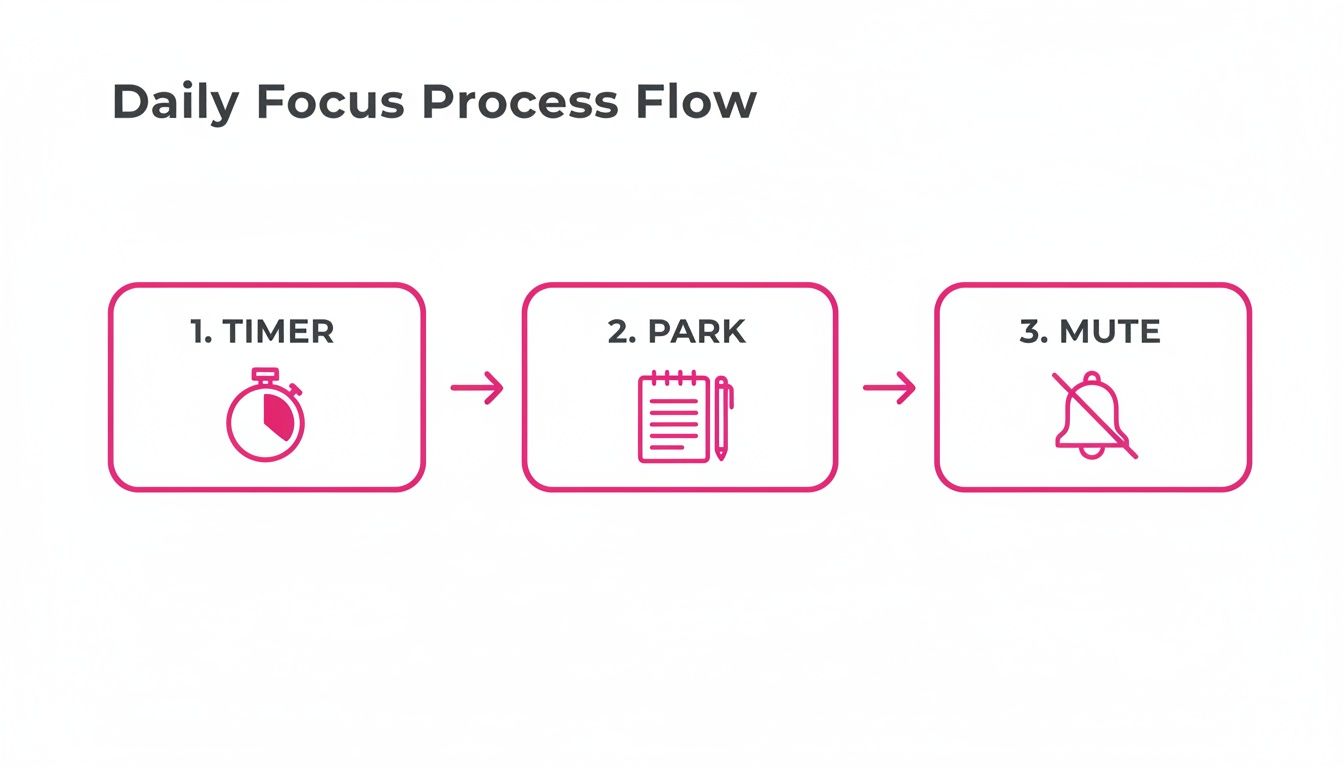
This simple cycle—timer on, distractions parked, notifications off—is the core loop for building your focus muscle.
Your New Daily Focus Workflow
So, how do you pull this all together into a daily habit? It's simpler than you think. Here’s a concrete workflow you can steal and start using today.
- Set Your MITs: First thing in the morning (or the night before), define your 1-3 Most Important Tasks for the day. Be realistic.
- Block Your Time: Get on your calendar and schedule dedicated, do-not-disturb blocks for those MITs.
- Start a Pomodoro Sprint: Pick your first MIT, set a 25-minute timer, and just start.
- Log Your Progress: When the timer dings or you finish a chunk of work, take 30 seconds to micro-log your win. Seriously, just 30 seconds.
- Take a Real Break: Get up. Walk around. Stare out the window. Do anything but look at a screen for five minutes.
- Rinse and Repeat: Fire up the next Pomodoro and go again.
By weaving these simple habits together, you stop hoping for a focused day and start engineering one.
For more practical tips on keeping your tasks and thoughts in order, check out our deep dive on how to stay organized, which is the perfect companion to this workflow.
Get Your Space and Energy in Check for Maximum Focus
Let's be real. All the fancy scheduling tricks in the world won't help you if your desk looks like a disaster zone and your brain is powered by lukewarm coffee and sheer willpower. Staying focused at work isn't just a mental battle; it's a physical one. Your environment and your body's own energy levels are huge players in this game.
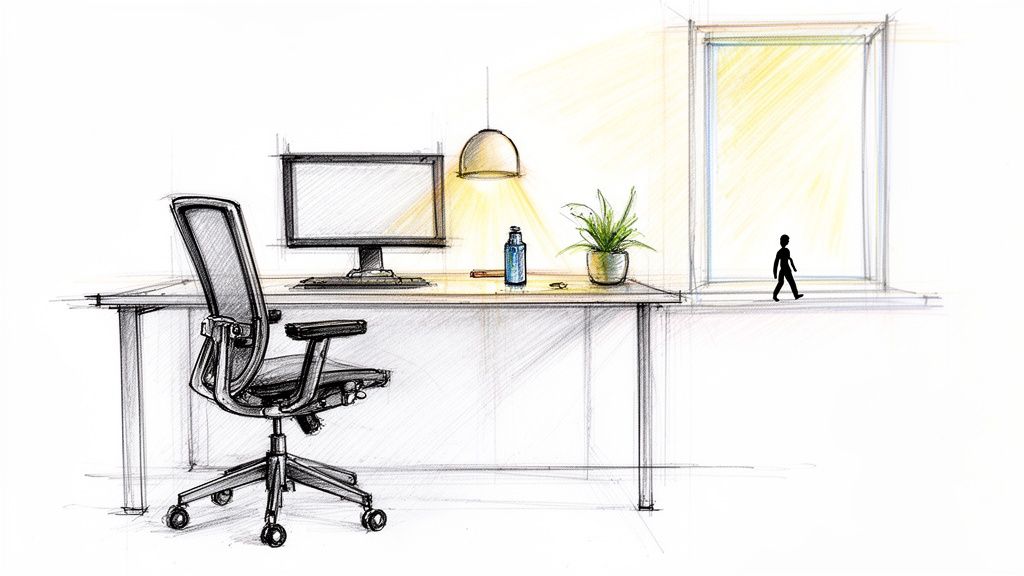
Think of it this way: a cluttered desk is constantly sending little signals to your brain, whispering about all the other things you could be doing. Bad lighting? It's a literal energy vampire. These tiny points of friction pile up, making it nearly impossible to get into that elusive state of flow.
Build a Workspace That Works for You
Your desk should be a launchpad for deep work, not a graveyard for old post-it notes and half-empty mugs. Seriously, clear everything off that isn't absolutely essential for what you're doing right now. This isn't just about being neat; it's about eliminating the visual noise that pulls at your attention.
Then, think about what you're hearing (or not hearing). Is your office dead silent or a chaotic symphony of keyboard clicks and chatter? Some of us need the cone of silence, while others actually focus better with some ambient noise, like the buzz of a café or a good instrumental playlist. Don't be afraid to experiment with noise-canceling headphones or an app that plays background sounds to find your sweet spot.
Lighting is another secret weapon. If you can, set up shop near a window for natural light. If you're stuck in a cubicle cave, a good desk lamp that mimics daylight can make a world of difference. And for goodness sake, get comfortable! A chair that doesn't kill your back and a monitor at eye level will prevent physical discomfort from morphing into mental fatigue.
Stop Managing Your Time—Manage Your Energy Instead
This is one of those secrets that, once you learn it, changes everything. The most focused people I know don't just manage their time; they manage their energy. We all have natural high and low points during the day. The trick is to stop fighting them and start working with them.
Are you a morning person who's firing on all cylinders at 9 AM? Awesome. That's when you crush your Most Important Task. Do you get a creative burst of energy around 3 PM? Perfect time for brainstorming. Trying to do complex work when you're in a slump is like trying to drive with the parking brake on.
This mindset shift applies to your breaks, too. Mindlessly scrolling Instagram for ten minutes isn't a break. It's just swapping one type of screen-based brain drain for another.
Try taking breaks that actually hit the reset button:
- Move your body: A quick walk around the office or even a few stretches can get your blood pumping and clear the mental cobwebs.
- Drink some water: Dehydration is a productivity assassin. Keep a water bottle at your desk and stay ahead of it.
- Give your eyes a break: Look out a window and focus on something far away for a minute. Your eyes will thank you.
When you intentionally shape your physical space and sync your work with your body's rhythm, focus stops feeling like a chore. You’re setting the stage for deep work to happen naturally.
Got Questions About Staying Focused? We've Got Answers.
Alright, so you’ve got the strategies. But let's be real, the moment you try to implement a new system, life throws a wrench in it. It's totally normal.
Let's dive into some of the most common "yeah, but..." questions people have when they start trying to wrangle their focus.
How Long Until This Focus Thing Actually Clicks?
This is the big one, isn't it? You're putting in the effort, and you want to know when you'll feel the payoff.
The textbook answer, based on research, is that it can take an average of 66 days for a new habit to feel like second nature. But please, don't get hung up on that number.
The goal isn't to be a perfect, time-blocking robot from day one. The secret is just to start. Like, ridiculously small. Can you commit to a single 25-minute focus block today? That's it. Do that, log the win, and feel that tiny jolt of accomplishment. That's the stuff that builds momentum and rewires your brain for good.
My Job is 100% Reactive. Is Deep Work a Lost Cause?
I hear this all the time from managers, support leads, and anyone whose job is basically putting out fires. When your entire day is a series of interruptions, a four-hour deep work session sounds like a fantasy.
And you're right. It is. So, don't even try.
The game here is to think in terms of "micro-focus."
You don't need a four-hour block. All you need is 15 minutes. A tiny, fiercely protected window of single-tasking between meetings can be the most productive part of your day.
Block these short sprints on your calendar. Throw up a Slack status that says, "Heads down until 11 AM." It's not about finding massive chunks of time; it's about reclaiming the little pockets you already have.
What About When I'm the Distraction?
Ah, the internal monologue. Sometimes the pings aren't coming from Slack, they're coming from inside your own brain. A random "Oh, I need to buy milk" or "Did I ever email Susan back?" can completely derail you.
This is where you need a "thought parking lot."
Keep a notepad—digital or physical—right next to you. The second one of those random thoughts pops into your head, just scribble it down. Don't act on it. Just get it out.
This simple act tells your brain, "I see you, I've got this, we'll deal with it later." It clears your mental runway so you can get right back to the task at hand without skipping a beat. It sounds almost too simple to work, but it's a game-changer.
Ready to stop your progress from vanishing into thin air? WeekBlast is a high-speed work log built to capture your wins in seconds. Ditch the disruptive status meetings and get a clear, async feed of what's actually getting done. Start your free plan on WeekBlast and never forget the work you did.


