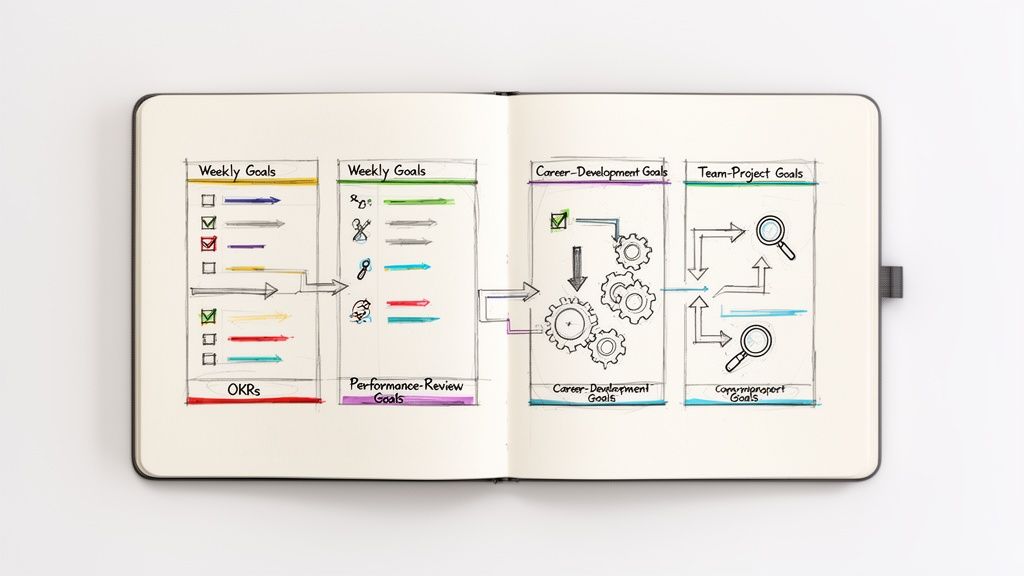
A solid goal setting template isn't just a document; it's the bridge that connects your big ambitions to actual, tangible achievements. It’s what turns a fuzzy wish into a concrete plan of attack.
Why Your Current Goals Keep Falling Flat
Let's be honest. We’ve all made that ambitious list of New Year’s resolutions, only to see it lose steam by February. If that feels familiar, you're definitely not alone. Most goals fail not because we lack desire, but because we lack a clear, structured path to follow.
We tell ourselves things like "I need to get better at my job" or "we have to increase sales." These feel productive to write down, but they’re essentially dead on arrival. Why? Because they don't give you a destination. Without a specific endpoint, you can't possibly map out a route, so you just end up wandering until your motivation fizzles out. This is where burnout and inaction start to settle in.
The Problem with Vague Ambitions
When your goals are fuzzy, you have no way of knowing if you’re actually making progress. Are you getting closer, or just spinning your wheels? This uncertainty is a major momentum killer. It’s like trying to build a piece of furniture with all the parts scattered on the floor but no instruction manual. You might have all the right pieces, but you have no clue how they're supposed to fit together.
Motivation will only get you so far. Real, lasting momentum comes from seeing the needle move. A good template gives you that crucial visual feedback, reinforcing your commitment and helping you push through when things get tough.
The real magic of a goal setting template isn't about being organized, it's about forcing clarity. It takes a vague idea like "grow the business" and transforms it into an actionable target: "I will acquire 50 new customers by the end of Q3."
Structure Is Not Optional
The data on this is crystal clear. A Leadership IQ survey of nearly 13,000 people found that only 30% felt a sense of urgency to act on goals that lacked structure. On the flip side, when you apply a solid framework, everything changes. One study showed that teams using simple criteria like SMART hit their targets 90% more reliably, simply because the framework demanded measurable results.
To put it another way, unstructured goals are a gamble. They depend on fleeting moments of inspiration instead of a deliberate, repeatable process. This is exactly why creating a powerful goal setting template is the first real step toward turning your ambitions into accomplishments. It’s the foundation for everything that follows, and it’s a critical part of learning how to stay focused at work.
Crafting a Goal Template That Actually Works for You
Let's be honest: most generic goal-setting templates are doomed from the start. A one-size-fits-all approach just doesn't work because it isn't built for you. The real power comes from creating a custom template from scratch, one that reflects how you think, work, and define success. This turns a simple document into your personal roadmap.
It all starts by defining your "North Star." This isn't just a vague wish; it's your big-picture objective, the compelling vision that fuels all the smaller tasks. It's the 'what' and the 'why' that gets you going every day. For a software developer, "get better at coding" is a wish. "Become the go-to expert on our new payment integration system in the next six months" is a North Star.
Once you have that guiding light, you can start building a structure around it. This is where leaning on a proven framework can save you a lot of headaches.
Choosing Your Goal Setting Framework
Different goals need different approaches. I've found that most successful plans rely on one of two powerhouse frameworks: SMART or OKRs. They provide the scaffolding you need to break down that big North Star into something you can actually work on day-to-day.
To help you pick the right one for your template, here’s a quick breakdown of the most popular methodologies.
| Framework | Best For | Core Concept |
|---|---|---|
| SMART Goals | Specific, short-term projects and individual tasks. | Makes goals Specific, Measurable, Achievable, Relevant, and Time-bound, removing all ambiguity. |
| OKRs | Ambitious, long-term strategic initiatives for teams or individuals. | Sets a high-level Objective and tracks it with 3-5 measurable Key Results that define progress. |
| HARD Goals | Pushing boundaries and driving motivation through challenge. | Goals are Heartfelt, Animated, Required, and Difficult, tapping into emotional drivers. |
Choosing a framework isn't just about preference; it's about giving your ambition a backbone. Without that structure, it's incredibly easy to fall into a cycle of failure. You start with a fuzzy idea, flounder without a clear path, and eventually just burn out.

This is what happens when good intentions meet poor planning. Your template is the guardrail that keeps you on track and away from that all-too-common dead end.
Putting Your Framework into Practice
Now for the fun part: building the template itself. You don't need fancy software. A simple spreadsheet or a document in a tool like Notion or Evernote works perfectly. The important thing is creating fields that force you to think through the details. If you need some inspiration, checking out different goal statement examples can show you how others articulate their targets with clarity.
Make sure your template has dedicated spots for these key elements:
- The Goal Statement: A clear, concise sentence written using your chosen framework (like SMART or OKR).
- Key Milestones: Break the main goal into smaller, bite-sized steps. What are the major checkpoints you need to hit along the way?
- Success Metrics: How will you know you've won? Define the specific numbers, percentages, or tangible outcomes that signal success.
- Deadline: Give the overall goal a firm deadline. Just as important, assign due dates to each of your milestones.
Here's a pro tip: Add a "Not-To-Do List" to your template. Deciding what you're going to stop doing is often more powerful than deciding what to start. It frees up the focus and energy you need to pour into the things that truly matter.
How Consistent Tracking Keeps You Motivated
A great template is just a map, it shows you the destination. But the real work, the actual journey, happens day by day. This is where consistent tracking comes in. It’s the difference between a goal that lives on a document and one that actually gets achieved. Following through is what transforms your goal setting template from a static plan into a living, breathing source of motivation.

There’s a simple psychological reason this works so well. When you break a massive goal into small, weekly chunks, you create a steady stream of "small wins." Every time you check something off your list, you get a little jolt of satisfaction that builds momentum. It’s a powerful feedback loop.
This turns vague ambitions into concrete proof of your effort. It’s one thing to say, "I want to run a marathon," but it's another thing entirely to look back at your log and see 15 successful training runs over the past month. That visible evidence is what keeps you going when motivation dips.
The Power of Visualizing Progress
Seeing your progress laid out in front of you is a huge deal. It creates a visual record of your hard work that’s impossible to ignore, especially on those days when you feel like you’re just spinning your wheels. This isn't just about feeling good; it directly impacts performance.
Believe it or not, employees with clearly defined goals are 14.2 times more likely to feel inspired and 3.6 times more inclined to put in extra effort. It gets even better when you add visuals. According to research from Mooncamp.com, people who visualize their goals are 52% more likely to love their job. This shows that seeing your wins, no matter how small, is what fuels the fire.
A goal without a tracking system is just a wish. The simple act of logging your progress holds you accountable to your future self and is the one habit that truly guarantees you’ll get there.
Making Tracking a Natural Habit
The trick is to make tracking feel effortless, not like another task on your to-do list. Your goal setting template needs to fit right into your existing workflow. If it's a pain to update, you simply won't do it. That’s why a straightforward weekly progress report is one of the most powerful tools you can use. We actually have a whole guide on writing a weekly progress report template if you want to dive deeper.
Here are a few tips I've seen work time and time again:
- Schedule a Weekly Check-in: Block out just 15 minutes every Friday to review your milestones and log what you’ve accomplished. It’s a small commitment that creates a powerful rhythm.
- Keep Your Tools Simple: A bulleted list in an email or a quick update in a tool like WeekBlast is often more sustainable than a clunky, oversized project management platform. The less friction, the better.
- Track Actions, Not Just Outcomes: Don't just focus on the final number. Log the effort you put in, like "made 10 sales calls" or "completed two code reviews." This rewards the grind and keeps you motivated even when results are slow to come.
When you connect your daily work to your long-term vision this way, your template becomes more than just a plan. It becomes a daily reminder of where you’re headed and a clear record of how far you've come.
Integrating Your Template with WeekBlast for Seamless Updates
A great goal setting template is a powerful starting point, but let's be honest, it's only half the job. If that beautifully crafted plan just sits in a shared drive, it’s not actually helping anyone. It's just collecting digital dust. The real magic happens when you connect your goals to your team's day-to-day work, making progress visible and continuous.
That’s why I’m a big fan of integrating my plans with a tool like WeekBlast. It bridges the gap between your static goals and the dynamic, real-time work your team is doing. Instead of getting bogged down in a clunky project management app, you can build a living record of your progress with almost no extra effort.
Turning Milestones into Actionable Updates
The whole system is built on a dead-simple idea: logging progress should be as easy as sending an email.
You just send your updates directly to a special address: [email protected]. The system is smart enough to strip out all the email fluff (signatures, headers, reply chains) and posts your clean update to a personal work log. It takes seconds.
This tiny action is what turns your static plan into a compelling story of progress. Here’s how I’ve seen it play out in practice:
For an Engineering Team: Let's say their goal setting template has a two-week sprint to ship a new feature. Each day, a developer can fire off a quick email with a single bullet point like, "Completed unit tests for the authentication module," or "Pushed final front-end changes to staging." Without a single meeting, you get a complete, time-stamped history of the entire sprint.
For a Marketing Manager: Imagine your Q3 goal is a big ad campaign launch. Your template milestones might be things like "Finalize ad creative" or "Set up audience targeting." As you knock each one out, you send a quick blast. This creates a crystal-clear audit trail of the campaign's journey from an idea to a live test.
This screenshot shows you exactly how those messy emails are transformed into a clean, easy-to-scan feed.
As you can see, the raw email on the left is automatically parsed into the structured, searchable log entry on the right. This makes documenting your work feel effortless.
Gaining Visibility Without Constant Interruptions
For managers, this is a total game-changer. You get real-time visibility into what your team is actually shipping without having to constantly ping them with "What's the status on...?" or derail their focus with daily stand-ups. Research has found that context switching can cost a person up to 23 minutes of productive time for every single interruption. This async approach gives that time back.
The goal is to make progress logging so easy it becomes an automatic habit. When updates take just a few seconds, you're more likely to do them consistently, which builds a rich and reliable history of your accomplishments over time.
By following a team member’s feed in WeekBlast, you get silent, always-on awareness of what's getting done. This frees everyone up to do the deep, focused work they were hired for while keeping the whole team aligned. It’s the perfect way to connect individual actions directly back to the goals in your template, making sure everyone is moving in the right direction.
Using Goal Templates for Team Alignment and Reviews
A personal goal template is a fantastic tool for an individual, but the real magic happens when an entire team adopts the same framework. When you create a unified template, you’re essentially building a shared language for what success looks like. Everyone starts pulling in the same direction.
This simple act of alignment transforms a collection of individual efforts into a focused, cohesive force driving toward your most important objectives.

When every team member documents their progress using the same structure, managers get a clear, unfolding story of everyone's contributions. I like to call this "silent visibility." It completely replaces the need for invasive micromanagement because you can see the project's narrative develop without constantly interrupting your team’s flow.
For example, using a tool like WeekBlast, a manager can simply follow each person's feed. These feeds automatically collect the small, daily updates tied to the milestones in their templates. This creates a powerful, always-on view of progress and gives you total awareness without booking another meeting.
Make Performance Reviews Data-Driven
Let's be honest: performance reviews can be stressful. For managers and employees alike, that stress often comes from a lack of concrete data. It’s hard to remember key wins from months ago, and important contributions can get lost in the shuffle. A shared goal setting template system fixes this by creating a reliable, searchable log of work.
When review time rolls around, you no longer have to rely on fuzzy memories. Instead, you have a time-stamped history of every task, every milestone, and every goal. This turns a subjective conversation into a data-backed discussion about tangible impact.
The goal of a good review isn't to judge, but to accurately reflect an individual's journey and impact. Having a clear, searchable history of work makes this process fair, transparent, and significantly less stressful for everyone involved.
Modern tools like WeekBlast can even offer AI-generated summaries to do the heavy lifting for you. You can instantly pull a report on an individual's key accomplishments over the last quarter, giving you the exact evidence needed for a productive, meaningful review.
Handle Sensitive Projects and Find Key Evidence
Not every goal is meant for public consumption. You might have a small team working on a confidential new feature or a sensitive internal reorganization. A flexible system allows you to create private, firewalled groups where progress can be logged securely, visible only to a handful of people.
This is critical for maintaining confidentiality while still getting all the benefits of structured goal tracking. The team stays aligned without exposing sensitive information to the wider organization.
On top of that, one of the most underrated features of a digital work log is its searchability. Think about it. You need to find proof of a specific accomplishment from nine months ago.
- Who was it that led the Q1 client onboarding initiative?
- When exactly did the dev team push that critical bug fix?
- What was the final outcome of that marketing campaign from last summer?
Instead of digging through a mountain of old emails and documents, you just search the archive. A quick query for "onboarding" or a project codename can instantly pull up the exact updates that tell the story. Your team's entire work history becomes a powerful, accessible knowledge base.
Common Questions About Goal Setting Templates
Okay, so you've built this beautiful goal-setting template. Now what? It’s one thing to have a plan on paper; it's another to actually make it work day in and day out.
Once you start living with a new system, the real-world questions pop up. Let’s get ahead of some of the most common ones I hear so your template becomes a trusted sidekick, not another abandoned document.
How Often Should I Review My Template?
The trick is to find a natural rhythm that keeps your goals front and center without feeling like a chore. I’ve found a tiered approach works wonders for me and my teams.
- Daily Glance: A quick 60-second look over coffee is all you need. What's the one thing you need to get done today? This keeps your immediate tasks in focus.
- Weekly Review: Set aside 15-30 minutes on a Friday afternoon. This is your time to log what you actually accomplished, celebrate the small wins, and adjust your plan for the week ahead.
- Quarterly Check-in: Once every quarter, take a step back and look at the big picture. Are your long-term objectives still the right ones? Based on the last three months, do you need to pivot or double down?
This cadence keeps you connected to your ambitions on every level, from the daily grind to the grand vision.
What if I Fail to Meet a Goal?
First off, breathe. Missing a goal doesn't mean you've failed; it just means you've learned something. Think of your template as a lab notebook, not a report card. When you miss a target, you've just run a successful experiment.
Now, you get to ask the important questions. Was the goal a bit of a stretch to begin with? Did I get slammed with unexpected work that threw my timeline off? Was the deadline just plain unrealistic? The answers are gold.
Use that information to make your next move smarter. Maybe you need to break that goal into even smaller, more concrete steps. Or perhaps the deadline just needs a reality check. A goal setting template is a living document, so it’s supposed to change as you learn.
What Should I Stop Doing?
This is my favorite question, and it’s a game-changer. We're so focused on what we need to start doing that we forget to ask what we should stop doing. Creating a "Not-To-Do List" is one of the most powerful exercises you can do.
It forces you to be brutally honest about the tasks, meetings, or habits that are just draining your battery without giving much back. I do this as part of my Past Year Review, and it’s always an eye-opener.
When you consciously decide to ditch these energy vampires, you reclaim a surprising amount of time and mental space. That’s extra fuel you can pour directly into the goals that really move the needle.
Ready to turn your goals into a clear, searchable history of achievements? WeekBlast transforms your static template into a dynamic work log. Start logging your progress in seconds and give your team silent, always-on visibility. Get started for free at https://weekblast.com.