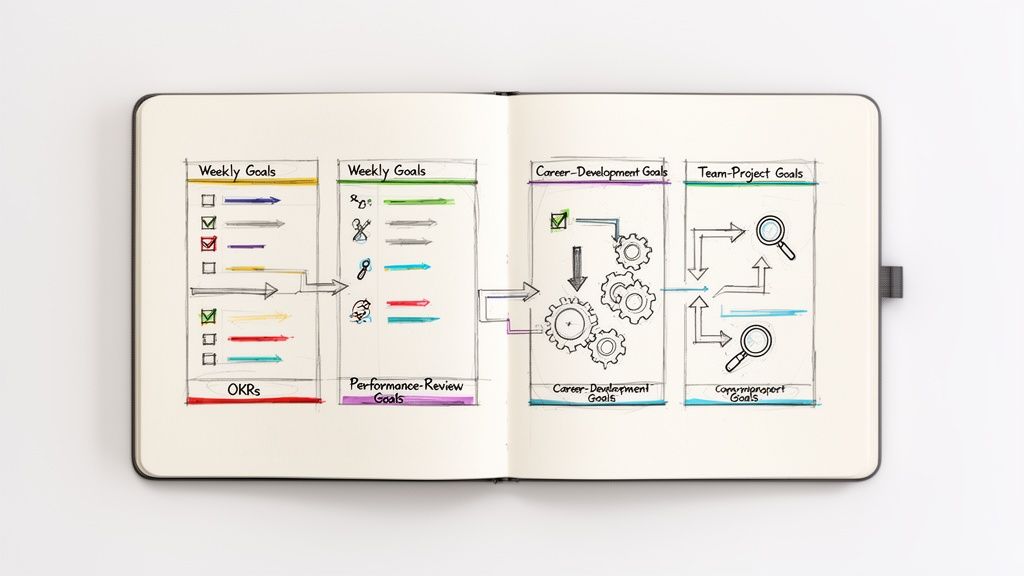
Setting goals is a common practice, but writing them effectively is a skill that separates high-achievers from the rest. A well-crafted goal statement transforms a wish into a concrete plan, providing clarity, motivation, and a clear path to success. Vague ambitions, such as 'get better at coding' or 'improve project management', often lead nowhere because they lack direction and a measurable outcome.
In contrast, a powerful goal statement acts as a roadmap. It guides your daily actions, keeps your focus sharp, and makes your progress undeniable. This is especially crucial in professional environments, where clarity ensures your individual efforts align with broader team objectives and company priorities. A good goal is not just about what you want to do; it's about defining precisely how you will do it and what success looks like.
This article provides a comprehensive collection of practical, real-world goal statement examples designed for immediate use. We will explore 10 distinct types of goals, from short-term career sprints to long-term aspirational targets. For each example, we break down its strategic value, convert it into the SMART framework, and provide copy-ready lines you can drop directly into a work log like WeekBlast. This approach helps you document your progress seamlessly, communicate your impact to managers, and turn your professional aspirations into tangible, measurable achievements.
1. SMART Career Goal Statement
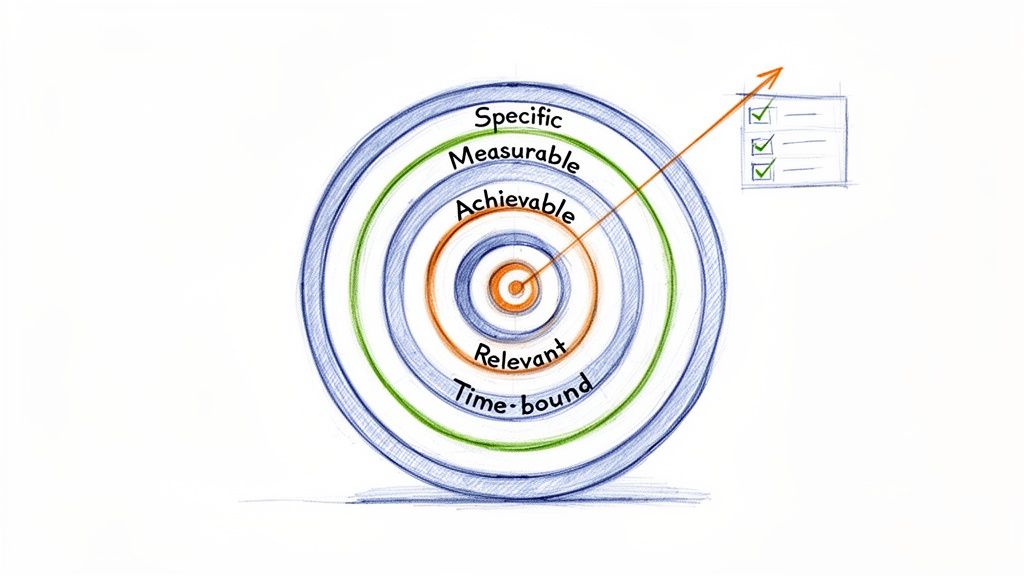
The SMART goal framework is the cornerstone of effective professional planning. It transforms ambiguous desires into a structured plan by ensuring your objectives are Specific, Measurable, Achievable, Relevant, and Time-bound. This method removes the guesswork from goal setting, creating a clear path from intention to accomplishment and making it a fundamental tool for any professional.
Why It Works
A SMART goal statement provides clarity and focus. For instance, an engineer's goal to "Improve the API" is vague, while "Increase API integration documentation coverage from 60% to 90% by the end of Q2" is a concrete target. This specificity makes it easy to track progress and hold yourself accountable, especially when logging weekly updates in a tool like WeekBlast.
Strategic Breakdown
- Specific: Clearly define what you want to achieve. Instead of "get better at coding," try "Complete the Advanced Python course on Coursera."
- Measurable: Define how you will track progress. Quantify your goal with metrics like percentages, numbers, or frequency.
- Achievable: Ensure the goal is realistic given your resources and constraints. Setting an achievable goal builds momentum.
- Relevant: Align the goal with your broader career aspirations and team objectives. This connection helps prioritize tasks effectively. If you're struggling with this step, our guide on how to prioritize tasks can provide a helpful framework.
- Time-bound: Set a clear deadline. A target date, such as "within 8 weeks" or "by end of Q3," creates urgency and prevents procrastination.
Actionable Examples for Your Work Log
Here are some goal statement examples formatted for easy tracking:
- For an Engineer: Deploy 3 major features (Project Phoenix, Titan, and Neptune) with zero critical bugs reported in the first 72 hours post-launch, all by September 30th.
- For a Product Manager: Reduce the average feature request resolution time from 5 business days to 2 business days within the next quarter by implementing a new triage system.
- For an Individual Contributor: Achieve AWS Certified Solutions Architect - Associate certification within 8 weeks, and document key learnings in a shared Confluence space.
2. Short-Term Goal Statement (30-90 Days)
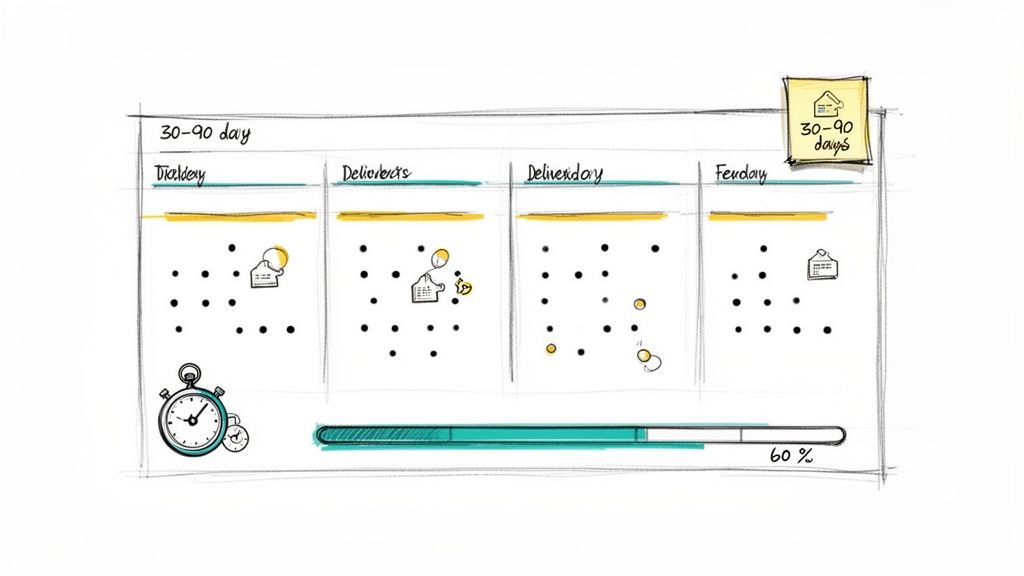
Short-term goal statements focus on immediate, achievable outcomes, typically within a 30 to 90-day window. They are essential for translating long-term strategic vision into actionable daily work. This approach, popularized by Agile methodologies and quarterly OKR cycles, creates momentum and urgency, making progress tangible and consistent. For WeekBlast users, these goals are perfect for weekly documentation, as they align with natural work sprints.
Why It Works
A short-term goal statement breaks down large, intimidating objectives into manageable pieces, preventing overwhelm and maintaining focus. For example, a designer’s goal to "Redesign the app" is too broad. A better short-term goal is "Complete the UI refresh for the user dashboard and gather initial feedback from 10 beta testers within 45 days." This provides a clear, immediate target that contributes to the larger initiative and is easy to track week over week.
Strategic Breakdown
- Connect to a Larger Vision: Ensure your 30-90 day goal is a stepping stone toward a bigger annual or long-term objective.
- Define Clear Deliverables: Identify the specific, tangible outputs you will produce. Vague goals like "improve operations" become concrete with deliverables like "migrate 10 legacy services to the new infrastructure."
- Establish a Rhythm: Use the short timeframe to build a consistent cadence of planning, execution, and review. This is ideal for weekly check-ins using your work log.
- Break into Weekly Milestones: Deconstruct the quarterly goal into smaller weekly tasks. Documenting these milestones in WeekBlast makes it easy to see progress and adjust your plan as needed.
- Communicate Progress: Share updates on your short-term goals regularly. This keeps stakeholders informed and builds cross-team visibility, a key strength of using a team feed.
Actionable Examples for Your Work Log
Here are some short-term goal statement examples formatted for your weekly updates:
- For an Engineer: Fix 15 high-priority bugs identified in the Q4 security audit and deploy patches to production by February 15th to improve system stability.
- For a Product Manager: Validate the new "AI Assistant" feature concept by conducting and summarizing findings from 20 customer interviews within the next 6 weeks.
- For a Designer: Deliver a high-fidelity prototype of the mobile app's onboarding flow and conduct 5 usability tests to gather feedback by the end of the month.
3. Long-Term Goal Statement (1-5 Years)
Long-term goal statements define your career trajectory and organizational vision over an extended period, typically one to five years. They act as a north star, providing direction for strategic planning while remaining flexible enough for adaptation. This approach shifts the focus from immediate tasks to a broader, more impactful purpose, shaping the smaller goals that lead to significant achievements.
Why It Works
A long-term goal provides context and motivation for short-term efforts. It answers the "why" behind your daily and weekly tasks. For example, a senior engineer’s weekly goal to "Refactor the authentication module" gains strategic importance when tied to a long-term vision of "Reducing system downtime from 2% to less than 0.1% over the next three years." This connection transforms a routine task into a milestone on the path to a major objective.
Strategic Breakdown
- Define Your Vision: Start with a broad, aspirational statement. What major impact do you want to have on your career, team, or product in the coming years?
- Establish Key Milestones: Break the 1-5 year vision into annual or biannual milestones. These act as high-level checkpoints to ensure you are on the right path.
- Create Quarterly Sub-Goals: Translate your annual milestones into actionable quarterly objectives. These are the goals you actively track and report on in tools like WeekBlast.
- Align and Revisit: Regularly review your long-term goal during performance reviews or quarterly planning. This ensures it remains relevant and aligned with both personal aspirations and company priorities.
Actionable Examples for Your Work Log
Here are some long-term goal statement examples that provide a clear vision for years to come:
- For an Engineering Lead: Build and scale a world-class platform team from 4 to 10 engineers over the next 2 years, establishing it as the center of excellence for infrastructure and reliability.
- For a Product Manager: Launch three successful new product lines that serve adjacent enterprise markets, achieving a combined $5M in ARR within the first five years.
- For an Individual Contributor: Transition from a Senior Software Engineer to a Technical Leadership role (Staff Engineer) within 3 years by leading two major cross-team initiatives and mentoring 3 junior engineers to promotion.
4. Personal Development Goal Statement
Personal development goal statements focus on professional growth, skills acquisition, and building effective habits separate from specific project deliverables. They address the core competencies needed for long-term career advancement, such as technical proficiency, leadership, or communication. This approach transforms growth from a passive hope into an active pursuit, creating a structured path for continuous improvement.
Why It Works
This type of goal statement prioritizes the individual's growth trajectory, ensuring skills remain relevant and career progression stays on track. A vague goal like "get better at public speaking" lacks direction. A focused personal development goal, such as "Present at 3 industry conferences and deliver 6 internal team talks over the next 12 months," provides a clear, actionable plan. Tracking these learning activities weekly creates a powerful, searchable record of your growth.
Strategic Breakdown
- Identify Growth Areas: Pinpoint skills or competencies that will unlock the next level in your career. Are they technical, like cloud certification, or soft skills, like leadership?
- Define Learning Activities: Break down the skill into concrete learning actions. This could include courses, reading books, deliberate practice, or seeking mentorship.
- Set Measurable Milestones: Quantify your efforts and achievements. This could be completing a certification, publishing a certain number of articles, or implementing a new leadership technique.
- Connect to Career Goals: Ensure your personal development goals align with your broader professional aspirations. This connection provides motivation and ensures your efforts are well-spent.
- Document and Reflect: Regularly log your learning activities and reflect on how new skills are being applied. This reinforces learning and demonstrates progress over time.
Actionable Examples for Your Work Log
Here are some personal development goal statement examples ready for tracking:
- For Technical Skills: Achieve AWS Certified Solutions Architect - Associate certification by the end of Q2 through 5 hours of dedicated study per week and completing the A Cloud Guru prep course.
- For Leadership Skills: Complete the company's executive coaching program by December 31st and implement 5 new leadership practices with my team, documenting the outcomes in weekly 1:1s.
- For Communication Skills: Enhance my technical writing abilities by publishing 12 in-depth technical blog posts, one per month, documenting engineering solutions and project learnings.
5. Academic/Knowledge Goal Statement
An Academic or Knowledge Goal Statement prioritizes learning, deep understanding, and research over immediate, tangible outputs. This approach is invaluable for teams in highly specialized or rapidly evolving fields, such as R&D, security, or data science, where building expertise is a strategic asset. Inspired by innovation models from places like Google and Bell Labs, it frames knowledge acquisition as a primary objective.
Why It Works
This type of goal statement legitimizes the time spent on research and exploration, which is often difficult to quantify with traditional output metrics. Instead of focusing solely on deliverables, it encourages documenting insights and discoveries. For example, a vague goal like "learn about quantum computing" becomes a structured academic pursuit: "Gain a comprehensive understanding of quantum computing applications for cryptography and publish initial findings in an internal white paper."
Strategic Breakdown
- Define Scope: Clearly outline the field of study. Instead of "look into machine learning," specify "analyze the latest techniques in adversarial machine learning for model security."
- Establish Learning Metrics: Measure progress through knowledge-based milestones, such as completing a certification, summarizing technical papers, or presenting findings.
- Set Application Context: Connect the research to a potential business or technical need. The goal should align with long-term innovation or risk mitigation for the team.
- Create Knowledge Artifacts: Define outputs that capture learnings, like documentation, blog posts, presentations, or proof-of-concept models.
- Time-box Exploration: Assign a specific timeframe for the research phase to ensure it remains focused and eventually translates into practical application or shared knowledge.
Actionable Examples for Your Work Log
Here are some academic goal statement examples ideal for tracking research progress:
- For a Research Engineer: Explore the practical applications of quantum computing for data encryption and publish a summary of findings with three potential use cases for our platform by the end of Q4.
- For an Architecture Lead: Complete a deep dive into service mesh technologies (Istio, Linkerd, and Consul) and create a comparative analysis document with a formal recommendation for our microservices architecture within 6 weeks.
- For a Security Team: Study emerging post-quantum cryptographic techniques and update our internal security recommendations to prepare for future standards, presenting a summary to the engineering leadership team by November 15th.
6. Team/Collective Goal Statement
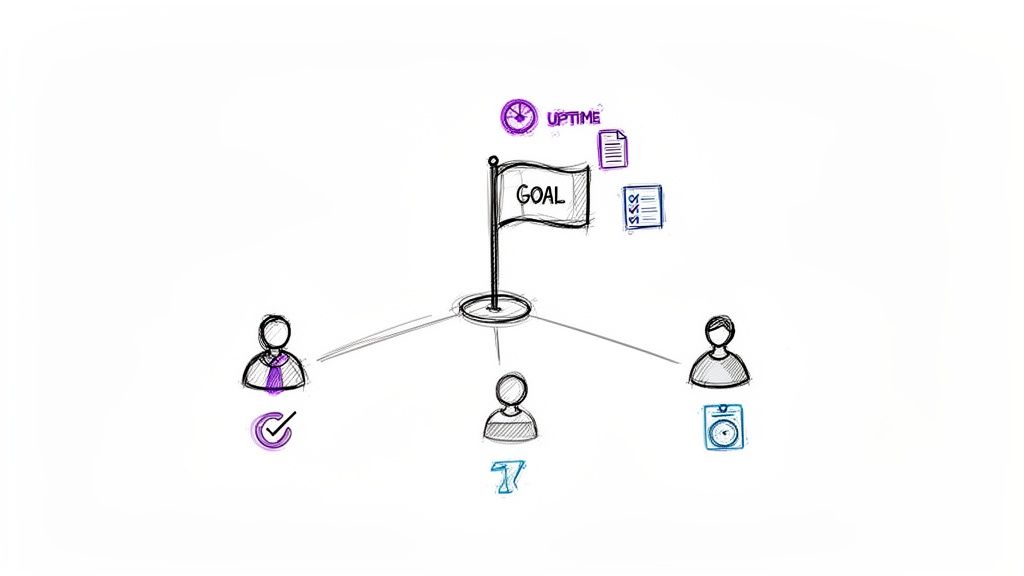
Team goal statements align multiple individuals toward a shared outcome, emphasizing collaboration and interdependence over individual performance. This approach is essential for modern, cross-functional teams where success depends on a unified effort, not siloed contributions. It transforms individual tasks into a collective mission, fostering a sense of shared ownership and accountability.
Why It Works
A team goal statement provides a North Star that guides every member's priorities and decisions. Instead of a support engineer focusing only on ticket count, their work is framed by the team's goal to "Achieve a 95% Customer Satisfaction Score (CSAT) for Q3." This collective target encourages collaboration. For instance, an engineer might help a support agent debug a complex issue because they both share the goal. This dynamic highlights why teamwork is important for achieving ambitious results.
Strategic Breakdown
- Define a Shared Outcome: The goal must be something that can only be achieved through collaboration. It should transcend individual roles.
- Assign Clear Metrics: The goal needs measurable key results that the entire team contributes to. Track metrics like uptime percentage, deployment frequency, or user adoption rates.
- Establish Interdependence: Structure the work so that team members rely on each other. This naturally fosters communication and mutual support.
- Ensure Visibility: All progress, setbacks, and contributions should be visible to the entire team, often through a shared dashboard or a dedicated feed in a tool like WeekBlast.
- Celebrate Collective Wins: Acknowledge milestones as a group to reinforce the shared identity and maintain momentum toward the final objective.
Actionable Examples for Your Work Log
Here are a few team-oriented goal statement examples that foster collaboration:
- For a Platform Team: Migrate our primary application infrastructure to a Kubernetes cluster by the end of Q4, achieving a 20% reduction in hosting costs and training all 15 engineers on the new environment.
- For a Product Team: Successfully launch the new recurring billing feature in 3 international regions (UK, Germany, and Japan) with full localization and acquire over 1,000 beta users by November 15th.
- For an Engineering Squad: Reduce average CI/CD deployment time from 45 minutes to under 5 minutes within the next 60 days by implementing a new parallelized build pipeline and optimizing testing protocols.
7. Outcome-Based Goal Statement (OKR Framework)
The OKR (Objectives and Key Results) framework, popularized by companies like Google and Intel, shifts the focus from activities to outcomes. This approach connects ambitious, qualitative Objectives with specific, quantitative Key Results that measure progress. OKRs are designed to align the entire organization around high-impact goals, creating a transparent system for tracking what truly matters.
Why It Works
An outcome-based goal statement forces you to define success in terms of impact rather than just completing tasks. Instead of an engineer's goal being "build the new signup flow," an OKR frames it as "Objective: Streamline user onboarding. Key Result: Reduce average signup time from 3 minutes to 45 seconds." This clarity ensures that effort is directly tied to business value, which is perfect for documenting weekly progress in a tool like WeekBlast.
Strategic Breakdown
- Objective: This is your ambitious, qualitative goal. It should be memorable and inspirational, answering the question, "What do we want to achieve?"
- Key Results: These are the measurable outcomes that prove you’ve achieved the objective. Each objective typically has 2-5 key results, and they must be quantifiable and verifiable.
- Alignment: OKRs are most effective when they cascade from the company level down to teams and individuals, ensuring everyone is pulling in the same direction.
- Cadence: Typically set on a quarterly basis, OKRs provide a regular rhythm for planning, execution, and reflection.
Actionable Examples for Your Work Log
Here are some goal statement examples structured as OKRs:
- For Product: Objective: Become the essential tool for async-first teams. KR1: Increase active users to 10,000. KR2: Achieve a Net Promoter Score (NPS) of 80. KR3: Reach 50% recurring revenue from annual plans.
- For Engineering: Objective: Achieve industry-leading platform reliability. KR1: Maintain 99.99% uptime for the quarter. KR2: Reduce p99 API latency to below 100ms. KR3: Limit critical bugs to fewer than 5 per quarter.
- For Sales: Objective: Win significant enterprise market share. KR1: Secure $2M in new Annual Recurring Revenue (ARR). KR2: Onboard 10 new enterprise customers. KR3: Achieve 30% year-over-year growth.
8. Performance Management Goal Statement
Performance management goal statements are crucial for aligning individual contributions with organizational objectives. They formalize the expectations for a role, defining clear criteria for success that form the basis of performance reviews, promotions, and compensation decisions. This approach transforms the subjective nature of performance evaluation into an objective, data-driven conversation.
Why It Works
These goals create a shared understanding between you and your manager, leaving no room for ambiguity about what constitutes success. Instead of a vague expectation like "be a good team player," a specific goal like "Maintain a 95% or higher code review turnaround time within 24 hours and proactively mentor two junior engineers on the new CI/CD pipeline" is clear and measurable. Using a tool like WeekBlast to document progress against these goals weekly builds an irrefutable log of accomplishments, making self-evaluations and manager reviews straightforward.
Strategic Breakdown
- Collaborate: Set performance goals collaboratively with your manager at the beginning of each review cycle to ensure alignment and mutual commitment.
- Document Continuously: Log progress in your weekly work log. This creates a detailed evidence trail, preventing you from forgetting key achievements when it's time for a formal review.
- Reference & Review: Use your logged accomplishments during mid-year check-ins to demonstrate progress and make any necessary adjustments to your goals.
- Prepare Evidence: Before your formal evaluation, export a summary of your achievements. Having this data ready makes preparing for your review much easier. Our guide on using an annual performance review template can help you structure this information effectively.
- Be Visible: Share significant achievements related to your goals in a team channel or feed. This provides visibility beyond your direct manager and reinforces your impact.
Actionable Examples for Your Work Log
Here are a few performance management goal statement examples formatted for easy tracking:
- For a Software Engineer: Ship 2 major features per sprint, maintain >90% test coverage on all new code, and complete all assigned code reviews within 24 business hours for Q3.
- For a Manager: Achieve a 90% direct report retention rate, promote at least one high-performing team member, and conduct documented monthly 1-on-1s with every report for the entire fiscal year.
- For a Designer: Lead the design and user testing for 4 major product initiatives, gather and synthesize qualitative feedback from at least 50 users, and contribute 10+ new components to the design system by year-end.
9. Stretch Goal Statement (Aspirational)
A stretch goal statement pushes you and your team beyond current capabilities. It describes an ambitious, high-risk, high-reward objective that isn't entirely achievable with existing resources or knowledge. Popularized by companies like Google, this approach prioritizes learning and innovation over guaranteed success, with a 60-70% completion rate often considered a win.
Why It Works
Stretch goals force you out of your comfort zone, stimulating creativity and rapid skill development. Unlike safer objectives, they encourage you to rethink processes and experiment with new strategies. For example, an engineer’s goal to “Reduce cloud costs by 50% while improving performance” is a powerful stretch goal statement because it demands a fundamental re-architecture, not just minor optimizations. The value lies in the journey and the lessons learned, even if the final target is not fully met.
Strategic Breakdown
- Frame as Aspirational: Communicate with your manager that this is a "stretch" objective. This sets clear expectations that the primary goal is growth and discovery, not just hitting a number.
- Document Your Hypothesis: Before starting, use a work log to outline your initial approach, assumptions, and expected challenges. This creates a baseline to measure learning against.
- Log the Process, Not Just Progress: Focus your weekly updates on experiments, failures, pivots, and insights. This narrative is more valuable than a simple percentage-complete metric.
- Normalize Failure: Share the journey, including setbacks, with your team. This fosters a culture of psychological safety where ambitious attempts are celebrated regardless of the outcome.
- Leverage Learnings: Use the detailed log of your attempts to inform future projects and to build a compelling narrative for performance reviews or career advancement discussions.
Actionable Examples for Your Work Log
Here are some stretch goal statement examples designed for ambitious tracking:
- For an Engineer: Architect and lead the migration of our monolith to a microservices architecture with zero user-facing downtime, aiming to reduce deployment time by 10x.
- For a Product Manager: Enter and establish our product as a leader in a new market vertical where we have zero prior experience, capturing a 5% market share within 12 months.
- For a Data Scientist: Design and implement a real-time machine learning recommendation system that delivers personalized content with a sub-100ms latency.
10. Preventive/Risk Mitigation Goal Statement
Preventive or risk mitigation goal statements shift the focus from creating new features to strengthening existing systems. Popularized by Site Reliability Engineering (SRE) and DevOps practices, these goals prioritize system reliability, security, and operational stability. They are essential for platform teams and anyone responsible for maintaining the health of a product, as they aim to proactively prevent problems before they impact users.
Why It Works
This type of goal statement makes invisible work visible and valuable. While building a new feature provides obvious output, preventing a major outage is equally, if not more, important. A goal to "Improve system stability" is abstract, but "Reduce critical production incidents from an average of 5 per month to fewer than 1 per month by improving monitoring and on-call processes" is a clear, impactful objective. Tracking this in a work log like WeekBlast demonstrates proactive value and highlights contributions to operational excellence.
Strategic Breakdown
- Identify Risk Areas: Pinpoint recurring issues, single points of failure, or areas with high technical debt. Look at past incident reports to find patterns.
- Quantify Stability: Define success with clear metrics. Use Service Level Objectives (SLOs) like 99.99% availability, Mean Time To Recovery (MTTR), or a reduction in vulnerability patch times.
- Prioritize Proactive Fixes: Focus on actions that prevent future problems. This includes creating better documentation, automating manual recovery steps, or implementing chaos engineering tests.
- Document and Communicate: Log all preventive maintenance, successful incident mitigations, and improvements. Sharing these updates in a team feed celebrates stability and provides visibility to leadership.
Actionable Examples for Your Work Log
Here are some goal statement examples formatted for easy tracking:
- For an Infrastructure Engineer: Achieve a 99.99% availability SLO for the core API service this quarter by eliminating all identified single points of failure in the database cluster.
- For a Security Specialist: Reduce the average vulnerability discovery-to-patch time from 30 days to 7 days for all critical services by Q3 through automated scanning and deployment pipelines.
- For a Quality Assurance Lead: Implement a chaos engineering program by the end of the month, and successfully find and fix 10 potential failure modes before the next major release.
Comparison of 10 Goal Statement Examples
| Goal Type | Implementation Complexity 🔄 | Resource Requirements ⚡ | Expected Outcomes 📊 | Ideal Use Cases 💡 | Key Advantages ⭐ |
|---|---|---|---|---|---|
| SMART Career Goal Statement | Medium, structured planning and metrics required | Moderate, time for specification and tracking tools | Measurable progress, aligned objectives, clear deadlines | Career development, performance reviews, measurable projects | Objective evaluation, accountability, easy progress tracking |
| Short-Term Goal Statement (30–90 Days) | Low–Medium, short planning cycles, frequent updates | Low, focused effort and weekly check-ins | Quick wins, rapid feedback, reduced scope creep | Sprints, weekly documentation, validation experiments | Fast iteration, maintain momentum, easy visibility |
| Long-Term Goal Statement (1–5 Years) | Medium, strategic planning with flexible paths | Variable, sustained investment over quarters/years | Directional growth, major milestones, career trajectory | Multi-year planning, succession, organizational vision | Strategic focus, attracts talent, supports long-term planning |
| Personal Development Goal Statement | Low, self-directed with habit focus | Low–Moderate, learning time and possible course costs | Skill acquisition, certifications, improved competencies | Individual upskilling, career transitions, continuous learning | Builds capability, visible learning trail, supports promotions |
| Academic/Knowledge Goal Statement | High, research cycles, validation, peer review | High, time, expertise, possible funding/support | New knowledge, publications, deep technical expertise | Research teams, thought leadership, specialized engineering work | Elevates expertise, creates organizational knowledge, thought leadership |
| Team/Collective Goal Statement | High, coordination and cross-functional alignment | High, multi-role collaboration and communication overhead | Shared deliverables, improved cohesion, collective impact | Cross-functional projects, distributed teams, large launches | Builds cohesion, enables async coordination, clear prioritization |
| Outcome-Based Goal Statement (OKR) | Medium–High, defining objectives and measurable KRs | Moderate, measurement systems and regular check-ins | Strategic alignment, measurable impact at scale | Company/quarterly strategy, cross-team alignment | Balances ambition & measurability, transparent objectives |
| Performance Management Goal Statement | Medium, role-specific metrics and calibration | Moderate, ongoing documentation and manager time | Fairer reviews, evidence-backed compensation decisions | Annual reviews, promotions, manager-employee alignment | Clarifies expectations, reduces recency bias, supports fairness |
| Stretch Goal Statement (Aspirational) | High, experimental approach, high uncertainty | High, significant time, talent, and tolerance for failure | High learning, potential breakthrough impact, frequent pivots | Innovation projects, high-performer development, moonshots | Drives innovation, accelerates growth, fosters resilience |
| Preventive / Risk Mitigation Goal Statement | Medium, ongoing processes and monitoring | Moderate–High, monitoring, documentation, reliability work | Reduced incidents, improved reliability, lower operational risk | Platform teams, SRE, security, ops and maintenance work | Prevents costly failures, documents invisible work, increases stability |
Making Your Goals a Reality, One Week at a Time
We have journeyed through a comprehensive collection of goal statement examples, from the precision of SMART goals for career development to the ambitious scope of OKRs and the strategic foresight of risk mitigation goals. Each example serves as more than just a template; it is a strategic blueprint for converting abstract ambitions into tangible achievements. Across all these formats, from short-term personal development sprints to long-term team projects, a powerful, unifying thread emerges: the immense value of clarity and consistency.
The difference between a goal that inspires action and one that gathers dust is not its brilliance, but the system supporting it. A well-written goal statement is your launchpad, providing the initial direction and momentum. However, the real work, the day-to-day and week-to-week effort, is what propels you toward the finish line. This is where intention meets execution, and it is the most common point of failure for even the most well-defined objectives.
The Power of Consistent, Lightweight Tracking
One of the most critical takeaways from this guide is that the act of tracking progress should never be more cumbersome than the progress itself. Traditional methods often fail here. Lengthy status update meetings, complex project management software, and last-minute scrambles for performance review evidence all create friction. They turn the vital process of reflection into a dreaded administrative task.
The solution is to build a habit of consistent, lightweight documentation. Think of it as creating a living log of your professional journey. By capturing small wins, roadblocks, and shifts in priority as they happen, you build an invaluable repository of your work. This practice accomplishes several key things:
- It maintains focus: A weekly check-in reinforces what truly matters, steering you away from distractions and low-impact tasks.
- It simplifies reporting: Performance reviews become a simple process of pulling from a detailed, pre-existing record, not a frantic search through old emails and calendars.
- It boosts motivation: Seeing a clear, documented history of your progress provides a powerful psychological lift, especially during challenging weeks.
- It enhances visibility: For teams, this continuous log offers asynchronous clarity, letting everyone see what is being accomplished without scheduling another meeting.
From Aspiration to Accomplishment: Your Next Steps
Mastering the art of writing effective goal statement examples is the first, essential step. Now, it is time to build the system that will bring them to life. The examples we analyzed, whether tailored for your manager or for your own maker-focused workflow, all benefit from a simple, repeatable tracking cadence. Your immediate action plan should be to bridge the gap between setting a goal and seeing it through.
Here is a simple way to start:
- Select One Goal: Choose one of the goal types from this article that resonates with your current needs, perhaps a short-term professional development goal or a key project objective.
- Refine Your Statement: Use the SMART framework and the linguistic tips we discussed to craft a clear, powerful goal statement. Is it specific? Is it measurable? Is the language tailored to your audience (even if that audience is just you)?
- Commit to a Weekly Log: Find a simple, low-friction tool or method to document your progress at the end of each week. This entry should only take a few minutes. Note what you accomplished, what you learned, and what you plan to do next.
This simple, repeatable loop transforms goal setting from a one-time event into a continuous cycle of action, reflection, and adaptation. It is the engine that drives meaningful, sustainable growth. By committing to this process, you are not just writing goals; you are building a career narrative defined by clear intentions and undeniable results.
Ready to turn your powerful new goal statements into a documented track record of success? WeekBlast is designed for exactly that. It provides a simple, asynchronous way to log your weekly progress in seconds, creating a permanent, searchable record that makes performance reviews effortless and eliminates status meetings. See how easy it is to build your narrative of accomplishment at WeekBlast.


