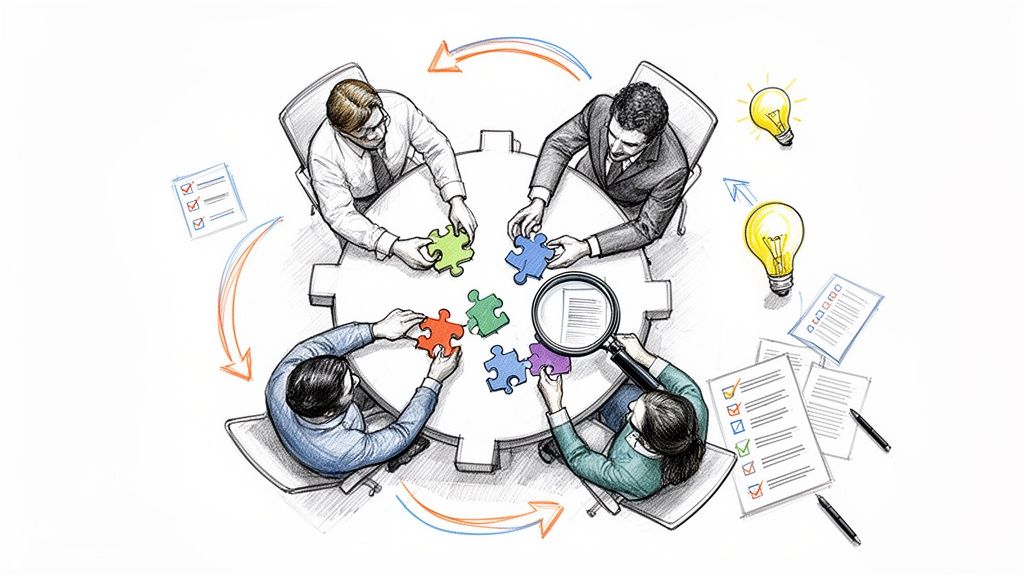
The incident is over, the graphs are flat again, and someone asks the question every team dreads, “So, what happened?”
Many organizations waste the incident. They had pain, real customer impact, a flood of alerts, a half-dozen hurried decisions, and a handful of workarounds nobody wants to admit felt improvised. Then they reduce all of that into a vague summary, a few finger-pointing comments, and one action item that says “improve monitoring.”
A good post mortem analysis template fixes that. Not because templates are magical, but because under pressure people skip steps, fill gaps with memory, and settle for the first explanation that sounds reasonable. The right structure forces the team to reconstruct what happened, name the system conditions that made it possible, and leave with changes someone will implement.
The best teams also stop treating post-mortems as isolated documents. A one-off writeup that nobody revisits is a dead artifact. What works better, especially for remote teams, is an async operating rhythm where incident evidence, decisions, changes, and follow-ups stay visible over time. That’s how a review becomes a learning loop instead of a compliance chore.
Why Most Incident Reviews Fail and How to Fix It
A familiar pattern plays out after a rough outage.
An engineer pushed a change. Latency spiked. The rollback didn’t fully recover service. Another team got paged late because the first alerts weren’t clear. Support started fielding customer complaints before engineering had a clean summary. By the time everyone meets to review it, people are tired, defensive, and already back in feature work.
So the review goes badly.
The blame version never finds the real problem
The weakest incident reviews ask who made the mistake. That question feels efficient, but it usually stops the investigation too early.
If a reviewer says, “The deployer skipped a check,” they might be technically right and still operationally useless. Why was the check skippable. Why did the system allow a risky path. Why didn’t alerting make impact obvious sooner. Why did the handoff between teams fail.
Those are the questions that prevent repeat incidents.
A post-mortem should make the next incident less likely, not make the last responder feel worse.
This blameless approach didn’t come out of nowhere. Structured reviews came from high-reliability fields like aviation, where their use since 1959 contributed to a 90% decline in accident rates, and in tech, Atlassian’s frameworks introduced around 2012 are now used by over 200,000 teams, with reported 40 to 60% faster root cause identification in software incidents, according to Craft’s summary of post-mortem analysis templates.
Most reviews fail for boring reasons
The common failure modes aren’t mysterious.
- People rely on memory: Timelines drift fast after an incident.
- The document starts too late: Important context disappears into chat scrollback.
- The meeting has no structure: Stronger voices dominate, quieter responders hold back.
- Nobody owns follow-through: The team agrees on fixes, then moves on.
A useful incident retrospective should capture decisions, system behavior, and coordination gaps, not just the technical trigger. That matters even more in distributed teams where nobody can rely on hallway conversations to stitch the story together later.
The fix is simple, but not easy
Use a template, fill it quickly, and keep it factual.
A solid review has three properties:
- It reconstructs events from evidence
- It separates trigger from cause
- It creates owned action items with due dates
For teams that work asynchronously, this only works if the writeup lives inside a broader knowledge system. A scattered incident doc buried in a wiki won’t help much six months later. A searchable archive of decisions and patterns will. That’s the same discipline behind strong operational memory, and it overlaps heavily with knowledge management best practices.
Your Copy and Paste Post Mortem Analysis Template
At 03:17, the incident channel is still active, people are tired, and the facts are already starting to drift. That is the worst time to ask a team to write from memory. A usable template fixes that by giving responders a place to capture what happened while the details are still visible in alerts, tickets, and chat logs.
Teams use templates that are fast to fill out and easy to revisit. The version below works in Markdown, fits in a wiki or docs tool, and holds up in async teams where the real record is spread across issue trackers, chat, deploy logs, and weekly updates. If your team already logs work in tools like WeekBlast, connect those logs to the post-mortem instead of treating the review as a one-off writeup. The best incident reviews become part of an ongoing operating rhythm, not a document nobody reads after Friday.

A practical rule: keep the template strict enough to force clarity, but light enough that incident owners will complete it. I have seen polished forms fail because they asked for too much before the system was stable and the evidence was collected. Start with the fields that preserve facts, ownership, and follow-through. Add team-specific fields later if they repeatedly help you make better decisions.
If your review meeting also relies on shared notes, these project meeting notes template resources can help standardize facilitator notes and decisions alongside the incident record.
The template
# Post Mortem Analysis

## Incident Overview
- Incident title:
- Severity:
- Date:
- Start time:
- End time:
- Duration:
- Status:
- Incident owner:
- Review facilitator:
- Teams involved:

## Executive Summary
Write 3 to 6 sentences covering:
- What happened
- What users or internal teams experienced
- What was done to restore service
- What will change to reduce recurrence

## Impact Analysis
- Affected services:
- Customer impact:
- Internal business impact:
- Scope of disruption:
- Detection method:
- Escalation path used:

## Timeline
| Timezone | Timestamp | Event | Evidence link | Notes |
|----------|-----------|-------|---------------|-------|
| UTC      |           |       |               |       |

Include:
- Lead-up events
- First detectable signal
- First confirmed impact
- Escalations
- Key decisions
- Changes made during response
- Recovery confirmation
- Post-incident follow-up milestones

## Contributing Factors
List all conditions that increased likelihood or impact.
- Technical contributors:
- Process contributors:
- Communication contributors:
- External dependencies:

## Root Cause Analysis
Use Five Whys and expand if multiple causes exist.

### Why chain
1. Why did the impact occur?
2. Why was that possible?
3. Why was that not prevented earlier?
4. Why did detection or safeguards fail?
5. Why did the broader system allow this condition?

### Root causes
- Primary root cause:
- Secondary root cause:
- System weaknesses exposed:

## Detection and Response
- How was the issue detected?
- What worked during response?
- What slowed diagnosis?
- Which tools, dashboards, or runbooks helped?
- Which handoffs created delay or confusion?

## Mitigation and Resolution
- Immediate mitigation:
- Permanent fix:
- Validation steps:
- Rollback or recovery notes:

## Lessons Learned
### What went well
-
### What could improve
-
### Open questions
-

## Preventive Measures
- Monitoring changes:
- Process changes:
- Testing changes:
- Documentation updates:
- Ownership clarifications:

## Action Items
| Action | Owner | Due date | Tracking link | Success criteria | Status |
|--------|-------|----------|---------------|------------------|--------|
|        |       |          |               |                  |        |

## Appendix
- Links to logs
- Dashboard screenshots
- Chat transcript
- Ticket references
- Deployment records
- Related incidents
What each part is doing
This template follows the same practical logic used in structured review methods. Pixelmatters describes a 13-step postmortem methodology that runs from incident overview through action item tracking, and reports that teams using structured templates see 92% action item completion versus 45% for ad-hoc reviews, according to their incident writeup on structuring a post-mortem document after an incident.
A few fields matter more than teams think:
- Incident Overview: This removes basic confusion before the analysis starts.
- Executive Summary: Write this last, not first. Early summaries are usually wrong.
- Timeline: This is the backbone. If the timeline is weak, the rest of the review gets mushy.
- Contributing Factors: Use this section to avoid the trap of pretending there was one neat cause.
- Action Items: If a lesson doesn’t become owned work, it’s just a comment.
Practical rule: If a field won’t help someone understand the incident or reduce recurrence, cut it.
Post-Mortem Fields by Incident Severity
Not every incident needs the same depth. A SEV-1 should be exhaustive. A SEV-3 should be lightweight enough that people readily complete it.
| Template Section | SEV-1 (Critical) | SEV-2 (High) | SEV-3 (Medium) |
|---|---|---|---|
| Incident Overview | Required in full | Required | Required |
| Executive Summary | Required, leadership-readable | Required | Short summary |
| Impact Analysis | Detailed | Moderate detail | Brief |
| Timeline | Full minute-by-minute if possible | Detailed sequence | Key events only |
| Contributing Factors | Full breakdown | Required | Required if pattern exists |
| Root Cause Analysis | Full Five Whys plus secondary causes | Five Whys | Brief causal summary |
| Detection and Response | Detailed | Required | Short notes |
| Mitigation and Resolution | Detailed | Required | Required |
| Lessons Learned | Full | Full | Short |
| Preventive Measures | Required | Required | Optional if no systemic issue |
| Action Items | Mandatory with tracking | Mandatory | Only if change is needed |
| Appendix | Include evidence set | Include relevant links | Minimal |
If your team already documents meetings separately, it helps to keep the post-mortem tighter and link out to supporting notes. For teams refining that side of their workflow, these project meeting notes template resources are useful for capturing discussion without bloating the actual review.
Running an Effective and Blameless Post-Mortem
At 2:13 a.m., the service is down, the rollback half-works, Slack is noisy, and three people are already defending decisions nobody has written down yet. That is how bad post-mortems start.
A useful review starts earlier. By the time people join the meeting, the team should already have evidence collected, the rough sequence of events drafted, and the scope of the discussion set. If you wait to reconstruct everything live, the loudest memory usually wins over the best evidence.

Start before the meeting
The meeting should confirm facts, close gaps, and assign follow-through. It should not be the first time anyone sees the incident record.
Prep usually includes four things:
- Collect evidence early: alerts, deploy history, logs, tickets, chat threads, status page updates
- Draft the sequence: pre-fill key timestamps so the group can correct and extend, not guess
- Assign a facilitator: someone calm, neutral, and willing to stop blame language fast
- Limit attendance: responders, service owners, and stakeholders who need context to act
Async teams have an advantage here if they use it well. Work logs, handoff notes, and update threads often capture intent that dashboards miss. A shared system such as WeekBlast’s post-mortem project workflow helps turn those scattered updates into a working draft before the review starts. That matters when the team is split across time zones and no single meeting captures the whole incident.
Set the tone in the first minute
Teams copy the behavior the facilitator allows.
Open with a plain statement: we are here to understand what happened, what conditions made it possible, how the response unfolded, and what needs to change. We are not here to decide who to blame. If you do not say this clearly, people start protecting themselves instead of contributing details.
Then enforce it in real time:
- Replace “Why did you do that?” with “What information did you have at that moment?”
- Replace “Who missed this?” with “What control should have caught this?”
- Replace “Why wasn’t this obvious?” with “Which signal was absent, noisy, or misleading?”
This sounds small. It changes the quality of the review.
Use a facilitation flow that matches how incidents actually unfold
The best post-mortems follow the shape of incident response. Teams observe signals, form hypotheses, try mitigations, and adjust under pressure. The review should examine that path in order instead of jumping straight to a verdict.
A practical flow looks like this:
State the incident in plain language
Describe what broke, who felt it, and when service was stable again.Walk the timeline from evidence
Correct timestamps, add missing events, and separate facts from assumptions.Identify contributing conditions
Cover technical gaps, missing safeguards, documentation problems, staffing issues, and coordination failures.Discuss root cause after the facts are stable
If the timeline is still disputed, root cause work will be shallow or wrong.Turn findings into tracked work
Every meaningful lesson needs an owner, a due date, and a place in the team’s normal planning system.
The trade-off is simple. A smaller, disciplined review produces better findings than a large meeting full of spectators. If leaders want visibility, send them the written summary after the responders finish the factual review.
The facilitator is there to keep the discussion factual, calm, and specific.
What to avoid
A blameless post-mortem is not a polite conversation. It is a precise one.
| Anti-pattern | What goes wrong | Better move |
|---|---|---|
| Leadership speaks first | Responders filter what they say | Let responders reconstruct events first |
| Fixes are discussed before facts are clear | The team treats symptoms as causes | Finish the timeline before solutioning |
| The invite list is too broad | People perform for the room | Keep the core review small |
| Nobody updates the doc live | Decisions and disagreements get lost | Edit the record during the meeting |
| The write-up ends at publication | Lessons never change day-to-day work | Feed action items into the team’s regular async workflow |
That last failure is common. Teams write a careful post-mortem, nod at the action items, and then let them disappear into backlog gravity. The review only matters if it changes how the team works next week, not just what it writes this week.
Blameless does not mean vague. If a runbook was missing, say it. If alerting was noisy, say it. If an approval step existed on paper but not in practice, document that clearly. Focus on the system conditions, the decision context, and the operational habits that need to improve.
A Deep Dive into Key Post-Mortem Components
Three parts of a post mortem analysis template decide whether the document becomes useful or decorative.
They are the timeline, the root cause analysis, and the action items. Teams usually get the headings right and the substance wrong.

Build the timeline from evidence, not memory
A timeline is not a story. It’s a factual sequence.
That means every entry should answer five things: when it happened, what happened, how you know, who was involved if relevant, and why that event mattered. Pull from alert timestamps, deployment history, incident channels, dashboards, and log trails. If the team works asynchronously, add work-log entries or handoff notes to capture intent that raw telemetry won’t show.
A useful timeline usually includes:
- Lead-up events: Deployments, config changes, dependency issues
- Detection moments: First alert, first internal report, first customer signal
- Decision points: Escalations, attempted mitigations, rollback calls
- Resolution milestones: Stabilization, verification, closure
Don’t clean the timeline up so much that it loses tension. If responders tried something that failed, keep it in. Failed mitigation attempts often explain underlying delays.
Use Five Whys without turning it into a ritual
The Five Whys technique gets mocked because teams often use it badly. They either stop at the first plausible answer or force a single linear chain onto a messy incident.
Used properly, it’s still valuable. Atlassian’s postmortem framework leans heavily on Five Whys, and analysis across more than 10,000 incidents found that teams applying it consistently reached 75% action item completion and identified recurring patterns in about 60% of cases, often around detection or automated testing gaps, as described in Parabol’s guide to running a post-mortem.
Here’s the practical version:
- Ask why the impact occurred, not why a person made a mistake.
- If the chain splits, let it split. Complex incidents often have multiple causes.
- Stop when you reach a changeable system condition, not a moral judgment.
- Test each answer against evidence from the timeline.
Example:
| Weak version | Better version |
|---|---|
| “The engineer deployed bad code” | “The deployment path allowed an untested change into production” |
| “Monitoring failed” | “The alert existed but didn’t reflect customer-facing impact” |
| “The on-call missed the issue” | “Alert volume made the critical signal hard to distinguish” |
If your Five Whys chain ends with “someone should have been more careful,” you haven’t finished.
Write action items that survive contact with real work
Most post-mortems die here.
The team has a thoughtful discussion, everyone nods, and then the document closes with vague cleanup work nobody can prioritize. “Improve testing” is not an action item. “Review alerts” is not an action item either.
Good actions have six properties:
- One owner
- A due date
- Clear scope
- A success condition
- A place to track status
- A connection to the root cause
A bad action item says, “Add safeguards.”
A good action item says, “Platform team adds deployment policy to block production release when integration checks fail, tracked in Jira, complete when policy is enforced in all production services.”
Short list, high impact, tracked visibly. That’s better than fifteen “nice to haves” nobody finishes.
From Document to Action and Continuous Improvement
A post-mortem that ends as a document is unfinished work.
The point isn’t to publish a polished report. The point is to change operating conditions so the same incident, or a close cousin of it, becomes harder to trigger and faster to recover from.

Treat action items like production work
If reliability tasks live outside the team’s normal workflow, they usually lose to roadmap pressure.
The fix is simple. Put post-mortem actions into the same systems where the team already manages work, then review them in the same cadence as feature delivery, operational chores, and technical debt. Action items should show up in sprint planning, ops review, or whatever regular rhythm the team already respects.
The strongest teams also separate actions by type:
- Immediate safeguards: Changes that reduce short-term risk fast
- Structural fixes: Deeper work on architecture, automation, or process
- Knowledge updates: Runbooks, escalation paths, ownership docs
Build a searchable learning loop
This is the part most templates miss.
Many post-mortem guides assume a single event with manual writeup, then stop there. But async teams need a lighter system where evidence and learning accumulate continuously. Existing templates often undervalue that workflow, even though teams with quantified async logs can improve performance review accuracy by 40%, and that process gets easier when actions live in tools with CSV and Markdown exports, according to UptimeRobot’s discussion of post-mortem template gaps for async teams.
That matters because a useful learning loop has more than one output:
| Output | Why it matters |
|---|---|
| Incident document | Captures one event clearly |
| Searchable archive | Helps future responders find similar failures |
| Action tracker | Keeps remediation visible |
| Team summary | Shares learnings beyond the incident group |
A practical pattern is to publish a short incident summary for broad visibility, then maintain the detailed technical review separately. Teams also benefit from a running list of follow-ups outside the post-mortem itself, especially when multiple incidents produce related work. A simple action items list keeps those changes from disappearing into stale docs.
Make the system feed itself
The strongest operational habit is to stop starting from zero every time.
Use ongoing notes, changelogs, responder logs, and saved links during the incident. Then the post-mortem becomes a refinement step, not a memory reconstruction exercise. Over time you get a body of searchable operational history, not isolated PDFs and forgotten docs.
That’s the difference between “we wrote a review” and “we got better.”
Common Post-Mortem Pitfalls and How to Avoid Them
Teams rarely fail at post-mortems because they lack a template. They fail because they use the template badly, too late, or without follow-through.
The frustrating part is that these failure patterns are predictable.
Anti-pattern one, incomplete timelines
When the timeline is partial, the analysis gets distorted.
Someone remembers the escalation happening earlier than it did. Another person forgets a deployment because it looked unrelated at the time. A failed mitigation attempt disappears because nobody wants to relive it. Then the review points at the wrong thing.
ilert’s incident response benchmarks report that their optimized template can reduce MTTR by 35%, in part because the structured process helps identify patterns behind 80% of recurring incidents, and they note that pitfalls like incomplete timelines or unowned action items can double the risk of repetition in incident response workflows documented at ilert’s postmortem template guide.
The fix is mechanical. Start the timeline during the incident if possible, then enrich it from logs and records before the review.
Anti-pattern two, action items with no owner
This is the classic fake conclusion.
The team ends with “improve testing,” “tighten alerts,” and “update docs.” Nobody owns the work, no due dates exist, and no tracker is linked. Two weeks later, everything is still “important.”
Use this standard instead:
- One person owns each action
- Each action has a due date
- Each action has a visible tracker
- Each action defines what done means
If an item can’t meet that bar, it’s not ready.
Anti-pattern three, blameless in name only
Some teams say “blameless” and then spend the next hour dissecting a responder’s judgment. People notice.
That kind of review trains the team to protect themselves. They talk less, sanitize more, and avoid mentioning uncertainty. Once that starts, the post-mortem loses its value.
A better habit is to challenge every blame-shaped sentence and rewrite it into system language. Not softer language, system language. “The production path allowed this.” “The alert didn’t show impact.” “The runbook assumed knowledge the responder didn’t have.”
Good post-mortems are strict about facts and generous about people.
Anti-pattern four, trying to solve everything
Another trap is analysis paralysis.
A complicated outage can expose ten real weaknesses. That doesn’t mean you should launch ten parallel remediation efforts. Teams that overreact to one incident often create a reliability backlog nobody can finish.
A sharper response is to pick the few changes with the highest impact. Usually that means one safeguard, one detection improvement, and one process fix. Finish those well before adding more.
Frequently Asked Questions About Post-Mortems
When is a full post mortem analysis template too much
Not every issue needs a long review.
If the event was low impact, quickly understood, and didn’t expose a systemic gap, use a lightweight format. A short summary, a compact timeline, a brief cause statement, and a single action item may be enough. The key test is whether the event taught you something worth preserving.
If the incident had customer impact, confusing detection, cross-team coordination problems, or exposed a repeat pattern, don’t go lightweight just to save time.
What’s the difference between a post-mortem and a retrospective
A post-mortem usually starts with a failure, outage, or near miss. It’s reactive and focused on understanding impact, reconstruction, and recurrence prevention.
A retrospective reviews a planned slice of work such as a sprint, launch, or project phase. It’s broader and often includes what worked well, where planning drifted, and how the team collaborated. The formats overlap, but the intent is different.
Should small teams use the same template as larger orgs
Mostly no.
Small teams need enough structure to be consistent, but not so much ceremony that they stop doing reviews. Keep the core sections, summary, impact, timeline, cause, actions, and cut anything that creates busywork.
Larger organizations often need more explicit fields for cross-team ownership, auditability, and communication because more people consume the output.
How soon should the review happen
Soon enough that evidence is still easy to gather and decisions are still fresh.
You don’t need to force a meeting immediately after a stressful event. But if you wait too long, recall degrades, context gets buried, and the team starts rewriting history around the outcome. Draft first, then review once people can think clearly again.
Should security incidents use the same format
The structure is similar, but handling is different.
Security reviews often need tighter access control, careful evidence handling, and a deliberate split between internal detail and broader summaries. You still want a factual timeline, contributing factors, and owned corrective actions. You just may need restricted sections for sensitive details, exploit paths, or legal review inputs.
Can you use post-mortems for successful launches or near misses
Yes, and good teams do.
Near misses are valuable because they reveal weak spots before customers feel them. Successful launches are useful because they show what controls, coordination, or preparation worked. The same template can handle both with minor edits. Keep the focus on conditions, signals, and repeatable practices.
What’s the minimum viable post-mortem
If you need the shortest version that still works, use this:
- Summary: What happened and impact
- Timeline: Key moments in order
- Cause: What conditions allowed it
- Action: One to three owned follow-ups
That’s enough for many medium-sized operational issues. Anything less usually turns into opinion.
If you want post-mortems to become part of an async operating rhythm instead of another forgotten doc, try WeekBlast. It gives teams a fast, human work log they can update by app or email, keeps a permanent searchable archive, and exports cleanly to Markdown or CSV. That makes it much easier to turn incident notes, weekly logs, and follow-up actions into a continuous learning loop without adding more meetings.