The annual performance review often feels like a high-stakes, high-stress event for everyone involved. For managers, the pressure to deliver fair, accurate, and motivating feedback is immense, and the traditional approach is fundamentally broken. Relying on vague memories and subjective feelings from months ago frequently leads to employee disengagement, manager burnout, and a sense of procedural injustice. In a work environment defined by speed and distributed teams, a structured, evidence-based process is no longer optional; it is a core leadership function.
This guide provides ten powerful performance review tips for managers designed to transform the process from a dreaded obligation into a powerful tool for growth and alignment. We will move beyond generic advice and focus on actionable strategies that produce tangible results. You will learn how to build a system grounded in continuous documentation, clear goals, and specific, behavioral feedback that makes evaluations fair, effective, and significantly less stressful for your entire team.
Instead of scrambling to recall accomplishments at the end of the year, you will learn to create a "performance trail" that makes reviews a simple summary of ongoing conversations. We will explore practical methods for gathering 360-degree feedback, separating evaluation from development, and using transparent rubrics to remove bias. We'll also cover how modern tools, like WeekBlast, can streamline the most time-consuming parts of this process, helping you capture weekly wins and evidence effortlessly. These tips will equip you to deliver reviews that are not only accurate but also genuinely motivating.
1. Use Continuous Documentation to Create a Performance Trail
The most common pitfall in performance reviews is recency bias, where a manager disproportionately weighs an employee's performance from the last few weeks while forgetting crucial contributions or challenges from months prior. To combat this, one of the most effective performance review tips for managers is to shift from annual memory recall to continuous, year-round documentation. This practice involves creating a "performance trail": a living record of accomplishments, feedback, and growth milestones.
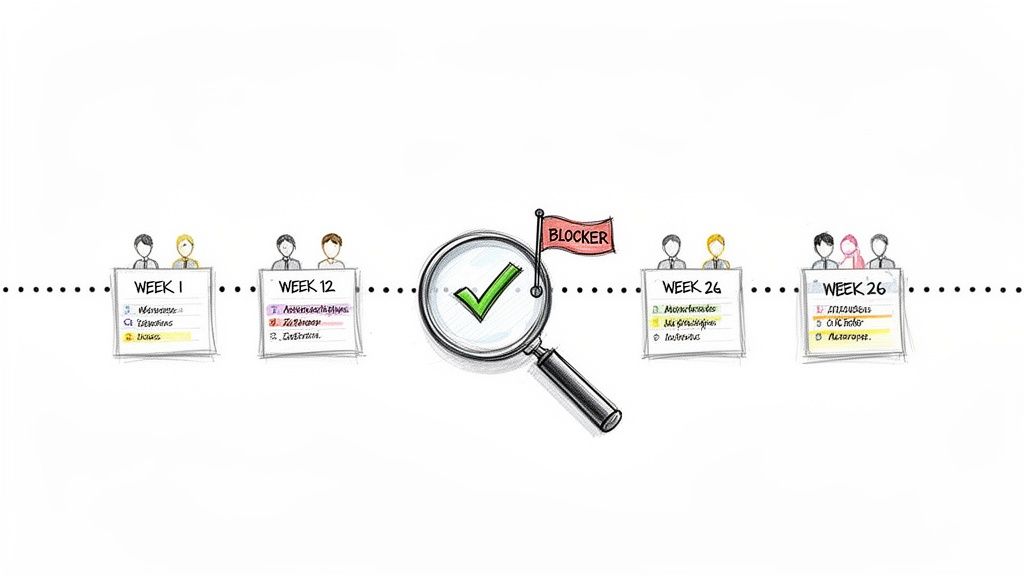
Instead of relying on scattered notes or a faulty memory, a dedicated system provides objective, time-stamped evidence. This approach, popularized by modern remote-first companies and methodologies like Radical Candor, transforms the review from a subjective judgment into a collaborative analysis of a documented journey. It ensures fairness, reduces manager prep time, and empowers employees to see a clear connection between their daily work and long-term evaluation.
How to Implement a Performance Trail
- Use a Dedicated Tool: Platforms like WeekBlast are designed for this purpose, creating a permanent, searchable archive of weekly updates. An engineering manager can quickly find a specific developer's contributions to a Q2 feature launch, while a product manager can reference project archives to detail cross-functional wins.
- Establish a Consistent Cadence: Encourage direct reports to submit brief, structured updates every week. This habit builds a rich dataset over time.
- Review Periodically: Don't wait for the annual review. Spend 15-30 minutes bi-weekly or monthly reviewing these logs to spot trends, identify coaching opportunities, and provide timely feedback.
Key Insight: A continuous performance trail isn't just for the manager. When employees document their own progress, they become more self-aware, proactive in tracking their impact, and better prepared to advocate for themselves during review conversations. This shared record fosters a culture of accountability and transparency.
2. Establish Clear, Measurable Goals at the Beginning of Review Cycles
A performance review should never contain surprises about expectations. To ensure fairness and clarity, managers must work collaboratively with employees to define specific, measurable goals at the start of each review cycle. This foundational step transforms the review process from a subjective critique into an objective assessment of progress against mutually understood targets.
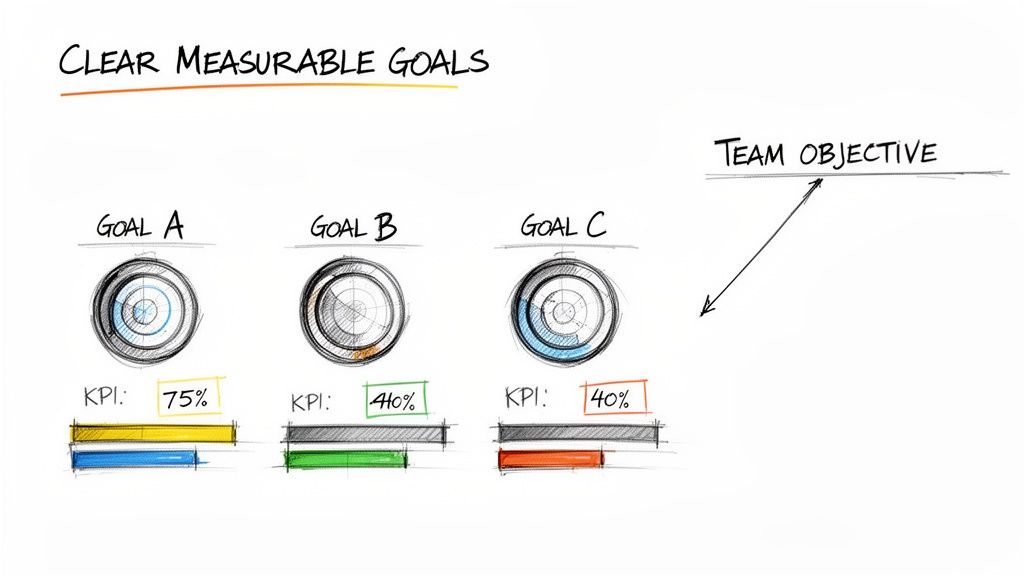
This approach, championed by frameworks like John Doerr's Objectives and Key Results (OKRs) and adopted by performance-driven companies like Google, creates a direct line of sight between an individual's daily tasks and the company's broader objectives. When an employee knows exactly what success looks like, they are empowered to prioritize their work, take ownership of their outcomes, and actively track their contributions. This removes ambiguity and sets the stage for a productive, data-informed review conversation.
How to Implement Goal-Setting Effectively
- Focus on Impact, Not Volume: Establish 3-5 key, high-impact goals per employee for the review period. This prevents goal overwhelm and ensures focus on what truly matters. For example, a support team member might have a goal to improve their customer satisfaction score by 10%, not just to close 500 tickets.
- Make Goals Visible and Central: Use a shared space to document and review goals. A platform like WeekBlast allows managers to reference team goals within the weekly feed, keeping them top-of-mind. Employees can then tag specific updates and wins directly to these objectives, creating a clear evidence trail.
- Track Progress Consistently: Don't just set goals and forget them. Encourage employees to log progress against their objectives in their weekly updates. Engineering teams can document sprint goal completion, while product managers can report on feature adoption metrics against their launch targets.
- Revisit and Adjust Mid-Cycle: Business priorities can shift. Schedule a mid-cycle check-in to review goal progress, identify blockers, and make adjustments as needed. This proactive approach ensures goals remain relevant and achievable.
Key Insight: The power of this performance review tip for managers lies in its collaborative nature. When employees are active participants in setting their own goals, their sense of ownership and motivation increases significantly. The review becomes less of a top-down judgment and more of a strategic partnership focused on mutual success and professional growth.
3. Conduct Regular 1:1 Check-ins Using Work Log Data
Performance reviews should never contain surprises. The best way to ensure alignment and prevent unexpected feedback is to integrate performance discussions into your regular cadence of one-on-one meetings. A powerful method for this is to ground your check-ins in concrete data from an employee's work log. This transforms vague, "how are things going?" conversations into focused, evidence-based dialogues about specific accomplishments, challenges, and growth opportunities.
This approach, rooted in the principles of Andy Grove's High Output Management and adapted by modern remote-first companies like GitLab, uses the employee's own documented progress as the agenda's foundation. Instead of relying on memory, a manager can reference specific entries to praise a win, ask clarifying questions about a blocker, or connect recent work to broader career goals. This makes feedback timely, relevant, and far more impactful than saving it all for an annual review.
How to Implement Data-Driven 1:1s
- Prepare in Advance: Spend 15-20 minutes reviewing your direct report's work log entries from the past week or two before your meeting. Platforms like WeekBlast make this efficient by centralizing updates. For example, a remote team lead can use async work logs to understand exactly what a report accomplished without a status meeting.
- Start with Specific Praise: Open the 1:1 by acknowledging a specific achievement you saw in their log. For instance, "I saw in your update you unblocked the API integration for the new feature; that was a huge win for the team."
- Probe on Blockers and Challenges: Use the log to identify areas for support. Ask questions like, "You mentioned a delay in getting the design assets. What can I do to help clear that path for you?" This proactive problem-solving builds trust.
- Connect to Broader Goals: Tie small, weekly accomplishments back to larger performance goals. This helps employees see how their daily tasks contribute to their overall career development and impact.
Key Insight: Using a work log as the basis for 1:1s shifts the dynamic from a managerial report-out to a collaborative coaching session. It empowers employees to drive the conversation with their own documented progress, making them active participants in their performance management and professional growth.
4. Gather 360-Degree Feedback Using Peer and Cross-Functional Input
A manager’s perspective, while critical, is inherently limited. You see the final outputs and the interactions directed at you, but you often miss the day-to-day collaborative dynamics that define an employee's true impact. Gathering 360-degree feedback from peers, direct reports, and cross-functional partners provides a holistic view, revealing strengths and development areas that a top-down assessment alone cannot capture.
This multi-perspective approach, championed by organizations like Microsoft and Adobe, moves the evaluation beyond a single point of view to a more comprehensive and fair assessment. It uncovers how an employee’s contributions ripple across the organization, highlighting their influence on team morale, project velocity, and inter-departmental harmony. For managers, this is one of the most powerful performance review tips for creating a balanced and well-rounded evaluation.
How to Implement 360-Degree Feedback
- Use a Centralized Platform: A tool with a shared feed, like WeekBlast, makes cross-functional collaboration visible. When a product manager reviews an engineer's performance, they can reference shared project updates in the team feed to see how communication and deliverables were handled.
- Structure Your Requests: When soliciting feedback, ask specific, behavior-based questions. Instead of "What's it like working with Jane?", ask "Can you provide an example of when Jane effectively collaborated to solve a complex problem in Q3?".
- Synthesize and Share Themes: To maintain psychological safety, never attribute feedback directly. Instead, synthesize the input into key themes (e.g., "A common theme in your feedback was your exceptional ability to unblock others") and share these insights during the review. This improves workplace communication and builds trust. For more strategies, you can learn how to improve communication in the workplace.
Key Insight: 360-degree feedback is not just about identifying weaknesses; it's a powerful tool for uncovering hidden strengths. A quiet engineer might not self-promote their mentorship of a junior developer, but their peers will. This process validates an employee's full spectrum of contributions and ensures their impact is fully recognized.
5. Separate Evaluation from Development Conversations
One of the most powerful performance review tips for managers is to decouple the conversation about past performance (evaluation) from the one about future growth (development). When an employee hears a rating or a compensation number, their brain often switches into a defensive or analytical mode, making it nearly impossible to productively discuss skill gaps or long-term career aspirations. By separating these two critical discussions, you create the psychological safety needed for genuine, forward-looking dialogue.
This approach, championed by thought leaders like Kim Scott and Brené Brown, acknowledges that evaluation is inherently backward-looking and judgmental, while development is forward-looking and collaborative. Combining them forces a difficult context switch that serves neither purpose well. Splitting them allows each conversation to have a clear, distinct goal: one to assess impact and outcomes, and the other to build a plan for the future. This transforms the review process from a single, high-stakes event into a more constructive, two-part journey.
How to Implement Separated Conversations
- Schedule Two Meetings: Clearly label and schedule two separate meetings. The first is the "Performance Evaluation," and the second, held a week or two later, is the "Career Development Discussion."
- Focus the Evaluation: Use the first meeting to review accomplishments and assess performance against goals, leveraging documented evidence from tools like WeekBlast. Share the performance rating and any related compensation decisions. Keep this conversation focused on the "what" and "how" of the past review cycle.
- Set the Stage for Development: At the end of the evaluation meeting, explicitly schedule the follow-up development conversation. Frame it as a dedicated time to partner on the employee's growth, separate from the assessment.
- Drive the Development Discussion: Use the second meeting to explore career ambitions, identify skills to build, and co-create a development plan. Ask questions like, "What projects would excite you?" and "What skills do you want to master in the next year?"
Key Insight: Separating these talks isn't just a scheduling trick; it's a fundamental shift in mindset. It signals to your employee that you see them as more than just their last six months of output. You are investing in their evaluation and their evolution, which is a cornerstone of effective team management skills that build long-term trust and loyalty.
6. Leverage AI-Generated Summaries for Efficient Review Preparation
One of the most time-consuming aspects of performance reviews is manually sifting through months of notes, emails, and project documents to synthesize an employee's contributions. This manual process is prone to error and can take hours per team member. A modern, efficient approach is to leverage AI-generated summaries to do the heavy lifting, transforming raw data into a coherent performance narrative.
This method involves using tools that analyze continuous documentation, like weekly work logs, to automatically create high-level digests of accomplishments, challenges, and key themes. Instead of starting from scratch, managers receive a structured overview that serves as a powerful foundation for the review. This practice, central to platforms like WeekBlast and increasingly adopted in modern HR tech, saves significant preparation time and helps managers identify patterns that might otherwise be missed.
How to Implement AI-Generated Summaries
- Use a Tool with Built-in AI: Adopt a system where employees log weekly updates. A tool like WeekBlast can then automatically generate monthly, quarterly, or yearly summaries that highlight recurring achievements and progress against goals.
- Review and Refine: Use the AI summary as your first draft, not the final word. Review it for accuracy, add crucial context that the AI may have missed, and align the summary’s themes with the employee's official goals. An engineering manager might use a yearly summary as the basis for a promotion packet, adding specific technical details.
- Integrate into Check-ins: Don't wait for the annual review. Use automated monthly digests to prepare for quarterly check-ins or one-on-ones, ensuring conversations are always data-informed and focused on recent, relevant performance trends.
Key Insight: AI summaries act as a powerful bias filter. By algorithmically identifying key contributions based on documented work logs, they help mitigate recency bias and ensure a more balanced, evidence-based assessment of an employee's entire performance period. This transforms the review from a memory test into a data-driven conversation.
7. Provide Specific, Behavioral Feedback Using Work Log Examples
Vague feedback like "you're a great team player" is well-intentioned but lacks substance, leaving employees unsure of what specific actions to replicate. One of the most impactful performance review tips for managers is to anchor all feedback, both positive and constructive, in specific, observable behaviors documented in work logs. This approach shifts the conversation from subjective opinion to objective analysis of actual events, making the feedback more credible, less personal, and highly actionable.
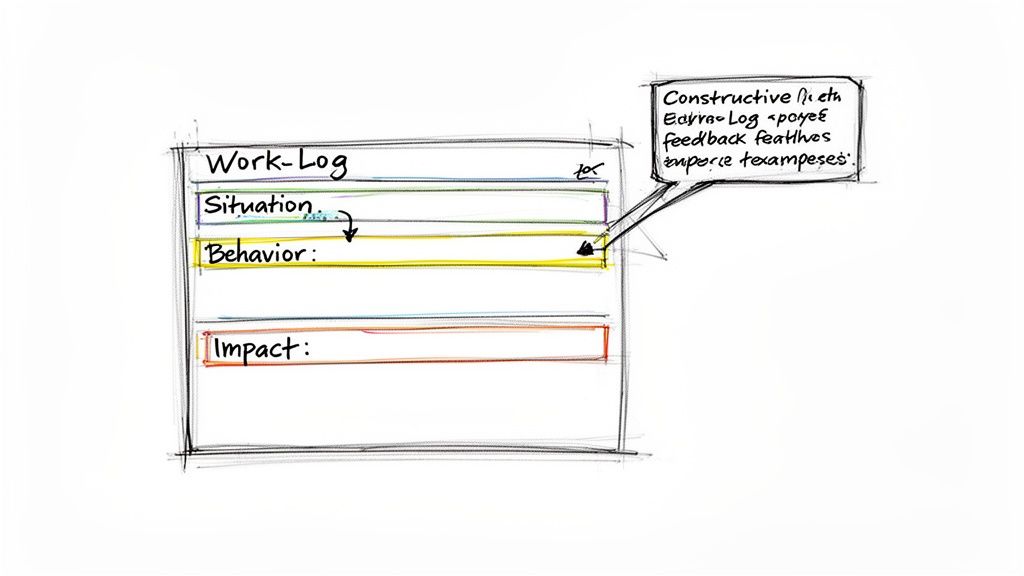
This method, rooted in principles from frameworks like the Situation-Behavior-Impact (SBI) model and Radical Candor, uses concrete evidence to illustrate a point. By referencing an employee’s own updates, you create a shared context. Instead of guessing, the employee knows exactly what you're talking about, which builds trust and makes them more receptive to coaching. This specificity is crucial for reinforcing positive behaviors and clarifying expectations for areas needing improvement.
How to Implement Behavioral Feedback
- Reference Direct Entries: Use the employee’s exact language from their work logs. For example, say, "In your Q2, week 4 update in WeekBlast, you noted that you proactively created new documentation for the API. That initiative saved the new hires at least a week of onboarding time."
- Focus on Observable Actions: Tie feedback to what the employee did, not who they are. Instead of "You're disorganized," try, "I noticed in your logs for the Q3 project that key deadlines were missed three times. Let's discuss how we can better track milestones."
- Balance Praise and Critique: Use logs to find examples of both wins and challenges. For praise, you could say, "Your logs show you paired with five different teammates last quarter. That collaborative approach directly improved our team's code quality." For constructive feedback, you might note, "In your logs from May, I saw you delayed reporting a blocker for two weeks. In the future, please flag blockers immediately, as you did in the August project, which was very effective."
Key Insight: Grounding feedback in a documented work history transforms the manager's role from a critic to a coach. When you can point to specific examples of both success and struggle within the employee's own record, the conversation becomes a collaborative problem-solving session about performance, not a judgment of character.
8. Track Performance Improvement Plans (PIPs) and Recovery with Documentation
When performance issues arise, a manager's role shifts from coaching to structured intervention. A Performance Improvement Plan (PIP) is a formal tool designed to give a struggling employee a clear path to success, but its effectiveness hinges on objective, consistent tracking. This is where meticulous documentation becomes one of the most critical performance review tips for managers, transforming a subjective process into a data-driven one.
Instead of relying on vague impressions of improvement, a documented PIP creates an indisputable record of progress or continued challenges. This approach, rooted in HR best practices and modern management, provides a transparent framework for both the manager and the employee. It ensures the process is fair, defensible, and focused on tangible outcomes, removing ambiguity and emotion from a difficult situation.
How to Implement a Documented PIP
- Establish Clear, Measurable Metrics: Before starting a PIP, define 2-3 specific, non-negotiable goals. For example, a sales manager could require a 15% increase in weekly qualified leads, while an engineering manager might track a reduction in code-review-flagged issues.
- Mandate Weekly Logging: Require the employee to document their progress against the PIP metrics in a shared tool. Platforms like WeekBlast create a time-stamped log, making it simple to track weekly pipeline updates or adherence to new quality assurance protocols. This is not optional; it is a core requirement of the plan.
- Review Logs in Weekly Check-ins: Use the weekly log as the agenda for your 1:1s. This keeps the conversation focused on the data, allowing you to review progress, provide targeted coaching, and document any additional concerns or support provided during the meeting.
- Consult HR and Maintain Records: Always partner with HR to ensure the PIP process adheres to company policy and legal standards. At the conclusion of the PIP period, export the entire 30, 60, or 90-day record as a comprehensive report documenting the journey and final outcome.
Key Insight: Documenting a PIP isn't just about creating a paper trail for potential termination. It is an act of fairness that provides the employee with a structured, transparent opportunity to recover. This objective record protects the company and, more importantly, gives the employee a clear, data-backed understanding of their performance and the specific requirements for success.
9. Recognize and Celebrate Wins in Real-Time, Not Just in Reviews
One of the most powerful performance review tips for managers is to decouple recognition from the formal review cycle. When praise and acknowledgment are only delivered once or twice a year, employees can feel undervalued, and their accomplishments lose their motivational impact. A culture of real-time recognition ensures that positive momentum is maintained, desired behaviors are reinforced instantly, and the formal review becomes a capstone summary of celebrated successes rather than a surprise reveal.
This approach, championed by engagement research from Gallup and thought leaders like Daniel Pink, transforms the manager’s role from a periodic judge to a continuous coach and champion. By celebrating wins as they occur, you create a positive feedback loop that boosts morale and reinforces the connection between an employee’s daily efforts and team success. It makes the entire performance management process feel more authentic, supportive, and less like a transactional evaluation.
How to Implement Real-Time Recognition
- Leverage Weekly Updates: Use tools like WeekBlast to monitor progress. When you see a significant accomplishment in a weekly entry, leave a specific, appreciative comment immediately. For example, "Great job resolving that complex bug on the checkout page; your persistence saved us from a major headache."
- Amplify Wins Publicly: During team meetings or in a dedicated Slack channel, call out specific achievements. Reference the documented win: "I want to give a shout-out to Sarah for her work on the new API integration, which she detailed in her WeekBlast last Friday. It was a huge cross-functional effort."
- Encourage Peer-to-Peer Recognition: Foster a culture where team members celebrate each other. Features like pinning a colleague’s accomplishment on a shared feed allow peers to highlight and validate important contributions, strengthening team bonds and collaboration.
Key Insight: Real-time recognition is not just about big, project-launching victories. Acknowledging the steady, consistent work that underpins team success is equally crucial. Celebrating an employee who consistently writes clear documentation or provides thorough code reviews shows that all forms of contribution are valued, not just the most visible ones.
10. Create Transparent Criteria and Rubrics for Objective Assessment
One of the most effective performance review tips for managers is to remove ambiguity from the evaluation process. When employees don't know the standards they are being measured against, reviews can feel arbitrary and unfair. Establishing transparent criteria and detailed rubrics creates a shared understanding of what success looks like, transforming the review from a subjective judgment into an objective assessment against a clear framework.
This approach involves creating competency frameworks that define different performance levels with specific, observable behaviors. Instead of relying on vague ratings, a manager can point to concrete examples that place an employee's performance on a predefined spectrum. This method, popularized by competency-based HR models and companies like Amazon with its Leadership Principles, grounds the conversation in evidence and promotes fairness across the team. It clarifies expectations and gives employees a roadmap for career progression.
How to Implement Performance Rubrics
- Define Competencies and Levels: For each role, define key competencies (e.g., Technical Skill, Mentorship, Project Ownership). Then, create levels for each. An engineering rubric might define Level 1 as "completes assigned tasks," while Level 4 is "shapes team strategy and technical vision."
- Map Evidence to the Rubric: Use a continuous log of work, like the archives in WeekBlast, to find evidence that maps to the rubric. Did a salesperson’s weekly updates consistently mention collaborating with marketing? That maps directly to a "Cross-Functional Collaboration" competency.
- Share and Calibrate: Distribute the rubrics to your team at the beginning of a performance cycle, not just at the end. Use them as a coaching tool in 1-on-1s to discuss development and ensure everyone understands the path to the next level.
Key Insight: Rubrics aren't just an evaluation tool; they are a powerful career development guide. When employees can see the specific behaviors and impacts required to advance, they are empowered to take ownership of their growth. This transparency builds trust and turns the performance review into a constructive, forward-looking dialogue about a person's career trajectory.
10-Point Performance Review Tips Comparison
| Item | Implementation complexity 🔄 | Resource & effort ⚡ | Expected outcomes 📊 | Ideal use cases 💡 | Key advantages ⭐ |
|---|---|---|---|---|---|
| Use Continuous Documentation to Create a Performance Trail | Medium, initial setup + ongoing discipline 🔄🔄 | Moderate ongoing logging; better long‑term efficiency ⚡⚡ | Searchable evidence; reduces recency bias 📊 ⭐⭐⭐ | Annual reviews, distributed teams, audits 💡 | Fairer assessments; trend detection; audit trail ⭐⭐⭐ |
| Establish Clear, Measurable Goals at the Beginning of Review Cycles | Medium, alignment and calibration required 🔄🔄 | Time‑intensive up front; low maintenance after setup ⚡⚡ | Clear expectations; measurable performance 📊 ⭐⭐⭐ | OKRs/SMART-driven teams; promotion cycles 💡 | Objective targets; motivates; defensible decisions ⭐⭐⭐ |
| Conduct Regular 1:1 Check-ins Using Work Log Data | Low–Medium, scheduling + prep 🔄🔄 | Recurring manager time; prep improves efficiency ⚡⚡ | Fewer surprises; stronger manager–report relationships 📊 ⭐⭐ | Coaching, blocker resolution, remote teams 💡 | Focused feedback; timely recognition; early issue ID ⭐⭐ |
| Gather 360-Degree Feedback Using Peer and Cross-Functional Input | High, coordination, anonymity, aggregation 🔄🔄🔄 | Time‑consuming to collect/analyze; needs tooling ⚡ | Multi-perspective insight; reduces single‑manager bias 📊 ⭐⭐⭐ | Leadership reviews; cross‑functional roles 💡 | Balanced view of impact; collaboration signals ⭐⭐⭐ |
| Separate Evaluation from Development Conversations | Medium, process change and scheduling 🔄🔄 | More meetings but focused; moderate effort ⚡⚡ | Less defensiveness; clearer development plans 📊 ⭐⭐ | High‑stakes reviews; career planning sessions 💡 | Clearer communication; better psychological safety ⭐⭐ |
| Leverage AI-Generated Summaries for Efficient Review Preparation | Low, automated generation dependent on input quality 🔄 | Saves manager time; fast synthesis ⚡⚡⚡ | Quick themes and digests; may miss nuance 📊 ⭐⭐ | Large teams; high‑volume review prep 💡 | Time‑saving; consistent formats; scalable ⭐⭐ |
| Provide Specific, Behavioral Feedback Using Work Log Examples | Medium, requires detailed log review 🔄🔄 | Time‑intensive per instance; high impact when done ⚡⚡ | Actionable change; less defensiveness 📊 ⭐⭐⭐ | Performance coaching; behavior change initiatives 💡 | Concrete, actionable feedback; accountability ⭐⭐⭐ |
| Track Performance Improvement Plans (PIPs) and Recovery with Documentation | High, structured plans, frequent check‑ins 🔄🔄🔄 | High manager/HR involvement; documentation heavy ⚡ | Objective improvement records; legal protection 📊 ⭐⭐ | Formal remediation; legal/HR processes 💡 | Legal‑grade evidence; clear improvement metrics ⭐⭐ |
| Recognize and Celebrate Wins in Real-Time, Not Just in Reviews | Low, cultural habit + platform use 🔄 | Low prep; consistent attention required; high payoff ⚡⚡⚡ | Improved morale and engagement; continuous reinforcement 📊 ⭐⭐ | Culture building; motivation and retention 💡 | Immediate motivation; reinforces desired behaviors ⭐⭐⭐ |
| Create Transparent Criteria and Rubrics for Objective Assessment | High, design, calibration, manager training 🔄🔄🔄 | Time to build and train; consistent use saves time later ⚡⚡ | Fair, consistent evaluations; clearer career paths 📊 ⭐⭐⭐ | Scaling teams; compensation and promotion decisions 💡 | Objective standards; defensible and repeatable ratings ⭐⭐⭐ |
Turning Reviews into a Catalyst for Continuous Growth
Mastering the art of the performance review is one of the most impactful skills a leader can develop. The journey from a dreaded annual obligation to a powerful, ongoing growth mechanism is not about finding a single magic formula. Instead, it’s about architecting a system of continuous feedback, objective documentation, and forward-looking development. The collection of performance review tips for managers we’ve explored provides the blueprint for that system, shifting the focus from rearview-mirror judgment to future-focused coaching.
The core principle weaving through every tip is the move away from recency bias and subjective memory. By creating a continuous performance trail with regular documentation, you transform the entire dynamic. The review becomes a data-informed conversation, not an opinion-based debate. When you establish clear, measurable goals and supplement them with 360-degree feedback, you create a holistic and fair picture of an employee’s contributions.
Key Takeaways for Modern Performance Management
Let's distill the most critical actions you can take to revolutionize your review process:
- Documentation is Your Foundation: Stop relying on memory. Implement a system for continuous, lightweight documentation of wins, challenges, and feedback. This evidence is the bedrock of fair, specific, and impactful reviews.
- Separate Conversations for Clarity: One of the most powerful changes you can make is to decouple the evaluation conversation (the "what") from the development conversation (the "how"). This separation allows for honest assessment without shutting down an employee's willingness to engage in growth-oriented dialogue.
- Focus on Behaviors, Not Traits: Vague feedback like "be more proactive" is unhelpful. Ground your input in specific, observable actions and their impact. Use documented examples to illustrate your points, making the feedback concrete and actionable.
- Consistency Breeds Trust: A transparent process with clear criteria and rubrics builds psychological safety. When employees understand how they are being evaluated and see the process applied consistently, they are more likely to trust the outcomes and engage constructively.
From Checkpoint to Launchpad
Ultimately, a well-executed performance review is not an endpoint; it is a checkpoint that serves as a launchpad for the next phase of an employee's career journey. It’s a moment to align on future goals, identify development opportunities, and reinforce the connection between individual contributions and team objectives. This modern approach, grounded in continuous dialogue and objective evidence, turns a once-feared event into a genuinely motivating experience.
By embracing these performance review tips for managers, you do more than just improve a single process. You cultivate a culture of high performance, continuous learning, and mutual respect. You empower your team members with the clarity they need to succeed and position yourself as a coach and a true leader, not just an evaluator. The result is a more engaged, more effective team ready to tackle its next big challenge.
Ready to eliminate recency bias and make your next review cycle the most effective one yet? Start building a continuous, objective performance trail with WeekBlast. See how our simple weekly work logs can streamline evidence gathering and empower you to deliver fair, data-driven feedback by visiting WeekBlast today.


