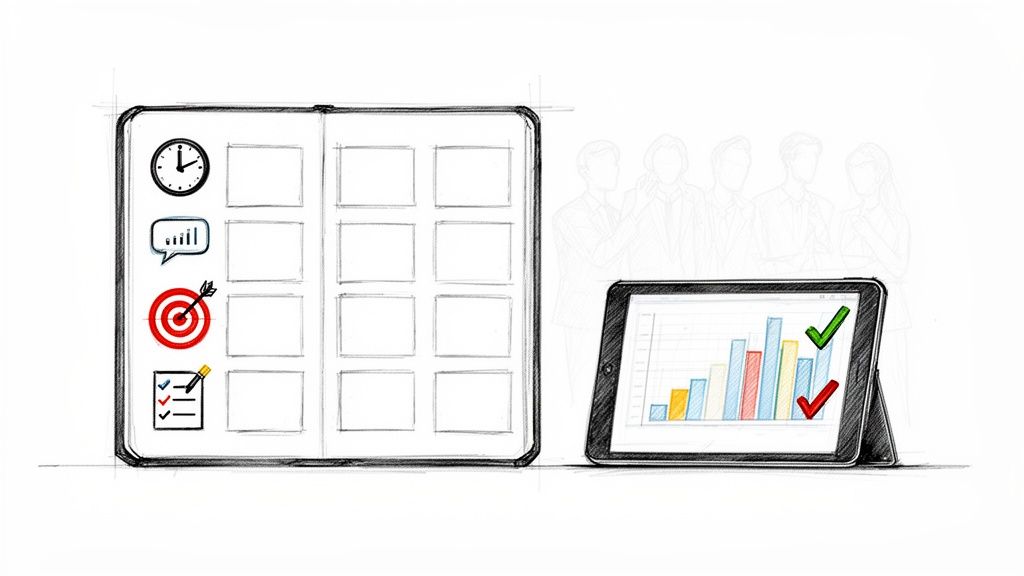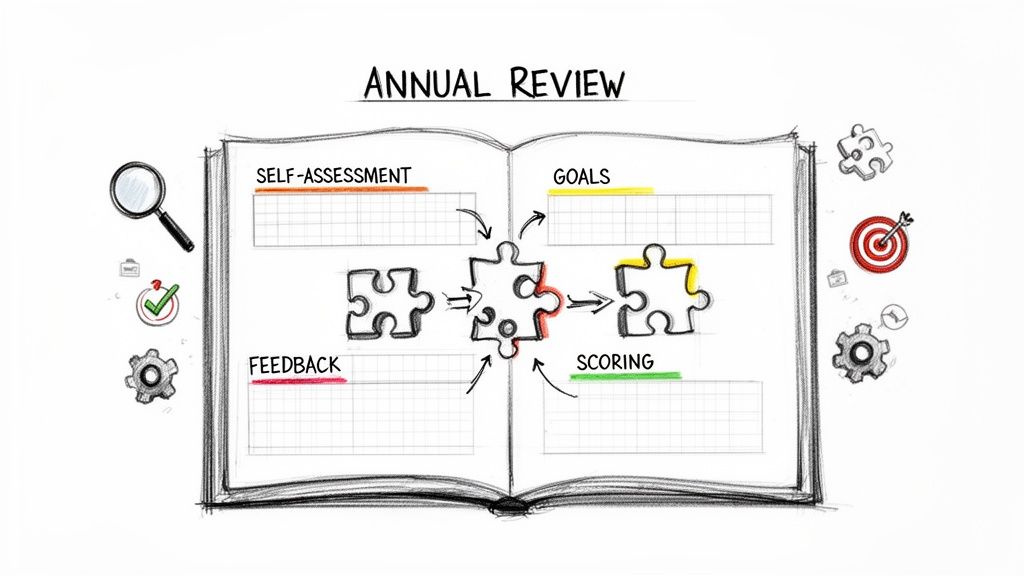
An annual performance review template is a pre-built document that keeps the conversation between a manager and an employee on track. Think of it as a consistent roadmap for discussing the past year (what went well, what was tough, and where to go next) so everyone is on the same page.
Why Traditional Performance Reviews Fail Teams
Let's be honest. For most people, the phrase "annual performance review" conjures up a feeling of pure dread. It often feels less like a productive chat and more like a final exam where a whole year's work is judged based on whatever happened last month. This old-school model is just broken, for everyone involved.
The whole process is just full of problems. Employees walk in feeling like they’re being judged on a sliver of the full picture, while managers are drowning in a sea of paperwork. This usually leads to a conversation that feels like a box-ticking exercise, not a real chance to connect and grow.
The Weight of Recency Bias
One of the biggest culprits is recency bias. It’s just human nature to remember recent events more clearly. An employee could have an amazing first ten months, but if they hit a snag on a project in the last quarter, their review might unfairly zoom in on that one struggle.
The flip side is also true: a big win right before review season can easily overshadow months of so-so performance. This natural bias completely skews the evaluation, making it a poor reflection of someone’s contribution over the entire year. It creates a system where timing can feel more important than steady, consistent effort.
A Disconnected and Stressful Process
So often, the traditional review feels completely detached from the day-to-day grind. The goals set a year ago? They might be totally irrelevant now. And the feedback you finally get is usually way too late to do anything about. It’s a frustrating cycle where nobody really gets much value out of the conversation.
This flawed system isn't just a headache; it's a massive time sink. The numbers tell a story of a process that’s completely off the rails. While a whopping 71% of companies still cling to traditional annual reviews, a tiny 14% of employees actually feel they help them improve. And for managers, the administrative load is staggering; they spend an average of 210 hours a year preparing for reviews. That’s more than five full workweeks! You can learn more about these performance management statistics and what they really mean for teams.
The core problem is simple: the traditional annual review is a look backward, not a conversation about the future. It judges the past instead of building a roadmap for what comes next.
This is exactly why a modern, thoughtfully designed annual performance review template is so important. It’s not just about filling out another form. It’s a tool built to fix these deep-rooted problems by giving you a framework for a fairer, more productive, and forward-looking conversation that actually helps everyone.
The Building Blocks of an Effective Review Template
Think of building a great annual performance review template like building a sturdy house. You can't just slap a few walls together and hope for the best. You need a solid foundation and a clear blueprint where every single piece serves a purpose. Together, these components create a framework for a fair, balanced, and evidence-based conversation.
A modern template isn't about a manager just delivering a verdict. It’s a powerful development tool designed to spark a genuine dialogue. The real goal isn't just to recap the last 12 months, but to chart a clear course for an employee's growth and career path.
When the process is poorly designed, it creates a vicious cycle of stress and bad data, which this diagram illustrates perfectly.
The pressure on managers trickles down, causing employee anxiety and forcing everyone to rely on spotty, inaccurate information. A well-structured template breaks this cycle by bringing clarity, fairness, and objectivity to the table.
Let's break down the essential sections that make a template work. This table outlines the core components and why each one is critical.
Table: Essential Sections of a Modern Performance Review Template
| Section Component | Primary Purpose | Key Elements to Include |
|---|---|---|
| Employee Self-Assessment | Empowers employees to reflect and provide their perspective first, setting a collaborative tone. | - Major accomplishments and contributions - Challenges faced and lessons learned - Self-rating on goals and competencies - Areas for desired growth |
| Manager Evaluation | Provides an objective, evidence-based assessment of performance, aligning with the employee's self-review. | - Performance against pre-defined goals (e.g., OKRs) - Specific, observable examples of behaviors and their impact - Data points, project outcomes, and peer feedback - Constructive feedback grounded in facts, not feelings |
| Core Competency Review | Assesses foundational skills and behaviors crucial for the role and company culture, beyond just task completion. | - A list of relevant competencies (e.g., communication, problem-solving) - Both employee and manager ratings for each competency - Examples illustrating strengths and areas for improvement |
| Development & Career Plan | Shifts the focus from past performance to future growth, creating a clear, actionable path forward. | - Specific, measurable development goals for the next period - Identification of training, mentorship, or new responsibilities - Discussion of long-term career aspirations and alignment with company opportunities |
| Final Sign-Off | Creates a formal record that the review conversation took place and was acknowledged by both parties. | - A summary of the key discussion points - Signatures (digital or physical) from both the employee and manager - Date of the review meeting |
Each of these sections plays a vital role in turning the review from a dreaded obligation into a valuable checkpoint for professional development.
H3: The Starting Point: Employee Self-Assessment
The first, and maybe most important, building block is the employee self-assessment. This is more than just homework for the manager. It’s a direct invitation for the employee to reflect on their own performance, wins, and struggles over the past year. When you give employees the first word, you empower them and immediately set a collaborative tone.
This section is where employees share their side of the story before their manager weighs in. It pushes them to gather real evidence of their work, which always leads to a richer, more accurate conversation. Self-reflection is a skill, and keeping a consistent work log makes this process much easier and more effective. A simple daily work log template can be an invaluable source of truth when it's time to look back.
A self-assessment transforms the review from a top-down judgment into a side-by-side conversation. It ensures the employee is an active participant in their own evaluation, not just a passive recipient of feedback.
H3: The Manager's View: Evaluation and Goal Alignment
Right after the self-assessment, the manager’s evaluation adds the next layer of perspective. This part should mirror the sections from the employee’s reflection, creating a natural point of comparison for discussion. A great template, however, will guide managers to be specific and stick to the facts.
Instead of vague feedback, this section should zero in on:
- Performance Against Goals: How did the employee stack up against the specific, measurable goals set at the start of the year? This is where frameworks like OKRs (Objectives and Key Results) really shine.
- Observable Behaviors: The evaluation should be about concrete examples of actions and their impact, not subjective opinions on personality.
- Data and Evidence: Managers should be prompted to pull in specific examples, metrics, and project outcomes to back up their ratings and comments.
This structured approach is designed to root out bias and make sure the evaluation is based on tangible contributions. It shifts the conversation from, "I feel like you did..." to, "Here is the data showing your impact..."
H3: Beyond the Tasks: Core Competencies and Future Growth
On top of hitting specific goals, a truly effective template has to look at core competencies. These are the fundamental skills and behaviors that drive success in a particular role and fit with the company culture, like communication, teamwork, problem-solving, or leadership.
By having both the employee and manager rate these competencies, you can spot broader skill strengths and development needs that go beyond day-to-day tasks. This is where the review pivots from looking back to planning ahead.
The final piece of the puzzle is the section on developmental feedback and career planning. This is the forward-looking part of the whole conversation. Based on everything discussed, this section lays out clear, actionable steps for growth, identifies training opportunities, and opens a discussion about future career goals. It answers the crucial question, "So, what's next?" and ensures the employee walks away with a motivating plan for the year to come.
How to Write Feedback That Inspires Growth
Let’s be honest: vague feedback like “good job” or “needs improvement” is a waste of everyone's time. It doesn't tell anyone what to do next. For an annual performance review to actually work, the feedback has to be specific, actionable, and fair. The real goal here is to move past simple judgments and hand your employee a clear roadmap for what they should keep doing and where they can focus on growing.
The words you choose are everything. They can be the difference between a conversation that leaves someone feeling defensive and demoralized, and one that sparks genuine motivation and progress. The trick is to ground every single piece of feedback in observable behaviors and the real-world impact they had, whether on the team, a project, or the company as a whole.
This approach pulls personal feelings out of the equation and puts the focus squarely on concrete actions. So instead of saying an employee has a "bad attitude," you can talk about a specific time their communication came across as dismissive and explain how that affected the team's morale. See the difference?
Structuring Feedback with a Clear Scoring Rubric
Consistency is the bedrock of a fair review process. A scoring rubric, like a simple 5-point scale, gives you a standard framework for every evaluation. But here's the catch: a scale is only as good as its definitions.
If you don't define what each number means, a "4" from one manager might be a "3" from another. Taking the time to spell out each level is critical. It makes sure that "Exceeds Expectations" means the same thing in engineering as it does in marketing, which helps managers apply standards evenly and reduces bias.
Here’s a straightforward example of a 5-point scale with clear definitions:
- 5 - Exceptional: Consistently performs far beyond all defined expectations, serving as a model for others.
- 4 - Exceeds Expectations: Regularly surpasses performance expectations in most key areas of responsibility.
- 3 - Meets Expectations: Consistently and reliably fulfills all job requirements to a high standard.
- 2 - Needs Improvement: Sometimes falls short of meeting key job requirements and needs development.
- 1 - Unsatisfactory: Consistently fails to meet the minimum requirements of the role.
By defining each level of your rating scale, you transform subjective opinions into objective measurements. This ensures every employee is evaluated against the same clear, transparent standard, building trust in the fairness of the process.
Using Sample Phrases for Key Competencies
No one is a perfect wordsmith on the spot, especially when delivering tough feedback. Having a bank of well-crafted phrases can help managers get their points across effectively. Think of them as conversation starters that can be customized with specific, real-life examples about the employee. Organizing these phrases by competency in your annual review template makes it even more powerful.
For a much deeper dive, you can explore our extensive list of performance review phrases with examples to find just the right words for any situation.
For Reinforcing Strengths (Problem-Solving):
- "You have a real knack for digging past the symptoms to find the root cause of complex issues."
- "You proactively developed a new workflow that fixed that recurring bottleneck, saving the team an estimated five hours per week."
- "You showed incredible composure and creativity when our main software failed, finding a workaround that kept the project from derailing."
For Offering Constructive Criticism (Collaboration):
- "Your individual work is top-notch, but bringing in team members for input earlier in the process could help us avoid rework down the line."
- "I’ve noticed you tend to work in isolation at times. Let’s talk about ways to collaborate more with the design team to make sure our final products are more aligned."
- "In team meetings, try to create more space for others to share their ideas before you finalize a decision. It would foster a more inclusive environment."
Notice how these examples are specific, focused on behavior, and tied to a clear outcome. They give employees exactly what they need to understand their performance and see a clear path forward. This is the kind of detail that turns a routine review into a powerful tool for growth.
Role-Specific Templates for Real-World Scenarios
A generic annual performance review template is like a one-size-fits-all t-shirt; it technically fits, but it rarely looks good on anyone. The skills that make a software engineer incredible are worlds apart from the qualities that define a great people manager. If you want meaningful results, your templates have to reflect the unique day-to-day reality of each role.
Sticking with a cookie-cutter approach is a fast track to irrelevant feedback and completely missed opportunities for growth. When you tailor your templates, you’re acknowledging that success looks different across the company. This shift allows you to zero in on the specific skills and metrics that actually matter for each position, making the whole review process far more impactful for everyone.
Let's dive into four distinct, real-world examples. These templates will show you exactly how to adapt the core components we’ve talked about to fit the specific context of any job on your team.
Individual Contributor Template
For most of your non-managerial staff, the name of the game is execution, collaboration, and personal accountability. This annual performance review template is designed to focus squarely on the quality of their work, their dependability, and how they contribute to the team's overall success.
Key Competencies for an Individual Contributor (IC):
- Job Knowledge & Skill Application: How well do they grasp the technical and procedural know-how for their job, and more importantly, how well do they apply it?
- Quality & Quantity of Work: This measures their output against established standards. Are they accurate? Efficient? Do they produce high-quality work?
- Collaboration & Teamwork: This looks at their ability to work well with colleagues, share information openly, and add to a positive team atmosphere.
- Initiative & Problem-Solving: We’re looking for proactivity here. Do they step up to solve problems on their own? Are they resourceful when challenges arise?
This structure keeps the conversation grounded in tangible contributions and behaviors that drive results, avoiding metrics that simply don't apply to their daily work.
People Manager Template
When you're evaluating a manager, the lens has to shift completely. Their success isn't just about their own output anymore; it's measured by the performance and growth of their entire team. This template rightly prioritizes leadership, strategic thinking, and their ability to nurture talent.
The true measure of a manager's performance is not what they do, but what their team achieves. An effective review template for a manager must reflect their role as a force multiplier for their team's talent and potential.
Key Competencies for a People Manager:
- Team Leadership & Development: How effectively are they coaching, mentoring, and creating real growth opportunities for their direct reports?
- Strategic Alignment & Execution: Can they connect their team's day-to-day work to the bigger company goals and successfully drive projects to the finish line?
- Communication & Influence: Do they set clear expectations, give regular and constructive feedback, and effectively advocate for their team's needs?
- Resource Management: How well do they handle budgets, balance workloads, and make the most of the resources they have?
This focus helps hold managers accountable for what truly matters: building a high-performing, engaged, and motivated team.
Software Engineer Template
Technical roles demand a specialized approach to evaluation. For a software engineer, a good template needs to balance their raw technical skill with their ability to collaborate and contribute to the larger system. It goes way beyond just counting lines of code to assess the quality, scalability, and maintainability of their work.
Key Competencies for a Software Engineer:
- Technical Proficiency: This covers their expertise in the right programming languages, frameworks, and system architecture. It's all about code quality and sticking to best practices.
- System Impact & Reliability: This measures how their work affects system stability, performance, and scalability. It also looks at how they handle incident response and debugging.
- Collaboration & Code Review: How are they in code reviews? Do they give helpful, constructive feedback and work well with other engineers and product managers?
- Problem-Solving & Innovation: This assesses their knack for untangling complex technical knots, designing elegant solutions, and contributing to important architectural decisions.
Using an annual performance review template like this ensures you're judging engineers on the factors that lead to robust, long-lasting technology.
Product Manager Template
Product managers live at the crossroads of business, technology, and user experience. Their performance is directly tied to their ability to steer a product from a simple idea to a successful launch and beyond. This requires a unique mix of strategic vision, user empathy, and cross-functional leadership.
Key Competencies for a Product Manager:
- Product Vision & Strategy: Can they define a compelling product vision, build a strategic roadmap, and get all the stakeholders aligned on key priorities?
- User Focus & Data Analysis: This measures their commitment to understanding user needs through research and their skill in using data to make smart product decisions.
- Cross-Functional Leadership: How well do they partner with engineering, design, marketing, and sales to bring a successful product to market?
- Execution & Prioritization: This hones in on their ability to manage a product backlog, make difficult prioritization calls, and ensure the team is shipping features that deliver real value.
These role-specific templates aren't just paperwork; they're frameworks for having more relevant, fair, and productive conversations. By adapting your approach, you show your team members that you truly understand what success looks like for them, and that’s how you build trust and inspire genuine growth.
Using WeekBlast to Power Evidence-Based Reviews
Let’s be honest: the biggest challenge of any annual review is simply remembering everything that happened over the last 12 months. Our memories just aren't built for that kind of recall. This often leads to "recency bias," where the last few weeks of work overshadow the previous eleven months, making it almost impossible for anyone to paint a fair and complete picture of performance.
The review process shouldn't feel like a high-stakes memory test. It should be a straightforward conversation backed by real data. The goal is to shift the discussion from vague feelings and recent events to objective facts that tell the story of the entire year.
The Real Cost of Getting Reviews Wrong
When performance reviews feel arbitrary or out of touch with reality, the damage to morale and engagement is huge. This isn't just a small problem, as low employee engagement costs the global economy an estimated $8.9 trillion every year.
And yet, only 5% of managers are happy with their company's review process, and a mere 10% of HR leaders think traditional annual reviews actually work. These numbers point to a massive gap between what we're doing and what actually helps people grow. It's no wonder so many companies are looking for a better way to track performance all year round.
Building a Living Record of Your Work
This is where a tool like WeekBlast comes in. It’s a simple way to turn scattered updates into a reliable, ongoing story of your progress. Think of it as a lightweight work log where you and your team can quickly capture wins, roadblocks, and important updates in just a few seconds.
Whether it’s by sending a quick email or jotting down a note, every key contribution gets filed away in a permanent, searchable archive. This simple habit changes the game when it's time for self-assessments. Instead of racking your brain to remember a project from last March, you have a detailed log ready to go. Our guide on performance review documentation dives deeper into why this evidence-based approach is so effective.
Let AI Summarize a Year of Accomplishments
WeekBlast’s AI summaries take this a step further. The system can automatically process an entire year's worth of updates and distill them into a clear, concise overview. With a single click, you get a summary that highlights your most important achievements and progress.
You can then copy and paste this directly into your annual performance review template, saving hours of work.
Here’s a peek at what that looks like:
The AI pulls out the most impactful updates, ensuring no critical contribution gets lost in the shuffle. It makes gathering the evidence for a fair, thorough, and low-stress review practically effortless for everyone involved.
Navigating HR and Legal Considerations
Let's be honest: an annual performance review template is more than just a conversation starter. It’s a vital HR document that needs to be legally sound. Get it wrong, and even your best intentions could put the company at risk. A structured, consistent process is your strongest safeguard against claims of bias or unfair treatment.
The whole point is to build a system that’s not just helpful for growth but also legally defensible. This means tying every single evaluation back to objective, job-related criteria that you apply to everyone in a similar role. When the standards are the same for everyone and the language is neutral, the review becomes a fair assessment of performance, not a stage for a manager's personal feelings.
Avoiding Bias and Ensuring Consistency
Unconscious bias is a massive legal landmine in performance reviews. It pops up everywhere. For example, managers might favor employees who remind them of themselves (affinity bias) or let one amazing skill blind them to other weaknesses (the halo effect). A thoughtfully designed annual performance review template is your first line of defense against these hidden biases.
A good template forces managers to measure every employee against the same set of competencies and goals. It creates a standardized playing field, and that consistency is everything. If you dock one employee for something you let slide with another, you’re practically inviting a discrimination claim. This is also why training your managers to spot and sidestep common biases is an absolute must.
Think of it this way: your performance review documentation needs to tell a clear, consistent story based on facts. It should be strong enough to prove that decisions were made based on performance, not personal prejudice.
The Importance of Clear Documentation
From a legal and HR perspective, clear and thorough documentation is non-negotiable. Every rating, every comment, and every piece of feedback needs to be backed up with specific, concrete examples. Vague feedback isn't just unhelpful for the employee; it's incredibly difficult to defend if someone challenges it.
Treat every review like an official record that could end up under a microscope. To make sure your documentation is solid, follow these best practices:
- Stick to the Facts: Document what you can see and measure. Instead of saying an employee has a "bad attitude," describe the behavior: "was late to three client meetings this quarter."
- Keep it Current: Encourage everyone, both managers and employees alike, to log notes and examples throughout the year. Waiting until review season means you’re relying on fuzzy memories, which often leads to mistakes and bias.
- Connect it to the Job: All feedback should relate directly to the duties and expectations laid out in the employee's job description.
Legal Implications of Follow-Up Actions
The annual review is often the jumping-off point for major career decisions like promotions, raises, or on the flip side, a Performance Improvement Plan (PIP). The legal stakes get especially high when a tough review leads to a PIP or, ultimately, termination.
The review itself provides the official justification for these actions. If that review is full of vague statements, inconsistent ratings, or personal opinions, it completely undermines the credibility of any corrective action you take later. By making sure your process is fair, consistent, and well-documented, you’re protecting both the employee and the entire company.
Got Questions About Performance Review Templates?
Even with the perfect template in hand, you're bound to have some questions when it's time to put it into practice. Getting the rollout right is just as crucial as the document itself. Let's walk through some of the most common questions managers and HR teams run into.
Think of this as your final pre-flight check before launching your new review process. These insights will help you handle the tricky parts, build trust with your team, and make sure your system is fair and effective from the get-go.
How Often Should We Update Our Review Templates?
Your performance review template shouldn't be a "set it and forget it" document. Treat it as a living, breathing tool that evolves with your company. A good rule of thumb is to revisit it at least once a year.
Why? Because business goals change, roles get redefined, and team structures shift. Your evaluation criteria need to keep up. An annual check-in makes sure your template reflects your company's current priorities. Of course, if you go through a major change, such as a re-org or a big pivot in strategy, you should update the template immediately to match the new reality.
Can a Good Template Eliminate All Bias?
A well-structured template is a huge step toward objectivity, but it's not a magic wand that can eliminate all bias. By grounding the conversation in specific criteria and requiring real, evidence-based examples, you can drastically reduce the impact of gut feelings or common pitfalls like the halo effect or recency bias.
But let's be realistic, as unconscious biases can still creep in. The best defense is a two-part strategy: combine a rock-solid, standardized annual performance review template with ongoing manager training. Teach them how to spot and actively counter their own biases.
A template provides the framework for a fair conversation. Training gives managers the skills to actually have one. The two work in tandem to create a review process that everyone can trust.
What's the Difference Between a Performance Review and Continuous Feedback?
Think of it this way: a performance review is a formal, big-picture event. It's the scheduled time to zoom out and summarize an employee's contributions over a long stretch, usually a year. It's where you formally assess performance against goals and map out a plan for career growth.
Continuous feedback, on the other hand, is all about the here and now. It's the collection of frequent, informal check-ins that offer real-time coaching and direction. It’s the day-to-day and week-to-week conversations about projects, wins, and roadblocks.
The two aren't separate; they're deeply connected. When you have a healthy culture of continuous feedback, it ensures there are no surprises come review time. The annual review simply becomes a thoughtful summary of all the productive conversations you've been having throughout the year.
Should Employees Get the Template Before Their Review?
Yes, absolutely. Giving employees the template before they even start their self-assessment is a must-do for building a transparent and trusting culture. How can they prepare if they don't know what they're being measured against?
Sharing it ahead of time empowers them to think through their accomplishments and gather specific examples that align with the criteria. It shifts the dynamic from a top-down judgment to a collaborative dialogue, making them an active partner in their own development.
A truly great review process is built on a foundation of steady, evidence-based feedback. With WeekBlast, you can easily capture a year's worth of wins and contributions in a simple, searchable work log. Walk into every review with the data you need to tell the real story of your team’s progress, instead of just relying on memory.